Article
5 min read
Pay Transparency Compliance Isn't One Project. It's Five.
Global payroll

Author
Solenne Mercier
Last Update
June 24, 2026

About the author
Solenne Mercier is a French employment lawyer and HR management expert covering France, Belgium, and Switzerland, with a strong focus on pay compliance and HR strategy. She advises multinational companies on cross-border employment, remote work, Employer of Record (EoR) setups, international mobility, pay transparency, and complex labor law compliance in highly regulated markets.
When I talk to HR leaders about the EU Pay Transparency Directive, the most common thing I hear is: "We know we need to do this. We just don't know where to start."
That hesitation makes complete sense. Because pay transparency preparation isn't one project with a clear owner and a deadline. It's five projects that need to run largely in sequence, each with its own complexity, its own stakeholders, and its own dependencies. And all of them land on top of the work your HR team was already doing before the Directive existed.
Understanding what those five workstreams actually involve is the first step to planning realistically.
EU Compliance with Deel
Tackle pay transparency, all in one place
The five workstreams for pay transparency readiness
1. Pay equity audit
A pay equity audit is an expert-led review of your current pay structures, the criteria in use across the organization, and your exposure to pay discrimination claims. The deliverables are a pay gap analysis and a risk map: where the gaps are, how significant they are, and which ones require remediation before your compensation structure becomes visible to workers and regulators.
This is typically the first workstream to engage because it tells you what you're working with. You can't design a remediation strategy without knowing where the problems are. Depending on the size and complexity of your organization and the state of your data, this takes weeks, sometimes longer if the data isn't clean enough to analyze without preparation work first.

EU Compliance with Deel
EU Pay Transparency Directive Readiness Checklist
2. Job architecture design
Job architecture is the structured framework that maps every job profile in your organization into consistent families, levels, and seniority bands, using objective, gender-neutral criteria. It is the foundation that everything else in pay transparency depends on.
The Directive's requirement to define "work of equal value" is not a theoretical exercise. It means that if a worker challenges their pay relative to a colleague in a different function, your organization needs a documented framework to demonstrate that the jobs were assessed against the same criteria and that pay differences are justified by factors other than gender. Without job architecture, that defense doesn't exist.
Building it requires interviewing business leaders across functions, mapping every job profile against a consistent set of criteria, resolving inconsistent titling across teams and geographies, and gaining organizational buy-in for a framework that will affect how compensation, performance, and progression decisions are made going forward. It is the most time-intensive of the five workstreams and the one most likely to create internal friction. For mid-to-large organizations, it typically takes several months.
Complementary reading:
3. Salary band-setting
Once the job architecture is in place, compensation bands can be built properly. Bands define the pay range for each job family and level, anchored to current market benchmarks and structured around transparent, non-discriminatory progression criteria.
This workstream requires current market data, an internal equity analysis that compares existing pay against the new framework, and multiple rounds of business review to stress-test the bands against real hiring and retention pressures. The output is a compensation framework your recruiters can share with candidates, your workers can access, and your managers can reference when making pay decisions. It needs to be ready before you communicate anything publicly. It depends on job architecture being completed first.
4. Manager and HR training
This workstream is often underestimated, partly because it feels less structural than the others, and partly because it comes last in the sequence. Both of those things make it easier to deprioritize. That's a mistake.
Pay transparency doesn't succeed or fail in policy documents. It succeeds or fails in the conversation a manager has with an employee who just found out they're below the midpoint of their band, or who asks why a recently hired colleague earns more. Managers who don't have a framework for those conversations, and real data to reference, default to deflection. Deflection erodes trust faster than the pay gap itself.
Effective training requires content built around your specific compensation structure, not a generic template. It requires delivery formats that reach frontline managers who won't sit through a two-hour seminar, and a toolkit that gives them something to hold in those conversations. It also requires HR to have a clear process for handling individual pay inquiries, since the Directive gives workers the right to request their individual pay level and comparator data. That process needs to be documented and practiced, not invented on the fly.
Complementary reading:
5. HR data and reporting
The final workstream is building the infrastructure that turns all of the above into a repeatable annual process. That means cleaning and centralizing your HR data, connecting your compensation records to your payroll data, and building a reporting structure that produces the seven gender pay gap metrics required under Article 9 from live, connected data rather than a manual reconciliation exercise.
This workstream also includes establishing the process for worker communications: the Directive requires employers to inform workers annually of their right to request pay information. That's not a one-off email. It's a documented, repeatable process that needs to be built and owned.
Getting all of this right: The sequencing problem
Each of these workstreams depends on the one before it. Bands without job architecture are arbitrary. Cycles without bands are ad hoc. Manager training without bands and documented criteria is theater. Reporting without clean, connected data produces a number nobody fully trusts.
The sequence is also where most timelines underestimate the challenge. A team that starts job architecture design in January and expects to have a full reporting framework in place by June is almost always underestimating how long stakeholder alignment on job profile mapping takes, how many rounds of review salary bands actually need, and how much data cleaning sits between the current state and a reportable dataset.
Realistic planning accounts for those dependencies. It also accounts for the fact that the people running these workstreams are already running a full HR function at the same time.
The capacity reality
Pay transparency preparation doesn't arrive in a vacuum. The HR team responsible for delivering these five workstreams is simultaneously running recruiting, managing performance cycles, handling employee relations, preparing for workforce planning, and doing everything else that existed before the Directive came into scope.
For most organizations, the honest answer to "can we do all of this internally on this timeline?" is no. Not because the team isn't capable, but because the capacity isn't there. Each of these workstreams is a project that, done right, could justify its own dedicated resource. Most HR teams don't have five spare people.
This is the practical case for external support. Not because the internal team can't do the work, but because the work needs to happen faster than internal capacity allows, and because specialist expertise in compensation, job architecture, and pay equity analysis is not something most HR generalists carry by default. These are disciplines with their own methodologies, benchmarks, and risk judgment. Bringing in people who do this work every day compresses the timeline and reduces the probability of building something that won't hold up under scrutiny.
How Deel helps
Deel supports organizations through this process across two layers that work together.
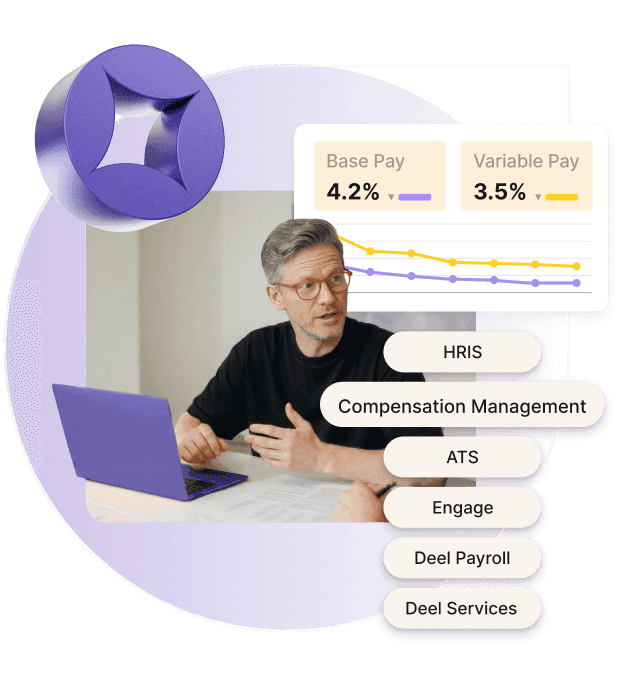
The software infrastructure handles the ongoing management side: job architecture and job profiles in Deel HR's HRIS, compensation bands and pay cycles in the Compensation module, pay gap reporting drawn from live, connected data across HR and payroll. For organizations operating across multiple EU countries, Deel's platform keeps each entity's data structured, attributed, and ready to report without rebuilding the process each cycle.
For organizations that need specialist support to build what goes into that infrastructure, Deel's consulting team works alongside your internal HR function. That support covers pay equity audits, job architecture design, salary grid and band-setting, manager and HR training, and HR data and reporting. It's structured around your specific situation, your existing data, and your timeline. For some teams, that means taking on the full sequence. For others, it means support on the workstreams where internal capacity or expertise is the constraint.
Pay transparency is here. The infrastructure to manage it doesn't have to be built alone.
Live Demo
Get a live walkthrough of the Deel platform
Solenne Mercier is a French employment lawyer and HR management expert covering France, Belgium, and Switzerland, with a strong focus on pay compliance and HR strategy. After more than a decade practicing law at renowned American and international law firms, she transitioned in-house, holding HR leadership roles in France and Switzerland. Today, she advises multinational companies on cross-border employment, remote work, Employer of Record (EoR) setups, international mobility, pay transparency, and complex labor law compliance in highly regulated markets. Passionate about the future of work, Solenne is particularly focused on the intersection of law, HR, technology, and the digital transformation driven by AI.