Article
14 min read
Job Level Classification: How to Build a Fair, Consistent System Your Team Will Actually Use
Global HR

Author
Lorelei Trisca
Last Update
May 05, 2026

Table of Contents
What is job level classification?
Which job level classification method fits your company?
What a job level classification system looks like
Individual contributor vs. management: why you need two tracks
Job level examples across three job families
Real-world job level classification examples
How to build a job level classification system
Job level classification mistakes that will cost you
Best practices for job level classification
The strategic value of a clear leveling system
Build your leveling framework in Deel

Explore this topic with AI
Key takeaways
Job level classification organises roles into a clear hierarchy based on responsibilities, skills, scope, and impact — giving your entire people strategy a consistent foundation.
Modern systems offer two parallel progression tracks — individual contributor (IC) and management — so high performers aren't forced into roles that don't suit them.
The most common reasons leveling systems fail: inconsistent application, ignoring the IC track, letting classifications go stale, and underestimating FLSA compliance requirements.
What is job level classification?
Job level classification is the process of organising roles into a structured hierarchy based on criteria like responsibilities, skills, decision-making authority, and impact on the organisation. The result is a tiered system, from entry-level to executive, that creates consistency across hiring, compensation, performance, and career development.
Done well, it answers three questions every employee has: Where do I fit? What's expected of me at this level? And what does it take to move up?
A few terms that often get used interchangeably — and shouldn't:
-
Job classification — groups similar roles into categories based on shared characteristics (duties, qualifications, scope). The result is descriptive: 'Software Engineer' or 'HR Business Partner.'
-
Job leveling — defines the hierarchy within those categories: what distinguishes an L2 engineer from an L3, and what it takes to progress.
-
Job architecture — the broader system that connects classification and leveling into a coherent org-wide framework, linking roles to compensation bands, career paths, and performance criteria.
In practice: classification slots jobs into levels, leveling defines what each level means, and architecture connects it all.
Career Management
Professional growth with AI-powered precision
Which job level classification method fits your company?
Before building your system, you need to choose your methodology. There's no single right answer — the best approach depends on your company's size, industry, and how much time you can invest in maintenance. Here's how the main options compare:
| Method | How it works | Best for | Watch out for |
|---|---|---|---|
| Job ranking | Roles ranked against each other holistically — no formal scoring | Small orgs, simple structures with fewer than 50 roles | Breaks down quickly as you scale; subjective and hard to defend |
| Job classification | Roles slotted into predefined categories with written descriptors | Public sector, regulated industries, government | Can be too rigid for fast-growing or dynamic companies |
| Point factor | Roles scored on weighted criteria: skills, responsibility, complexity, impact | Mid-to-large companies focused on pay equity and internal consistency | Time-intensive to build and maintain; needs governance |
| Market pricing | Roles benchmarked against external salary survey data | Startups and competitive talent markets moving quickly | Doesn't address internal equity; can create pay compression |
| Hybrid | Combines point factor internal scoring with external market data | Most scaling companies (51–1,000 employees) | Requires HR expertise to manage both dimensions consistently |
Most growing companies land on the hybrid approach: internal criteria (scope, decision-making, impact) determine the level, and external market data validates the compensation band. This balances fairness to employees with competitiveness in the market.
What a job level classification system looks like
A complete system has six core components. Think of them as layers — each one builds on the last.
1. Job families
A job family groups related roles that share similar functions, skills, and career paths — even if individual roles differ in seniority. Examples: Finance, Engineering, Marketing, HR, Sales, Operations.
Within each family, roles are organised by progression: Junior Accountant → Financial Analyst → Senior Accountant → Accounting Manager → Finance Director.
2. Job levels
Levels define the hierarchy within a family, typically ranging across five to seven tiers. Common level structures:
-
Entry/Junior — limited scope, working under direction, building core skills
-
Mid-level/Specialist — operates independently on defined work, some mentorship
-
Senior — owns a domain, significant individual impact, mentors others
-
Lead/Staff — cross-team influence, drives standards and direction
-
Manager/Director — people leadership, team delivery, departmental strategy
-
VP/Executive — organisational scope, business-wide decisions
3. Leveling criteria
The dimensions used to place a role at the right level. Standard criteria include:
-
Scope of impact: individual → team → department → organisation-wide
-
Decision-making authority: guided → independent → strategic
-
Problem-solving complexity: defined → ambiguous → novel
-
Technical or subject-matter expertise
-
Leadership and people management responsibility
-
Communication and cross-functional influence
4. Competency frameworks
A competency framework outlines the behavioural and technical skills expected at each level within a job family. Three types apply: core competencies (company-wide, e.g. collaboration, integrity), functional competencies (role-specific, e.g. coding standards for engineers), and leadership competencies (for management roles, e.g. strategic thinking, team development).
5. Job descriptions / role profiles
Each level should have a clear profile: job title and level, primary responsibilities, required skills and qualifications, reporting structure, and performance expectations. Consistency here is critical — it's what makes the system defensible in pay equity conversations.
6. Compensation bands
Each job level maps to a salary range (minimum, midpoint, maximum) that reflects both internal equity and external market data. For global teams, bands typically vary by geography. The leveling system and compensation structure must stay in sync — if they drift apart, you get pay compression and equity problems.

Free template
Clarify job levels in your organization
Individual contributor vs. management: why you need two tracks
One of the most common — and costly — mistakes in leveling design is building a single career ladder that forces individual contributors into management to advance. The result: you promote your best engineers into roles they're not suited for, and lose them within 18 months.
Modern leveling systems solve this with a dual-track structure:
-
IC track — rewards growing expertise, scope of influence, and technical leadership. A Principal Engineer or Distinguished Engineer can be as senior as a VP without managing a single person.
-
Management track — rewards people leadership, team delivery, organisational strategy, and business impact.
Here's what a dual-track engineering framework looks like in practice:
| Level | Individual contributor track | Management track |
|---|---|---|
| L1 | Junior Engineer — learning the codebase, completing defined tasks with oversight | — |
| L2 | Software Engineer — independently delivers features, owns small projects | — |
| L3 | Senior Engineer — sets technical direction for a domain, mentors L1–L2s | Engineering Manager — leads a team of 4–8 engineers, owns delivery and development |
| L4 | Staff Engineer — cross-team technical leadership, drives architectural decisions | Director of Engineering — multi-team scope, partners with product and design on roadmap |
| L5 | Principal Engineer — org-wide technical strategy, shapes the engineering culture | VP Engineering — executive scope, owns engineering org health and strategic direction |
The key differentiator between levels isn't just seniority — it's the scope of impact. An L3 Senior Engineer owns a domain. An L4 Staff Engineer influences multiple teams. An L5 Principal Engineer shapes the organisation's technical direction. Each step up expands the circle of influence, not just the complexity of the work.
This structure applies across functions. You'd build equivalent dual tracks for HR, Finance, Design, and Sales — the scope descriptors change, the principle doesn't. See our job leveling matrix guide for templates across multiple job families.
Deel HR
Unlock your team's full potential
Job level examples across three job families
To make this concrete, here are worked examples across marketing, engineering, and HR — three of the most commonly referenced job families when building a classification system.
Marketing job family
| Level | Title | Scope | Key differentiator from level below |
|---|---|---|---|
| L1 | Social Media Coordinator | Executes defined content tasks; reports to manager | First professional role; needs close direction |
| L2 | Marketing Specialist | Runs multi-channel campaigns independently; owns analytics reporting | Operates without day-to-day oversight; uses judgment on execution |
| L3 | Senior Marketing Manager | Leads a campaign vertical; contributes to strategy; mentors L1–L2 | Sets direction for others; owns outcomes, not just tasks |
| L4 | Director of Marketing | Owns the marketing function; budget accountability; executive stakeholder | Manages managers; connects marketing to business strategy |
| L5 | VP / CMO | Organisation-wide brand and revenue strategy; reports to CEO | Shapes culture and business direction, not just department outcomes |
Engineering job family (IC track)
| Level | Title | Scope | Key differentiator from level below |
|---|---|---|---|
| L1 | Junior Engineer | Completes defined tickets with guidance; learning codebase | Limited independent scope; needs regular check-ins |
| L2 | Software Engineer | Independently delivers features; owns small projects end-to-end | Self-directed on defined work; unblocks themselves |
| L3 | Senior Engineer | Sets technical direction for a domain; mentors L1–L2s | Multiplies others; decisions affect the team, not just their work |
| L4 | Staff Engineer | Cross-team technical leadership; drives architectural decisions | Org-wide influence; resolves ambiguous, high-stakes problems |
| L5 | Principal Engineer | Company-wide technical strategy; shapes engineering culture | Affects direction of the company, not just one product area |
HR job family
| Level | Title | Scope | Key differentiator from level below |
|---|---|---|---|
| L1 | HR Coordinator | Administrative support: onboarding logistics, scheduling, compliance tracking | Process-executor role; follows established procedures |
| L2 | HR Generalist | Employee relations, policy application, recruitment support | Handles ambiguity within known policy; advises managers on basics |
| L3 | HR Business Partner | Strategic partnering with a business unit; coaching managers; workforce planning | Proactive, not reactive; shapes the people agenda for their unit |
| L4 | HR Manager | Team leadership; HR programme ownership; cross-functional initiatives | Manages a team; owns outcomes across a people programme |
| L5 | HR Director | Departmental strategy; executive advisory; organisational design | Influences business strategy, not just people practices |
Free template
Core competency matrix for any industry
Real-world job level classification examples
When building your own system, seeing how established companies have structured their frameworks is a useful reference point.
Deloitte
Deloitte uses a well-defined career ladder for its consulting function:
-
Analyst (undergraduate entry)
-
Consultant (MBA or advanced degree entry)
-
Senior Consultant
-
Manager
-
Senior Manager
-
Director
-
Partner
Each level has defined expectations for client impact, business development, and leadership — making promotion criteria transparent from day one.
Singular Design
Software development company Singular Design uses a granular five-level, 15-sublevel system — demonstrating how a technical organisation can create meaningful progression without inflating titles:
-
(0) Junior: A, B, or C
-
(1) Advanced: A, B, or C
-
(2) Specialist: A, B, or C
-
(3) Expert: A, B, or C
-
(4) Senior Expert: A, B, or C
They use Deel HR’s career module to manage and display this system, connecting leveling directly to performance and development planning.
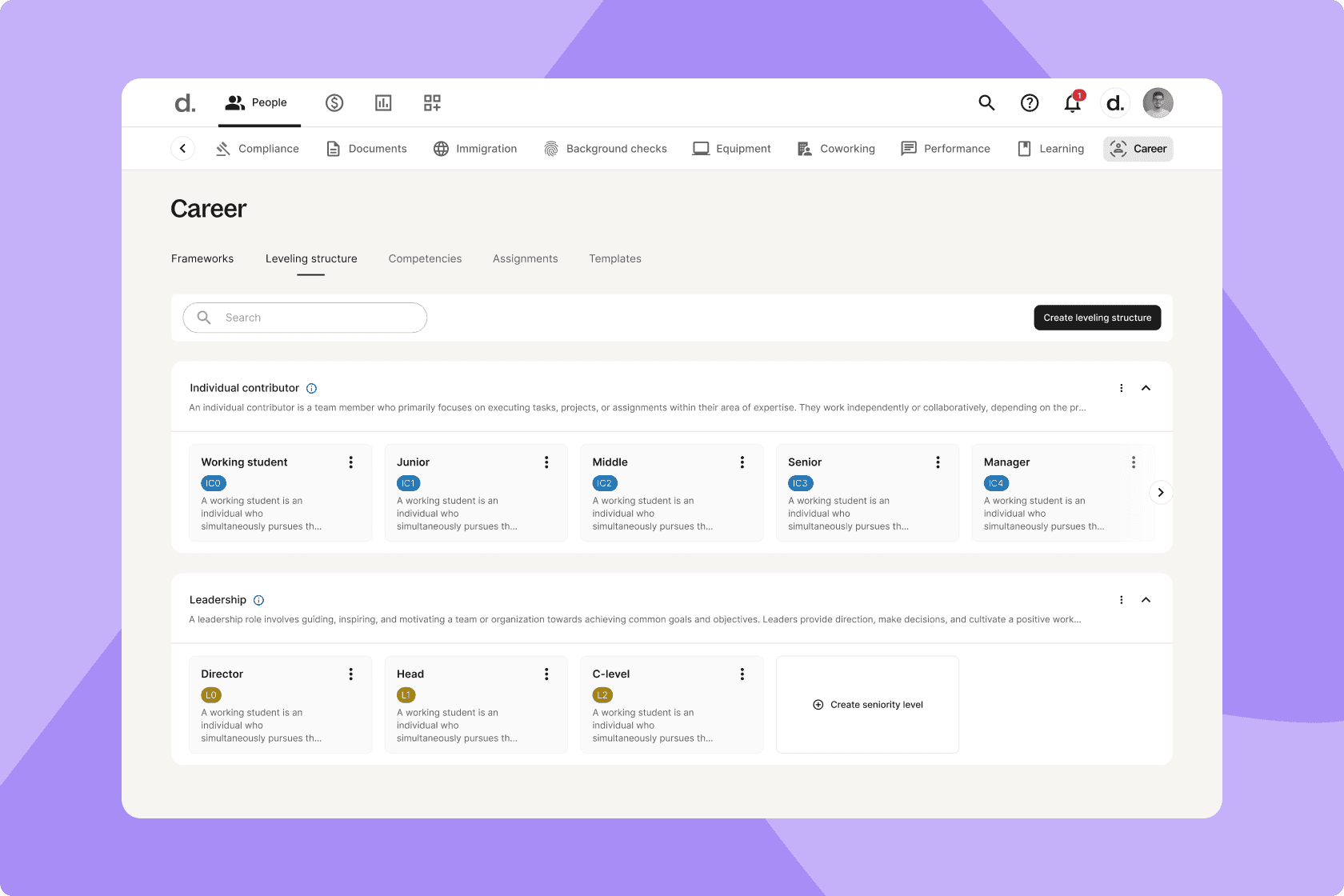
Career levelling within Engage, Deel HR's talent management module
How to build a job level classification system
Here's how to go from blank page to a working framework your organisation will actually use.
Step 1: Conduct a job analysis
Before you classify anything, you need to understand what people actually do. Not what their job description says — what they do. Run structured interviews with managers and employees, review existing documentation, and identify the core duties, decisions, and performance expectations for each role.
Common methods: employee surveys, manager interviews, observation, and reviewing outputs and deliverables. The goal is factual, not aspirational.
Related guide: How to conduct a job analysis in 9 steps
Step 2: Define job families and levels
Group similar roles into families based on function. Then define the levels within each family, what distinguishes entry from mid from senior. At this stage, focus on the scope of impact and decision-making authority as your primary differentiators.
Tips:
-
Start from existing job descriptions, but treat them as a starting point, not the answer — many job descriptions are aspirational or outdated
-
Use competencies and impact as key differentiators between levels, not years of experience alone
-
Design career progression into the structure from the start. Don't bolt it on later
Step 3: Create a job leveling matrix
A leveling matrix maps roles against your criteria in a structured grid. It's your internal reference for how any role should be evaluated, and it's what makes decisions consistent and defensible across departments.
The matrix should allow for future additions — new roles, new functions, new geographies — without requiring a full rebuild.
Step 4: Validate and implement
Before rollout, validate with department heads, HR leaders, and senior leadership. Pilot in one department first. Then implement with clear communication: employees should understand the system, how their role was classified, and what it takes to progress.
Build supporting materials: FAQs, plain-language guides, manager talking points. The more questions you answer proactively, the smoother the rollout.
Free template
Create actionable competency frameworks effortlessly
Job level classification mistakes that will cost you
Most leveling projects don't fail because the framework is wrong. They fail because of how the system is applied, communicated, or maintained. Here are the five mistakes that derail even well-designed systems.
1. Level creep
Level creep is the gradual inflation of titles and classifications over time without any corresponding increase in scope or responsibility. It typically happens when managers use level upgrades as retention tools, a well-intentioned short-term fix that creates long-term equity problems.
Fix: Establish a leveling governance committee. Every classification change should require documented justification against the criteria, not a conversation with a sympathetic HRBP.
2. Classifying the person, not the role
The system should evaluate the role's responsibilities and scope, rather than the individual currently in it. Bumping a long-tenured employee to a higher grade without a corresponding change in their actual responsibilities creates an inconsistency that their colleagues will notice.
Fix: Evaluate what the role does, not who does it. If two people have the same title and responsibilities, they should be at the same level regardless of tenure or performance.
3. Building one track and forcing everyone onto it
Requiring strong individual contributors to move into management to advance is one of the leading causes of senior talent attrition. Many exceptional engineers, designers, or analysts have no interest in, or aptitude for, people management.
Fix: Build a dual IC and management track before you need it. Ideally, design it into the framework from day one. Retrofitting a parallel track after the fact is significantly harder.
4. FLSA misclassification
The Fair Labor Standards Act sets specific criteria for classifying employees as exempt from overtime requirements. Simply giving someone a senior title or a salary above a threshold isn't sufficient. Misclassifying roles as exempt exposes your organisation to significant back pay liability.
Fix: Run any new classification framework through legal review before rollout. For global teams, equivalent regulations apply in most jurisdictions. The FLSA is not the only one to worry about.
5. Building it once and walking away
Job roles evolve faster than most HR frameworks. A classification that was accurate three years ago may no longer reflect what the role actually does, especially in functions heavily affected by AI, automation, or organisational restructuring.
Fix: Schedule an annual audit. Define triggers — new markets, M&A activity, significant technology changes — that automatically prompt a framework review. Build this governance in from the start, not as an afterthought.
Best practices for job level classification
Choose criteria that fit your context
The right criteria depend on your organisation's goals, industry, and workforce complexity. Use a combination of quantitative criteria (years of experience, certifications) and qualitative criteria (scope of impact, decision-making authority). Don't borrow another company's criteria wholesale without adapting them.
Be consistent across departments
Use the same criteria for all roles across the organisation. If identical responsibilities get classified differently in different departments, trust in the system erodes fast. Inconsistency is the most common source of employee grievances about leveling.
Be objective
Evaluate the role, not the person. Separate the classification question (what does this role require?) from the performance question (how well is this person doing it?). Mixing the two produces a system that feels arbitrary and is impossible to defend.
Foster transparency
Employees who understand the classification system — and how their role was evaluated — are more likely to trust it. Share the criteria. Explain the levels. Train managers to have informed conversations about leveling with their direct reports.
Pay transparency legislation is also driving this conversation. In jurisdictions with pay transparency requirements, a documented, defensible classification system isn't optional. See our guides on the EU Pay Directive and US pay transparency laws for more.
Audit regularly
Build a cadence of review into your governance model — at minimum, annually. When roles change significantly, when your organisation restructures, or when market data shifts meaningfully, review the affected classifications before the gap becomes a problem.

Guide
Global transparency laws are changing. Is your comp strategy keeping up?
The strategic value of a clear leveling system
A job level classification system isn't just an HR document. It's the infrastructure that makes your entire people strategy work.
Career progression
Transparent leveling shows employees how to advance, from entry to senior, from IC to lead. In tandem with career pathing, it gives employees a roadmap instead of a mystery. Employees who understand their path are more likely to stay.
Succession planning
Leveling helps identify candidates for more senior roles by making it clear which employees are operating at the edge of their current level and ready to move up. It takes guesswork out of succession decisions.
Fair compensation
By anchoring pay decisions to defined role criteria rather than individual negotiation, leveling supports internal equity and reduces pay compression. It also makes it easier to address gender, race, or location-based pay gaps with objective evidence.
Talent attraction
Candidates evaluate employers partly on the clarity of their career progression. A visible, coherent leveling system signals that growth is structured and achievable, and not just subject to a manager's discretion. It also supports transparent job postings in markets where pay transparency is legally required.
Organisational efficiency
When roles are clearly defined and leveled, employees know what's expected of them. Teams divide work more efficiently. Managers delegate with confidence. Less time spent on ambiguity means more time spent on work that matters.

Free template
Build a steady pipeline of leaders
Build your leveling framework in Deel
Building a career framework from scratch is a significant undertaking — especially when competency needs evolve as fast as your business. Deel HR’s talent management module, Engage, accelerates the process and integrates your leveling system with performance, learning, and development in one place.
With Engage, you can:
-
Define IC and management progression tracks for every function
-
Set the skills, knowledge, and expertise required at each job level
-
Generate accurate, tailored competency models and role descriptions with AI
-
Automatically assign learning and development pathways by level
-
Assess performance against level criteria and give employees clear visibility into what's needed to advance
-
Connect leveling to your global HRIS for a single source of truth across your workforce
Book a demo to see how Engage helps you build and maintain a leveling system that scales.
Live Demo
Get a live walkthrough of the Deel platform
FAQs
What is the difference between job level classification and job leveling?
Job classification groups roles into categories based on shared characteristics — duties, qualifications, scope. The result is descriptive (e.g., 'Marketing Specialist'). Job leveling is more specific: it defines the hierarchy within those categories and maps out what it takes to progress from one level to the next. Classification tells you where a role sits; leveling tells you how to move.
What's the difference between job level and position?
A job level is a general rank within the organisation's structure — 'Senior Engineer' as a level applies across all engineering teams. A position is a specific role held by an individual: 'Senior Engineer, Platform Infrastructure' is a position. Same level, different position.
What is level creep, and why does it matter?
Level creep is the gradual inflation of titles and classifications without corresponding increases in scope or responsibility. It typically happens when managers use leveling upgrades as retention tools. Over time, it distorts your compensation structure, creates internal inequity, and undermines trust in the system. Preventing it requires consistent governance — a committee that reviews and documents every classification decision.
How often should we audit our job classification system?
At minimum, annually. You should also build in triggers: significant organisational change, M&A activity, entry into new markets, or major shifts in the nature of a role (particularly in functions heavily affected by AI or automation). A framework that was accurate three years ago may no longer reflect what roles actually do.
What determines whether a role is exempt from overtime under the FLSA?
The FLSA sets specific criteria — executive, administrative, professional, and other exemptions — based on job duties and salary thresholds, not just job title. Misclassifying employees as exempt can result in significant back pay liability. Any new classification framework should be reviewed by legal counsel before rollout, particularly for roles near the boundary between exempt and non-exempt.
What is the hierarchy of corporate titles?
While structures vary by organisation, the most common hierarchy from entry to executive is:
-
Individual contributors: Junior/Entry-level → Specialist/Analyst → Senior → Lead/Staff/Principal
-
Management: Manager → Senior Manager → Director → Senior Director → VP → SVP → EVP → C-suite (CEO, CFO, CTO, etc.)
Many modern organisations add a parallel IC track that runs alongside the management track rather than converging at senior levels.
Lorelei Trisca is a Product Marketing Manager at Deel passionate about the future of work and global talent. She drives go-to-market strategy, product launches, and global campaigns, while championing client enablement and product adoption to help teams get more value from the tools they use every day.