Article
6 min read
What a Recruiting Tech Stack Audit Reveals for Mid-Market HR Teams
Global HR
Global hiring

Author
Jemima Owen-Jones
Last Update
October 23, 2026

Table of Contents
What is recruiting tool sprawl?
Pain point one: Integration depth and automation
Pain point two: DEI and neurodiversity filtering
Pain point three: AI sourcing quality
Pain point four: Annual price increases
How to audit your own recruiting tech stack
Consolidate your recruiting stack with Deel's ATS
Key takeaways
A recruiting tech stack audit typically exposes three to five disconnected platforms where data doesn't flow automatically between stages.
Integration depth is the pain point mid-market recruiters most consistently flag when they audit their current tools.
Deel's ATS and Talent sourcing connects recruiting to onboarding and payroll as a native module within Deel HR.
Most mid-market recruiting teams own more hiring tools than they realize. A tech stack audit typically turns up three to five discrete platforms: a job board aggregator, a legacy applicant tracking system (ATS), a sourcing plug-in, a scheduling tool, and a candidate relationship manager. Each runs independently, generates its own data, and arrives with its own annual renewal invoice.
Manual data re-entry between systems inflates admin hours, candidate records scatter across platforms, and costs increase each year. Research from SHRM confirms that fragmented recruiting workflows are straining talent acquisition teams at scale, with tool proliferation among the chief culprits.
This article examines four pain points mid-market teams consistently surface in a recruiting tech stack audit:
Integration depth
DEI filtering capability
AI sourcing quality
Pricing predictability
Each section maps what teams are finding in their own stacks and explains how a connected ATS addresses it.
What is recruiting tool sprawl?
Tool sprawl happens when a team accumulates recruiting software incrementally: adding a sourcing tool when LinkedIn outreach lagged, a scheduling app when calendar coordination became a bottleneck, a compliance tool when a legal question arrived.
The earlier systems rarely get retired.
The result is a stack of overlapping subscriptions, each with partial ownership of the hiring workflow and its own data format.
Mid-market companies are especially exposed. Enterprise teams often have dedicated HR tech governance. Startups typically start with one tool and grow from there. Mid-market teams sit between the two: large enough to run structured hiring across multiple departments, but rarely staffed to audit and rationalize a sprawling tool set.
As a buyer's guide to ATS selection notes, the most common mid-market symptom is not that individual tools are poor. It's that none of them communicate well enough to eliminate manual work between stages. When recruiting data crosses three or four platform boundaries during a hiring cycle, the manual effort at each handoff adds up to hours per recruiter per week.
Deel HR
Hire and recruit faster, with less effort
Pain point one: Integration depth and automation
Integration failures are the most immediate cost of tool sprawl. When systems don't share data natively, people fill the gap manually, copying candidates from one platform to another, toggling between a sourcing tool and an ATS, and chasing interviewers across calendar apps to confirm availability.
What participants reported
Recruiters running fragmented stacks consistently describe the same pattern. Sourcing happens in one tool, screening in another, and scheduling in a third. Each platform captures part of the candidate record, but no single system owns the full picture.
The cost is often invisible in the moment. A sourced profile that takes two minutes to import manually does not register as a problem on any dashboard. Multiply that by hundreds of candidates per quarter, and the aggregate time lost becomes significant without anyone having recorded it.
Calendar coordination is another persistent friction point. Without native calendar integration, scheduling a single interview can mean three or four emails to find a slot that works for both the interviewer and the candidate. Each exchange adds a day or more to the time-to-hire clock.
For teams that use LinkedIn heavily for sourcing, the absence of a native connection to their ATS means manually saving profiles, pasting data into a second system, and reconciling duplicates when the same candidate appears across tools. Across a full recruiting cycle, that manual layer costs hours per week per recruiter.
How Deel's ATS addresses this
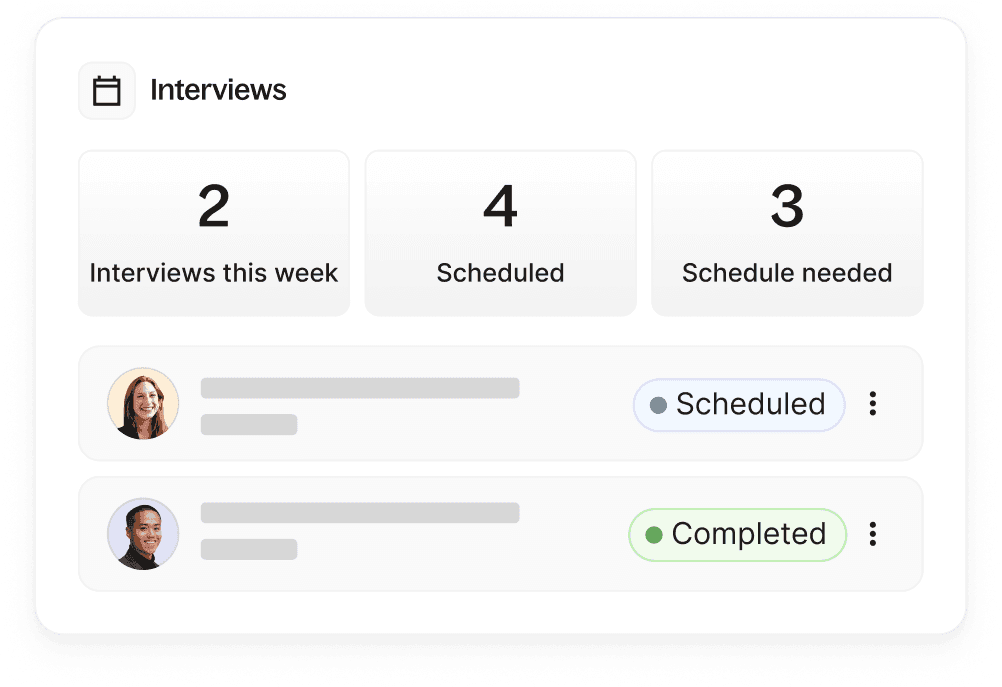
Deel's ATS module, built within Deel HR, integrates with LinkedIn, Google Workspace, and Microsoft 365. Recruiters can source candidates without leaving the platform, and calendar sync means candidates can self-schedule interviews against live interviewer availability rather than waiting for a human to broker a time slot.
Stage-based workflow automation handles the administrative follow-up. When a candidate advances to the next stage, Deel's ATS triggers the relevant emails, tasks, and notifications automatically and without any technical configuration required. This removes the coordination layer that typically falls between the ATS and the team's inbox.
The deeper advantage is the end-to-end data flow. When a candidate accepts an offer in Deel's ATS, their record moves automatically into Deel's HRIS for onboarding, payroll, and compliance setup. The candidate-to-employee transition completes without the team switching platforms, re-entering data, or sending a handoff email.
Signs of poor integration depth in your stack
Manual CSV exports between sourcing and ATS tools, duplicate candidate entries across systems, and calendar scheduling done outside the ATS are the clearest indicators that integration depth is limiting your team's speed.
Pain point two: DEI and neurodiversity filtering
Structured evaluation matters because informal hiring processes let bias in at every stage. Without consistent criteria, different candidates for the same role can end up assessed against different standards depending on who reviewed their application and how an interview was conducted that day.
What participants reported
Many mid-market recruiting tools offer limited control over how evaluation criteria are applied. The platform may allow interviewers to add notes, but it does not enforce a structured scorecard. It may display candidate demographics, but it does not mask identifying information during initial screening.
The result is a hiring process that looks structured because it runs through software, but operates without the safeguards that make structure meaningful.
Research from SHRM highlights how AI tools can develop their own biases when trained on historical hiring data that already reflects unequal outcomes. The issue applies to evaluation criteria more broadly: without deliberate design, a hiring workflow reproduces the patterns already baked into it.
For teams actively focused on inclusive hiring, the missing capability in their current ATS often surfaces only when someone asks for a report. The data for tracking DEI metrics exists in theory but is scattered across systems that don't produce a unified view.
How Deel's ATS addresses this
Deel's ATS applies structured hiring workflows that route all candidates through the same evaluation sequence. Interview scorecards present the same criteria to every interviewer for the same role, and equal opportunity safeguards mask identifying information at the stages where it doesn't affect the hiring decision.
AI-generated job descriptions in Deel's ATS are designed to attract a broad applicant pool, without language that inadvertently filters for a specific demographic. The platform's AI scoring is tied to the specific role criteria set upfront, not inferred patterns from historical hires. Custom permissions control who can access sensitive candidate data at each stage, keeping evaluation-relevant information in front of the people who need it and personal data away from those who don't.
The practical outcome is a hiring process that holds together structurally rather than depending on each individual interviewer to self-apply consistent standards across every candidate interaction.
Questions to ask your ATS vendor about DEI capabilities
Does the platform mask identifying information during initial screening?
Are interview scorecards enforced for all interviewers, or optional?
Can the system generate DEI-ready reports from data collected natively?
How does the AI scoring model account for potential bias in historical hiring data?
Deel's HRIS
Manage your global workforce compliantly

Pain point three: AI sourcing quality
AI sourcing tools promise to reduce the manual work of finding candidates. The reality for many mid-market teams is a high volume of poorly matched results that require as much review time as manual sourcing would have produced.
What participants reported
The primary frustration is opacity. When an AI tool surfaces a ranked list of candidates, recruiters often cannot see why a candidate ranked where they did. Without that visibility, it's difficult to calibrate sourcing parameters or explain a rejection to a hiring manager who asks why a strong-looking profile was filtered out.
A second problem, increasingly common, is AI-generated applications. As candidates use AI tools to write CVs and tailor applications automatically, the volume of applications that look polished but don't reflect the actual candidate has grown substantially. Gartner's analysis of talent acquisition trends for 2026 notes that AI adoption on both sides of the hiring equation is reshaping how teams evaluate candidate quality and manage pipeline volume.
For teams exploring AI in talent acquisition, the problem isn't that AI fails to reduce sourcing volume. It's that it shifts the manual work from sourcing to verification, and without the right tooling that shift is invisible until the pipeline is already overloaded.
How Deel's ATS addresses this
Deel's ATS provides transparent AI scoring. Each applicant receives a score tied to the specific requirements defined for the role, and the system shows exactly how the candidate maps against each requirement. Hiring teams see the breakdown, not just a number, which keeps human judgment in the loop rather than asking teams to trust a ranking they can't interrogate.
The platform also flags AI-generated applications at the intake stage. With auto-written CVs now widespread, that early signal gives reviewers a useful indicator before they invest time evaluating a candidate in depth.
Interview recordings, transcripts, and summaries are stored directly on the candidate profile, giving decision-makers a record of what each conversation covered rather than relying on interviewer recall at the point of decision.
AI sourcing quality checklist
Before committing to an AI-powered ATS, confirm:
(1) scoring breakdowns are visible per candidate (2) the system can flag AI-generated applications (3) human review remains a required step before any offer stage.
Pain point four: Annual price increases
Recruiting software renewals follow a familiar pattern. The initial contract arrives at a competitive price, the platform becomes embedded in the workflow, and each subsequent renewal comes in higher than the last. Mid-market teams running multi-tool stacks face this cycle across several vendors simultaneously.
What participants reported
Budget holders at mid-market companies consistently flag vendor pricing as unpredictable. License costs, per-seat fees, and integration add-ons are often priced separately, making total cost of ownership difficult to calculate until renewal arrives. Each platform in the stack adds another variable to that calculation.
The structural problem is that moving away from an embedded tool is costly even when pricing becomes unreasonable. Candidate data held in a proprietary format, custom workflows built within a closed platform, and the time required to migrate and retrain all create switching friction that vendors price against. Teams that want to consolidate often find that the cost of leaving their current tools rivals the cost of staying.
How Deel's ATS addresses this
Deel's ATS is available to customers with Deel HRIS as the platform foundation. Rather than a standalone subscription compounding on top of existing HR software costs, it sits within the Deel HR investment a team is already making. Transparent per-worker pricing means cost scales predictably with headcount rather than through annual renewal negotiations that reset expectations each cycle.
A Pro tier adds expanded AI sourcing capability and deeper interview analysis for teams whose hiring volume justifies it, providing a documented path for scaling the platform without a vendor change. Because Deel's ATS stores data within the same system as HRIS, onboarding, and payroll, teams stay within a single connected environment as their requirements grow rather than managing migration between separate platforms.
How to audit your own recruiting tech stack
Running a recruiting tech stack audit doesn't require specialized tooling. Most of the relevant information exists in current contracts, admin dashboards, and feedback from the recruiters who use the tools every day. The goal is a clear map of where data flows automatically, where it doesn't, and what each tool actually costs when admin time is included in the calculation.
Fragmented employee experience research shows that tool fragmentation tends to surface in candidate-facing processes before it registers internally. The questions below focus on the moments where disconnected tools create delays that candidates and hiring managers actually notice.
Integration depth: Map every platform the team uses in a hiring cycle, note which data transfers happen automatically versus by manual export, and flag each manual step as a cost center worth evaluating.
DEI capability: Verify whether the current ATS masks identifying information at initial screening, whether interview scorecards are mandatory, and whether DEI-relevant data is housed in a single system that produces consistent reports without manual assembly.
AI sourcing quality: Have the vendor walk through how candidates are scored. A ranking with no visible breakdown is a signal to probe further. Confirm whether the system can detect AI-generated applications, a capability that matters more with each passing quarter.
Pricing transparency: Total the recruiting tech stack cost across software licenses, per-seat fees, integration costs, and the estimated hours teams spend on manual admin created by integration failures. Compare the combined total against a connected alternative, and factor in the last two years of renewal increases as a guide to what the next cycle may bring.
Talent
Find top talent, hire globally

Consolidate your recruiting stack with Deel's ATS
Recruiting tech stacks grow piece by piece, and the cost of that growth is rarely visible in a single line item. By the time a team audits what they're running, the combined cost in license fees, integration workarounds, and admin hours typically exceeds what a connected platform would have cost from the start.
Deel's ATS is the recruiting module within Deel HR. It handles sourcing, structured evaluation, and offer management, and connects directly to HRIS, onboarding, and payroll so data moves forward at offer acceptance without re-entry or manual handoffs. A tiered model, including a Pro tier with expanded AI sourcing and interview analysis, means the platform scales with the team rather than requiring a vendor switch at each growth stage.
For mid-market HR and talent acquisition leaders ready to consolidate their recruiting stack, book a demo below to see how Deel's ATS works in practice.
Live Demo
Get a live walkthrough of the Deel platform
FAQs
How many recruiting tools does the average mid-market team run?
Most mid-market recruiting operations run three to five discrete platforms, typically covering sourcing, tracking, scheduling, assessment, and HRIS separately. Each handles part of the hiring workflow but rarely connects natively to the others, creating manual handoffs at each stage.
What is the difference between an ATS and a recruiting CRM?
An ATS manages active candidates in a live hiring pipeline, from application to offer. A recruiting CRM manages passive candidate relationships over time, keeping warm prospects engaged before a role opens. See our ATS vs. CRM guide for a deeper comparison.
How do you evaluate integration depth in a recruiting tool?
Ask whether data transfers between your sourcing tool, ATS, scheduler, and HRIS automatically or manually. Test the actual handoffs during a demo rather than relying on an integration list. Any transfer requiring a manual export or copy-paste step is a gap that will cost time at scale.
What should HR leaders ask vendors about DEI filtering capabilities?
Ask whether the system masks identifying information during initial screening, whether interview scorecards are enforced as mandatory or optional, and whether the platform generates audit-ready DEI reports from data collected natively within the system rather than assembled from multiple exports.
How does AI sourcing affect time-to-hire and candidate quality?
AI sourcing typically reduces sourcing time but can inflate the pipeline with lower-quality matches if scoring criteria aren't transparent. Ask the vendor how candidates are ranked, whether the scoring breakdown is visible to reviewers, and whether the system can detect AI-generated applications, since platform-generated CVs have become common enough to inflate hiring pipelines significantly.
This article is for general informational purposes and should not be treated as HR or legal advice. Consult a qualified professional for guidance specific to your situation.
Jemima is a nomadic writer, journalist, and digital marketer with a decade of experience crafting compelling B2B content for a global audience. She is a strong advocate for equal opportunities and is dedicated to shaping the future of work. At Deel, she specializes in thought-leadership content covering global mobility, cross-border compliance, and workplace culture topics.