Article
7 min read
How Small Businesses Can Offer Better Benefits to Employees Through a PEO
PEO
Employee Benefits

Author
Shannon Ongaro
Last Update
October 19, 2026

Table of Contents
What's legally required for US small businesses?
Compliance cheat sheet
At a glance: Mandatory vs. voluntary benefits in the US
Voluntary benefits
How to offer employee benefits as a small business
Two scenarios
Affordable options for offering benefits
Final thoughts: Offer smart benefits, not just legal minimums
Key takeaways
Small businesses can remain competitive in a tight labor market by going beyond the legal minimum requirements and investing in their employee benefit plans.
Start with mandatory benefits like Medicare, unemployment insurance, and workers' compensation to create a strong foundation for your plans, then add voluntary perks like health insurance top-ups, wellness programs, and flexible working arrangements.
Rather than compromising on benefits, explore government schemes and partner with a PEO service like Deel to secure more affordable plans, with benefits administration built in.
Small business owners can no longer afford to overlook employee benefits. Today's workers expect more than just a paycheck, and 70% of them are willing to change jobs to secure better perks.
However, delivering these benefits is challenging when running a lean operation. You're likely to have a tight budget and lack the internal HR and payroll expertise to administer programs, which makes it hard to manage the costs, complexity, and compliance requirements that come with offering competitive benefits.
Faced with this challenge, thousands of small US businesses have turned to PEO services. This lets them outsource key operations like HR, payroll, and benefits administration and access packages that would otherwise be out of reach.
Alongside easing their administrative burden, data shows that small businesses in partnerships with PEO providers tend to grow twice as quickly as before.
Is your small business struggling to manage employee benefits without stretching resources? This guide covers what to include, how to set up your plans, and how a Professional Employer Organization like Deel can support you throughout the process.
Mini-glossary
FICA (Federal Insurance Contributions Act): Federal law requiring employers and employees to fund Social Security and Medicare through payroll taxes.
ACA (Affordable Care Act): Federal law setting minimum coverage standards and requiring large employers to offer health insurance.
COBRA (Consolidated Omnibus Budget Reconciliation Act): Federal law letting eligible employees keep group health coverage after a qualifying job change, at their own cost.
FMLA (Family and Medical Leave Act): Federal law giving eligible employees unpaid, job-protected leave for family and medical reasons.
SUI (state unemployment insurance): State-run, tax-funded program that pays benefits to workers who lose their jobs through no fault of their own.
HSA (health savings account): Tax-advantaged savings account for medical expenses, available with a high-deductible health plan.
FSA (flexible spending account): Employer-sponsored account that lets employees set aside pretax dollars for medical or dependent care costs.
QSEHRA (Qualified Small Employer Health Reimbursement Arrangement): Arrangement that lets small employers reimburse employees tax-free for individual health insurance and expenses.
PEO (professional employer organization): Firm that co-employs a client's workforce to handle payroll, benefits, and compliance.
What's legally required for US small businesses?
Every US employer, regardless of size, must withhold and match Social Security and Medicare taxes under FICA. Beyond that, most federal requirements kick in at specific headcounts, and several benefits are governed at the state level.
When structuring your small business employee benefits package, make compliance your first step. Even companies with only a handful of employees are still required to offer many types of contributions, coverage, and insurance plans under state and federal law. Getting this step right minimizes the risk of legal issues and fosters trust among small, tight-knit teams.
Social Security and Medicare
All employers must withhold and match Social Security and Medicare contributions under FICA. This applies regardless of your business size or the state where you operate:
| Tax Provision | Employee Rate | Employer Rate | Combined Rate | 2026 Wage Limit | Additional Details |
|---|---|---|---|---|---|
| Social Security | 6.2% | 6.2% | 12.4% | $184,500 | Limit increased from $176,100 in 2025. |
| Medicare | 1.45% | 1.45% | 2.9% | No cap | Applies to all earned income. |
| Medicare Surtax | 0.9% | 0% | 0.9% | Threshold: $200,000 | Applies only to employee wages exceeding the threshold. |
See also: What are Medicare A, B, C, and D? An All-in-One Resource
Explore our PEO services
The market leader in PEO services for remote teams
Health insurance under the ACA
Businesses with 50 or more full-time equivalent employees must provide health insurance under the ACA. Your plans must also meet the Act's minimum coverage and affordability standards.
For plan years beginning in 2026, coverage is considered affordable if the employee's required contribution for self-only coverage doesn't exceed 9.96% of household income, up from 9.02% in 2025.
See also: A Guide to ACA Compliance Requirements
COBRA
COBRA requires you to offer continued health insurance coverage after qualifying employees leave if you offer a group health plan and have 20 or more employees.
Not all contract terminations trigger COBRA. Employees must experience a qualifying event, such as a reduction in working hours or involuntary dismissal for any reason other than gross misconduct. You can require departing employees to cover the premiums after they leave, but these contributions can't exceed the standard cost of coverage, including administrative fees.
FMLA leave
Under FMLA, businesses with 50 or more employees must provide up to 12 weeks of unpaid leave for the birth, foster placement, or adoption of a child; an employee's recovery from a serious health condition; caring for an immediate family member with a serious health condition; or a qualifying military family emergency.
New employees aren't immediately eligible. They must work for your business for at least 12 months and log at least 1,250 hours during that time.
State unemployment insurance
SUI is a federally authorized program managed at the state level. It typically involves registering with local authorities and contributing to a public fund through payroll tax withholdings. Rules vary by state: some use fixed percentages, while others calculate an individual rate for each business based on payroll and termination history.
Workers' compensation insurance
Most states require you to obtain workers' compensation, which covers medical bills and lost wages for employees with job-related illnesses and injuries. Requirements vary more than SUI: some states only require registration after your third or fourth hire, though state governments often encourage earlier coverage even where exemptions apply.
Disability insurance
California, New York, New Jersey, Rhode Island, and Hawaii require disability insurance on top of workers' compensation. This program covers employees who can't work due to illness or injury, regardless of whether their job caused it. Costs are typically shared between employer and employee, with rates and limits set annually by the state.
Free guide
A Beginner’s Guide to HR Outsourcing
Compliance cheat sheet
| Requirement | Who it applies to | Key rule |
|---|---|---|
| FICA (Social Security and Medicare) | Every employer | Withhold and match 6.2% Social Security (up to $184,500 in wages) and 1.45% Medicare per side in 2026 |
| State unemployment insurance | Every employer, rules set by state | Register and contribute to your state's fund; rates vary by state and claims history |
| Workers' compensation | Most employers, often from the first or second hire | State-set coverage for job-related injury and illness |
| ACA employer mandate | 50 or more FTE employees | Offer affordable, minimum-value coverage or risk a shared-responsibility payment |
| COBRA | 20 or more employees with a group health plan | Offer continued coverage after a qualifying event; the departing employee can be charged up to full cost plus admin fees |
| FMLA | 50 or more employees | Offer up to 12 weeks of unpaid, job-protected leave to eligible employees |
| State disability insurance | Employers in California, New York, New Jersey, Rhode Island, and Hawaii | State-set contribution rates, usually shared with employees |
How to calculate your FTE count
The ACA counts full-time employees (those averaging 30 or more hours a week) as one FTE each. For part-time employees, add up their total monthly hours and divide by 120 — that gives you their equivalent FTE count. Add the two totals together.
Worked example: A business with nine full-time employees and three part-time employees who each work 80 hours a month:
Part-time hours: 3 × 80 = 240 hours a month
Part-time FTE: 240 ÷ 120 = 2
Total FTE: 9 + 2 = 11
At 11 FTE, this business is well under the 50-employee ACA threshold, so the mandate doesn't apply, though FICA, SUI, and workers' compensation still do.
At a glance: Mandatory vs. voluntary benefits in the US
Mandatory, by category:
Health-related: ACA coverage, required at 50 or more FTE employees; COBRA continuation coverage, required at 20 or more employees with a group plan
Workers' compensation: required in most states, typically from the first or second hire
Unemployment: required in every state, with contribution rates that vary by state
Disability: required in California, New York, New Jersey, Rhode Island, and Hawaii
Leave: FMLA unpaid leave, required at 50 or more employees
Financial wellness: FICA contributions for Social Security and Medicare, required for every employer
Voluntary, by category:
Health-related: vision, dental, and mental health support, for example an employee assistance program or teletherapy access
Financial wellness: retirement plans, HSAs and FSAs, and life insurance, for example a modest 401(k) match
Leave: paid parental leave, paid time off, and paid vacation, for example two weeks of PTO plus four weeks of paid parental leave
Lifestyle and perks: flexible working arrangements and professional development stipends, for example a remote-work policy or an annual $500 learning stipend
Learn more: What Employee Benefits Are Required by US Law?
Benefits Administration
Fast, flexible global benefits
Voluntary benefits
Once you've met the legal minimum standards, consider which benefits you can add to sell yourself as an employer to candidates and retain your best people. The ideal benefits depend on your team's needs and preferences: a predominantly Gen Z workforce is more likely to appreciate student loan repayment than older demographics who have already paid off most of what they owe.
That said, the following employee benefits tend to have general appeal.
Health-related benefits
While your small business may already offer mandatory health insurance, look for opportunities to extend and top up your plans. Recent studies show that 42% of employees would rather be put on an improved plan than receive a pay raise.
Health insurance: Even if you're exempt from ACA requirements, register anyway. You're likely eligible for the Small Business Healthcare Options Program (SHOP), which entitles you to a 50% tax credit on qualified employer contributions.
Dental and vision: Most health plans don't include these, but employees consistently rank them among their top three benefits.
Mental health support: Often excluded from standard insurance, but high on employees' wish lists. Use a mix of options, such as employee assistance programs, teletherapy, and wellness programs, depending on whether your team is on-site, hybrid, or remote.
Financial wellness benefits
Research shows that people who feel financially secure report more job satisfaction, and a pay raise only helps in the short term. Benefits like retirement plans and savings accounts help employees plan ahead and feel more in control.
401(k)s or retirement accounts: 98% of employees expect employers to offer some kind of retirement benefit. Even a modest match shows you're investing in your team long term.
Savings accounts: HSAs and FSAs help employees cover medical and dependent care expenses, reduce taxable income, and lower payroll taxes for your business.
Life insurance: Often overlooked, but basic life insurance offers employees with families real peace of mind, and it's inexpensive to add to a group plan.
See also: Difference Between HSA and FSA: How to Choose the Right Option
Lifestyle perks
Lifestyle perks are where you can get personal and reflect your business culture, enticing top talent away from larger competitors with a less distinct employer brand.
Paid time off: Half of employees report feeling distracted by work during vacation. Extra paid leave signals that your company genuinely wants people to take time off.
Parental leave top-ups: Going beyond the legal minimum can win over the 25-to-40 demographic as they plan families.
Flexible working arrangements: Remote work and location flexibility are cost-effective and still in high demand; many employees would give up 20% of their salary to work from home.
Professional development stipends: These appeal to career-minded employees and prepare them to step into new roles as your business grows.
Before Deel, hiring in a new state meant increasing our risk of compliance issues. By ensuring we stay compliant, Deel's PEO not only saves us money but also alleviates our mental load.
—Andy Cloyd,
CEO and Co-founder, Superfiliate
How to offer employee benefits as a small business
Step 1: Determine what's required
Input: Your headcount, locations, and industry. Output: A list of the federal and state benefits that apply to your business.
Start by understanding the federal and state requirements based on your size, location, and occasionally your industry. For example, unemployment insurance rates run higher in construction because project-based work leads to more frequent layoffs.
Bookmark these for federal requirements:
IRS: Social Security and Medicare withholding rates
Healthcare.gov: coverage options for small businesses
DOL: COBRA continuation coverage
For your state, find the departments that handle workers' compensation, unemployment insurance, and disability insurance, typically your state's departments of revenue and labor.
Step 2: Set a budget
Input: Your required benefits list and current headcount. Output: A per-employee dollar range for mandatory and voluntary benefits, plus a contribution buffer.
Calculate how much funding you need for mandatory benefits, including a buffer for potential headcount growth. Then estimate what you can realistically spend on voluntary benefits — you may need to start small and build as your company's financial standing improves. Before you confirm your budget, benchmark against similar small businesses to see if you're under or overspending.
Step 3: Choose a delivery path
Input: Your budget, headcount, and internal HR capacity. Output: A selected delivery model — broker, platform, tax-advantaged allowances, or PEO.
Broker: Helps you compare plans and negotiate rates, but doesn't typically manage ongoing admin, so you need the internal capacity to handle that.
Benefits platform: Lets you shop plans, run enrollment, and sync deductions to payroll automatically.
Tax-advantaged allowances: A QSEHRA (Qualified Small Employer Health Reimbursement Arrangement) lets businesses with fewer than 50 employees reimburse individual health insurance and eligible expenses tax-free, without sponsoring a group plan.
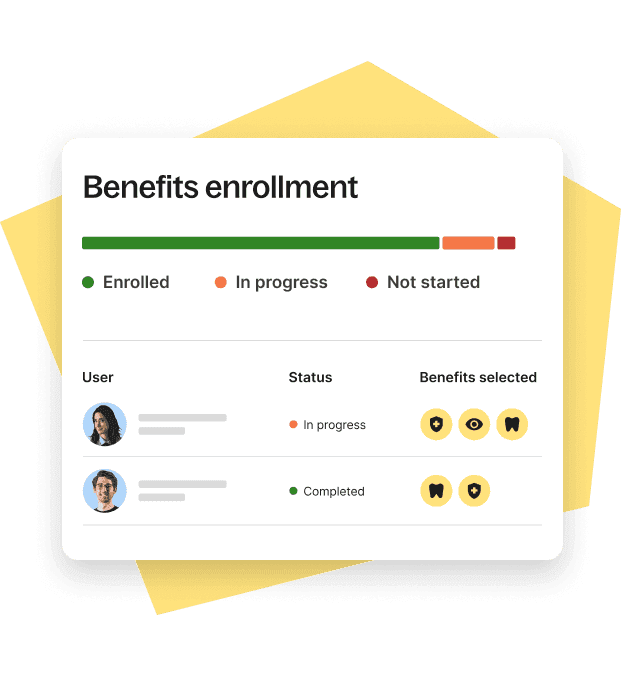
PEO service: Acts as the co-employer and handles plan sourcing, enrollment, and ongoing administration, while assuming some of the legal liability for compliance. Deel's PEO adapts to your business, whether you use our employee benefits or your existing provider. Scale into our benefits plans later if you want.
How benefits administration works alongside PEO
Because Deel already runs payroll for PEO clients, benefits enrollment and payroll deductions share the same source of truth: when an employee elects or changes a plan, the deduction updates in payroll without anyone re-entering it manually. That matters most around open enrollment and life events, like a marriage, birth, or move, where mismatched elections and deductions are the most common source of payroll corrections.
This is the same benefits infrastructure Deel uses for its own PEO and EOR employees, and it's built to handle life events with compliant enrollment windows applied automatically. If you later expand outside the US, the same platform runs benefits across 100+ countries, so you're not switching systems as you grow, though that's a separate consideration from the US-specific compliance this guide covers.
Step 4: Implement and communicate
Input: Your chosen delivery path and finalized plans. Output: An enrollment timeline, a company-wide announcement, and a record of employee acknowledgment.
Introduce plans through a company-wide message with a dedicated contact channel for follow-up questions, and keep an FAQ document in your shared drive. Ask everyone to confirm they've read the update and understand their options. If you use Deel HR, you can send your team a document, require an electronic signature, and monitor completion.
Keep communicating as you update plans: larger annual updates ahead of enrollment season, and smaller ones as voluntary benefits change.
Step 5: Stay compliant with changing laws
Input: Ongoing headcount and location changes. Output: An updated compliance status and an early warning before you cross a new threshold.
Governments regularly change eligibility criteria, contribution rates, and wage bases. Also monitor internal changes like headcount and annual income so you can see when you're about to cross a threshold, such as the 20-employee COBRA trigger or the 50-employee ACA and FMLA thresholds, before it happens.
A simple decision path
Start with headcount and locations. Are you single-state or multi-state? Multi-state teams need to track separate SUI, workers' compensation, and disability rules per state.
Confirm what's mandatory. Run your FTE count against the thresholds in the compliance cheat sheet above: 20 employees for COBRA, 50 FTE for ACA and FMLA, and check your state's rules for disability insurance and workers' compensation.
Choose a delivery path. Decide between an in-house plan with a broker or benefits platform, tax-advantaged allowances like a QSEHRA, or a PEO for full co-employment, payroll, and benefits administration in one service.
Get your outputs. A list of required coverages, plus recommended voluntary add-ons that fit your budget and workforce.
Two scenarios
Scenario 1: A 12-employee, single-state retail shop
Nine full-time employees and three part-time employees averaging 80 hours a month puts this shop at 11 FTE, well under the 50-employee ACA and FMLA thresholds, and under the 20-employee COBRA threshold.
Mandatory: FICA, SUI, and workers' compensation from the state where the shop operates. Recommended: A QSEHRA to offer tax-free health reimbursements without sponsoring a group plan, plus a modest PTO policy to compete for retail talent. Next step: Confirm the state's workers' compensation registration trigger, since some states require it from the first or second hire.
Scenario 2: A 48-employee, multi-state startup
Forty full-time employees plus 16 part-time employees averaging 60 hours a month works out to 40 + (960 ÷ 120) = 48 FTE, just under the ACA and FMLA thresholds, but close enough to require active monitoring as the company scales.
Mandatory: FICA, SUI, and workers' compensation in every state where the company has employees; COBRA, since the company has more than 20 employees and offers a group plan. Recommended: Monitor FTE count monthly, since crossing 50 triggers ACA and FMLA obligations; consider a PEO so payroll, compliance, and benefits administration stay in one place across states before that threshold hits. Next step: Model the cost of ACA-compliant coverage now, so there's no scramble if headcount crosses 50 mid-year.
Affordable options for offering benefits
QSEHRAs: Let small businesses without a group plan reimburse employees for individual health insurance and some medical expenses. You must have fewer than 50 employees to qualify.
Stipends for wellness or learning: Let individual employees decide what they need, keeping costs predictable while supporting your team.
Flat-rate perks vs. premium plans: A set dollar amount toward benefits can be more financially viable than high-cost premium plans, giving employees flexibility while keeping spending in check.
Pooled benefits through PEOs: Leading services like Deel often co-employ thousands of employees at once, letting them negotiate volume discounts that a small business could access even with only a few people on staff.
Checklist
Employee Benefits Renewal Checklist
Final thoughts: Offer smart benefits, not just legal minimums
Offering benefits isn't just about meeting compliance requirements. A comprehensive package is essential to attract and retain top talent in a competitive labor market, and relying on the legal minimum can put your company at a real disadvantage.
For many small businesses, the best approach is to start with mandatory benefits and build on that foundation by maintaining continuous compliance with federal and local requirements, then add voluntary benefits like retirement plans and savings accounts to stand out to skilled candidates.
Deel's PEO supports you through structuring your benefits package and beyond.
Deel's in-house team gets you access to top-tier packages in the US, and benefits administration is built into the service and payroll-connected, so plan renewals, open enrollment, and deductions stay in sync without a separate system to manage. As you expand across state lines, or eventually into other countries, PEO grows with you and keeps benefits consistent and compliant.
Ready to expand your small business? Book a 30-minute call with Deel to see how we can turn your employee benefits from an administrative burden into a growth enabler.
PEO
Get full-service HR, payroll, and benefits for your US employees
FAQs
Do employers have to offer health insurance under the ACA?
Only employers with 50 or more full-time equivalent employees must offer ACA-compliant coverage. Smaller employers aren't required to, though many still register for SHOP plans to access tax credits.
What triggers COBRA continuation coverage?
COBRA applies once you have 20 or more employees and offer a group health plan. Coverage continues after a qualifying event, like reduced hours or involuntary termination for reasons other than gross misconduct.
Is paid time off legally required in the US?
No federal law requires private employers to offer paid vacation or PTO. Some states and cities mandate paid sick leave, so check local rules before finalizing your policy.
How do rules change for multi-state teams?
Multi-state employers must track SUI, workers' compensation, and disability insurance separately for each state, since rates and registration triggers vary. ACA, COBRA, and FMLA thresholds apply at the company level regardless of state.
What's the Social Security wage base for 2026?
The Social Security wage base is $184,500 for 2026, up from $176,100 in 2025. Wages above that amount aren't subject to Social Security tax, though Medicare tax has no cap.
What counts as a full-time equivalent employee?
Full-time employees averaging 30 or more hours a week count as one FTE each. Part-time hours are added up monthly and divided by 120 to get their FTE equivalent.
Does FMLA apply to every small business?
No. FMLA only applies to employers with 50 or more employees, and employees must have worked at least 12 months and 1,250 hours to qualify.
What's a QSEHRA and who qualifies?
A QSEHRA lets employers with fewer than 50 employees reimburse workers tax-free for individual health insurance and eligible medical expenses, without sponsoring a group plan.
Is workers' compensation required for a one-person business?
It depends on the state. Some require coverage from your first hire, while others exempt businesses until the third or fourth hire. Check your state's labor department for the exact trigger.
What happens if a multi-state startup crosses 50 employees mid-year?
Once average FTE count hits 50 for the prior calendar year, ACA and FMLA obligations apply going forward. Monitoring FTE count monthly helps avoid a compliance gap.
Do I need separate benefits software if I use a PEO?
No. With Deel’s PEO employees have two options. The first is to use your existing benefits and healthcare in the US. The second is to use our US group benefits, where you'll get access to our master plans.
Shannon Ongaro is a content marketing manager and trained journalist with over a decade of experience producing content that supports franchisees, small businesses, and global enterprises. Over the years, she’s covered topics such as payroll, HR tech, workplace culture, and more. At Deel, Shannon specializes in thought leadership and global payroll content.