Article
3 min read
Time Tracking for Manufacturing: Optimize Labor Costs and Compliance Across Multiple Locations
Global HR
Legal & compliance

Author
Jemima Owen-Jones
Last Update
August 03, 2026

Table of Contents
The pain points grinding manufacturing operations
How Deel time tracking solves manufacturing scheduling
Closed-loop payroll: from time card to paycheck
A manufacturing scenario: global automotive supplier
Getting started with manufacturing time tracking
Key takeaways
- Production delays and overtime cost overruns happen when shift coverage and compliance tracking rely on spreadsheets, punch clocks, and manual email coordination across multiple facilities and countries.
- Manufacturing operations need real-time visibility into shift availability, automated alerts for state-specific compliance rules, and centralized payroll that calculates overtime correctly by location.
- Deel's time tracking and scheduling features centralize shift management across global facilities, enforces country-specific overtime and rest-period rules automatically, and connects time directly to payroll—eliminating manual reconciliation and compliance risk.
Manufacturing plants run on precision. Every minute counts—both for production schedules and labor budgets. Yet most manufacturing operations still rely on spreadsheets, punch clocks, and manual shift swaps to track hourly workers.
The result? Payroll delays. Overtime regulations get missed. Shift coverage gaps halt production lines. And when you're coordinating multiple facilities across different states or countries, compliance risk multiplies—each location with different wage-and-hour rules, different break requirements, different overtime thresholds.
Deel's time tracking and scheduling feature is purpose-built for shift-based manufacturing operations. It gives production teams visibility into every shift, helps enforce compliance requirements by location, and connects time records directly to accurate payroll—so you spend less time on manual reconciliation and more time managing production.
The pain points grinding manufacturing operations
Manufacturing teams face a unique set of scheduling challenges that generic time tracking software wasn't built to solve.
Shift coverage and production continuity
Plants operate in shifts—first, second, third—and each shift must be fully staffed or production halts. When a machine operator calls out at 6 a.m., the plant manager has minutes to find a replacement.
Spreadsheet-based scheduling makes it impossible to see who's actually available or qualified for that shift. The result: last-minute panics, unqualified workers covering critical roles, and production delays.
Overtime and labor cost control
Manufacturing facilities are bound by overtime rules that vary by state and industry. Some states enforce daily overtime thresholds; others track only weekly hours.
A worker who goes over 40 hours accidentally triggers unintended overtime costs. Without real-time tracking and alerts, supervisors don't know which workers are approaching their overtime threshold until the payroll runs—by then, the overage is locked in and labor budget is blown.
Compliance with shift work regulations
Different states enforce different rules around mandatory rest periods, break requirements, and consecutive shift limits. Some states require meal breaks at set intervals; others limit shift length to specific maximums.
A manufacturing facility with plants in three states needs to track these differently per location, but most systems track globally. Without state-specific compliance rules configured, a facility risks systematic violations—missed breaks, unauthorized shift extensions, rest period violations—that can trigger wage audits and back-wage claims from employees.
Seasonality and demand swings
Many manufacturing plants face seasonal demand spikes—automotive suppliers ramping up for model-year launches, food processing plants scaling during harvest season.
When demand doubles, plants suddenly need to on-board temporary workers and track them alongside permanent staff under consistent scheduling rules. When demand drops, they need to cut hours fairly and legally. Without the ability to apply consistent scheduling to seasonal workers, plants scramble to adjust staffing, leading to either over-hiring or under-staffing.
How Deel time tracking solves manufacturing scheduling
Deel's time tracking and scheduling system is built for shift-based operations with high labor density. It connects scheduling, time tracking, geofencing, and payroll into one system—so decisions made in the scheduling app automatically feed into accurate, compliant payroll.
Real-time visibility into shift coverage
Managers see every scheduled shift and every open slot across their entire operation in one dashboard. When a worker calls out, the system instantly shows which available workers are qualified for that role, what their availability looks like, and whether picking up that shift would push them into overtime.
Managers can swap shifts, call in on-call workers, or adjust the schedule—all in seconds. Production keeps running.
Real-time overtime visibility and controls
Deel's time tracking system tracks hours worked in real time and alerts supervisors when a worker approaches their overtime threshold. Once you set overtime rules for a state or facility (daily threshold, weekly threshold, or both), the system alerts supervisors and requires approval before logging hours that would exceed the threshold.
Come payroll time, overtime is calculated automatically based on the rules you've configured—reducing calculation errors and preventing unintended overtime costs.
Geofencing for labor verification
For manufacturing plants, geofencing ensures workers actually show up at the facility. Workers clock in via the Deel mobile app, and geofencing verifies they're physically on-site. This stops buddy punching and creates a verifiable record of attendance.
For plants with multiple lines or departments, geofencing confirms workers were at the right location—useful for OSHA audits and insurance claims.
Compliance with state and local shift work rules
Deel's time tracking system lets you configure compliance rules by state and location. Set meal break requirements, rest period rules, consecutive shift limits—the system tracks and alerts when rules are being approached.
When payroll runs, the system flags potential compliance issues based on the rules you've configured, so HR can review and address them before paychecks go out.
Schedule tools for consistent staffing patterns
When demand shifts, Deel's schedule tools help you plan consistent staffing patterns across shifts. When you bring on seasonal or temporary workers, they're tracked in the same system under the same schedule structure as permanent staff—rather than scrambling with ad-hoc scheduling changes.
Time Tracking
Closed-loop payroll: from time card to paycheck
The biggest source of manufacturing payroll error is the gap between time tracking and payroll. A supervisor records hours in one system. Finance imports data into another. An accountant reconciles discrepancies in a spreadsheet. By the time paychecks run, weeks have passed and no one's sure if overtime was calculated correctly.
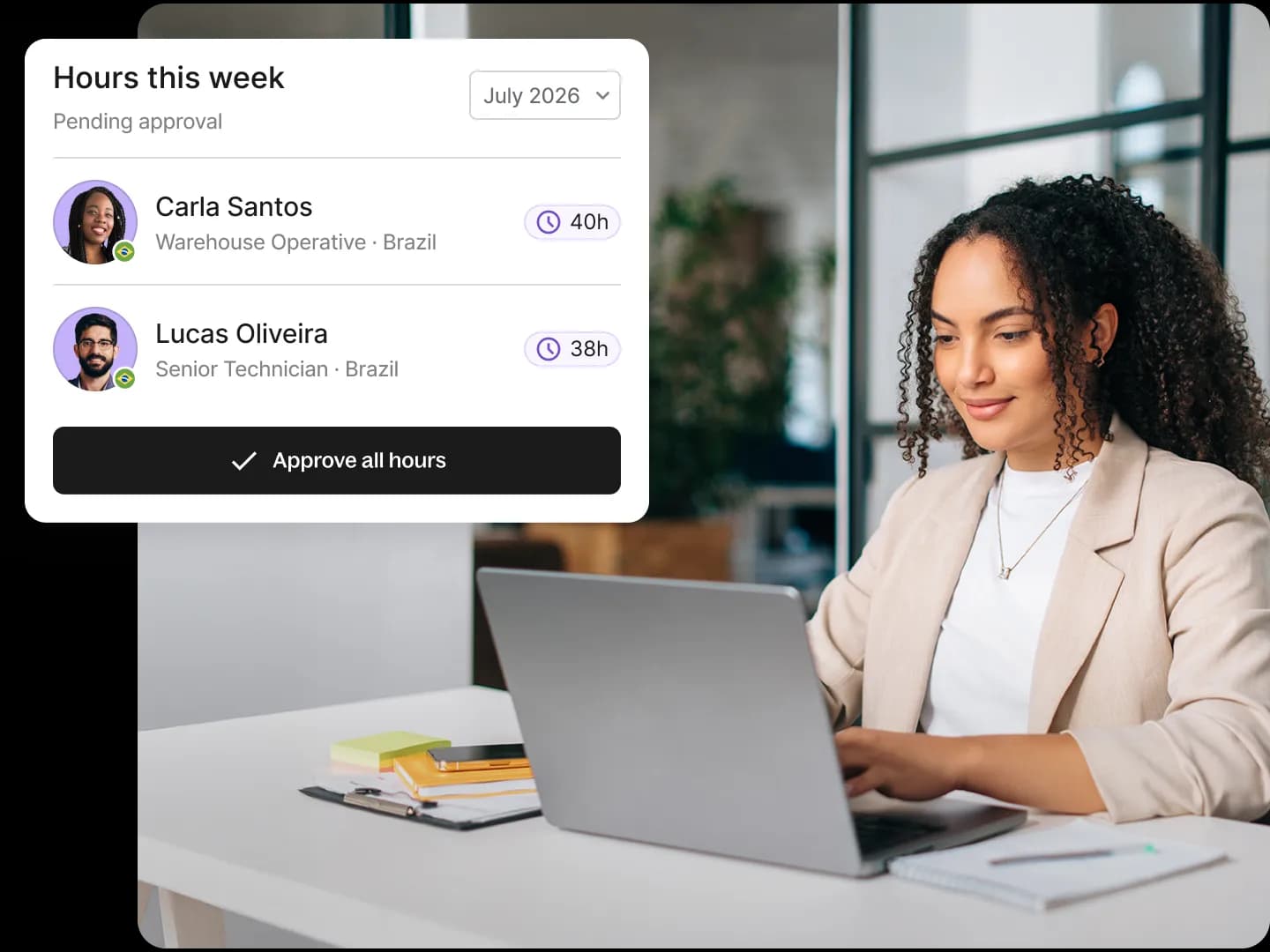
Deel's closed-loop payroll bridges this gap. Time tracked in Deel flows directly into payroll calculations. Overtime is calculated automatically based on the rules you've configured. Shift differentials, bonuses, and adjustments are applied. The result is payroll with full transparency and minimal manual re-entry.
For manufacturing operations managing workers across multiple states, this is significant. Each facility's time rules feed into one payroll system, so you get consistent payroll processing across every location without maintaining separate spreadsheets or reconciliation workflows for each site.

A manufacturing scenario: global automotive supplier
An automotive parts supplier with three facilities (Ohio, Mexico, Germany) employs 450 hourly workers on-site. Each plant works three shifts, with 50% seasonal variation between low and peak demand. Each country has different wage-and-hour rules and employment requirements.
Before Deel: Shift management happened via email and group chat. Time was tracked on punch clocks at each facility and manually entered into spreadsheets, which a central accountant reconciled against supervisor notes. Overtime was calculated in Excel—but with three countries' different rules, the calculations often conflicted.
During peak season, the company hired 40 temporary workers and tracked them in a separate payroll system, leading to reconciliation delays. Compliance with each country's labor law was spotty and reactive. The company had faced wage audits in Mexico and compliance issues in Germany.
After Deel: Shift scheduling is centralized across all three facilities in one dashboard, with each location's compliance rules configured independently. When demand ramps up, the scheduling team brings on 40 temporary workers and adds them to the same system under the same scheduling and compliance framework as permanent staff. Time flows directly into payroll, which calculates pay correctly for each country's regulations without manual adjustment.
During a wage audit, the company has a complete, auditable record of every hour worked, every rule configured, and how pay was calculated—in the right currency, under the right legal framework, for each location.
Result: Payroll processing time drops from five days to one. Overtime calculation is consistent and auditable across all locations. The company has a centralized audit trail that withstands wage audits in any country. Supervisors spend less time on manual scheduling and more time managing production.
Getting started with manufacturing time tracking
Implementing a new time tracking system in a manufacturing plant means minimizing disruption while building confidence in the new process. Deel works with manufacturing operations to:
- Map your shift patterns and compliance rules by location
- Set up geofencing at each facility
- Train supervisors and workers on mobile check-in (most facilities see adoption within 2–3 weeks)
- Run parallel payroll during the first month to verify accuracy
- Connect payroll to your existing accounting system so finance teams see what they expect
Ready to simplify time tracking for manufacturing? Learn more about Deel's time tracking solution or book a demo below.
Deel Hire
Find, hire, and manage anyone, anywhere

Jemima is a nomadic writer, journalist, and digital marketer with a decade of experience crafting compelling B2B content for a global audience. She is a strong advocate for equal opportunities and is dedicated to shaping the future of work. At Deel, she specializes in thought-leadership content covering global mobility, cross-border compliance, and workplace culture topics.