Article
6 min read
How to Build a Unified Hiring System: Combine AI ATS and Talent Marketplace
AI
Global hiring
Global HR

Author
Jemima Owen-Jones
Last Update
September 01, 2026

Table of Contents
What a unified hiring system actually looks like
Step one: Source candidates from a connected talent marketplace
Step two: Use AI matching that's criteria-based, not a black box
Step three: Automate interview scheduling and summaries without losing control
Step four: Move from hire to onboarding without leaving your hiring system
What to look for when evaluating a unified hiring platform
See how Deel brings ATS and talent marketplace together
Key takeaways
Disconnected hiring tools, including separate ATS, sourcing platforms, and job boards, create duplicated candidate data and slow time-to-fill for global HR teams.
A connected hiring system links pre-vetted talent pools with AI-assisted matching and automated scheduling, with each step flowing through a single candidate record.
Deel's ATS connects with a vetted talent marketplace, so HR leaders can manage sourcing and recruiting in one platform.
You're searching for a unified hiring system that actually unifies. Your ATS doesn't talk to your contractor marketplace. Your recruiters copy candidate names between systems. Your data lives nowhere and everywhere at once. Most HR teams didn't design this chaos—it accumulated.
An ATS from one vendor, sourcing credits scattered across three job boards, a scheduling tool that imports nothing, a separate contractor platform no one tracks end-to-end. For every global role you fill, someone re-enters information four times. The pipeline slows. Compliance gaps widen. Costs hide in tool subscriptions and lost recruiter hours.
89% of HR professionals whose organizations use AI for recruiting say it saves them time or increases efficiency. Companies using ATS cut hiring costs by $7k per role on average, and 75% of recruiters say ATS tools reduce time-to-hire by 30%+. When you connect sourcing, screening, scheduling, and offers into one system, those gains compound—your recruiters spend less time on admin work and more time making hiring decisions.
We've worked with 40k+ teams across 150+ countries building hiring systems from the ground up. What we've learned: the architecture matters.
If you're a scaling company or global HR leader juggling permanent hires and contractors, you already know this problem is real. This guide walks you through what a unified hiring system looks like in practice, how to build it step by step, and what to evaluate when selecting a platform. We'll show you how sourcing, matching, scheduling, and offers move from separate tools to one connected workflow—and why that shift changes everything.
The hidden cost of tool-switching in talent acquisition
Recruiter time is finite, and tool-switching is one of the least visible ways it gets consumed. Moving between a sourcing platform, an ATS, a scheduling link, and an email thread to manage a single candidate means each touchpoint carries overhead that accumulates to hours per week per recruiter.
The downstream effect on candidate experience is equally significant. When context doesn't follow a candidate across systems, delays are inevitable: slower responses, repeated requests for information candidates already provided, and handoff gaps that the candidate experiences as silence. LinkedIn's talent acquisition research consistently points to candidate experience as a driver of offer acceptance rates, which means operational fragmentation connects directly to hiring outcomes.
A buyer's guide to applicant tracking systems covers the ATS selection decision in detail, but the underlying principle holds: system architecture shapes the recruiter experience, which in turn shapes the candidate experience.
With 20 years in staffing, our team has used just about every system out there. Deel Talent stands out because it strips away the unnecessary steps and clutter. It’s simple, intuitive, and focused on results – no extra weight, no confusing navigation.
—Wendy Liu,
Co-founder, Ottomate
Deel HR
Hire and recruit faster, with less effort
What a unified hiring system actually looks like
A connected hiring system is not an ATS with a job board integration bolted on. A bolt-on integration creates a one-way data export from a sourcing tool into a tracking system, with no shared record and no synchronized status. A genuinely connected system means candidate information that begins at sourcing and carries through to offer and onboarding workflows, reducing duplicate entry and disconnected handoffs along the way.
A connected workflow typically includes:
A candidate surfaced from a marketplace flowing into the ATS pipeline, with their profile, skills, and availability information
Stage updates (screened, scheduled, interviewed, advanced, declined) visible to authorized hiring-team members in the shared candidate record
Interview summaries, feedback, and offer terms attached to the same record that started in sourcing
Connected onboarding workflows that carry candidate information forward after an accepted offer, reducing manual re-entry
The ATS vs. CRM comparison is a useful starting point for understanding how these architectures differ and why consolidation requires more than feature-stacking.
Architecture vs. integration
A native connection between your ATS and talent marketplace means candidates sourced in the marketplace arrive as tracked pipeline entries — not email attachments or CSV files. The difference is whether candidate data is structured and shared from the start, or manually re-entered at the handoff.
Step one: Source candidates from a connected talent marketplace
Cold-sourcing from job boards means starting from zero every time a role opens: writing new listings, paying for placements, and then triaging inbound applications of variable quality. A connected talent marketplace takes a different approach by surfacing AI-vetted candidate suggestions for supported roles and markets, with profile and availability information where provided.
Within Deel, when the ATS and Talent (Deel's AI Vetted Marketplace) are both enabled, marketplace candidates can sync into a dedicated ATS pipeline, so sourcers and recruiters are working from the same record from day one. This means the hiring team can compare sourced and applied candidates in a connected workflow rather than managing parallel processes in separate tools.
Explore Deel's talent marketplace to see how the sourcing-to-ATS workflow operates for supported roles and markets.
Working with Deel Talent was essential for our company, especially as we were hiring in a country where we didn’t have a strong understanding of the local workforce market... Having the ability to manage all potential candidates in one centralized platform was also a huge help and saved us a significant amount of time throughout the process.
— Amit Oz,
KingsRoad
Talent
Find top talent, hire globally

Step two: Use AI matching that's criteria-based, not a black box
The concern with AI-assisted matching is legitimate: if the system's scoring logic is opaque, recruiters cannot trust the output and cannot explain to candidates or regulators why certain profiles advanced. Rather than avoiding AI matching entirely, teams should require systems where criteria are visible, adjustable, and clearly separate from the advancement decision.
In Deel's ATS, AI suggests competency-based selection criteria derived from the job description, including technical skills, language requirements, and years of experience. These suggested criteria are visible to the hiring team and can be adjusted before matching runs. The system generates criteria-based matching scores against those criteria, excluding personal identifiers from scoring. The hiring team decides who advances. The system does not auto-screen candidates out.
This design matters for compliance as well as trust. The EU AI Act (Regulation 2024/1689) classifies certain AI systems used in recruitment—including candidate ranking, scoring, and filtering—as high-risk AI under Annex III, subject to specific conditions and scope definitions. Deel treats ATS candidate scoring accordingly, documenting transparency and human-oversight requirements as part of its AI compliance approach.
More detail on AI-powered ATS in practice: Deel's AI-powered ATS guide.
EU AI Act and recruitment AI
The EU AI Act classifies candidate ranking, scoring, and filtering tools as high-risk AI under Annex III. This means platforms used in hiring within the EU are expected to document transparency requirements, maintain human oversight, and support explainability of AI-generated outputs. Deel treats ATS candidate scoring as high-risk under this framework.
Step three: Automate interview scheduling and summaries without losing control
Interview scheduling is one of the highest-friction, lowest-value activities in recruiting. Coordinating availability across a candidate, a hiring manager, and one or more interviewers through email threads is a time sink and a source of delay that candidates experience as disorganization.
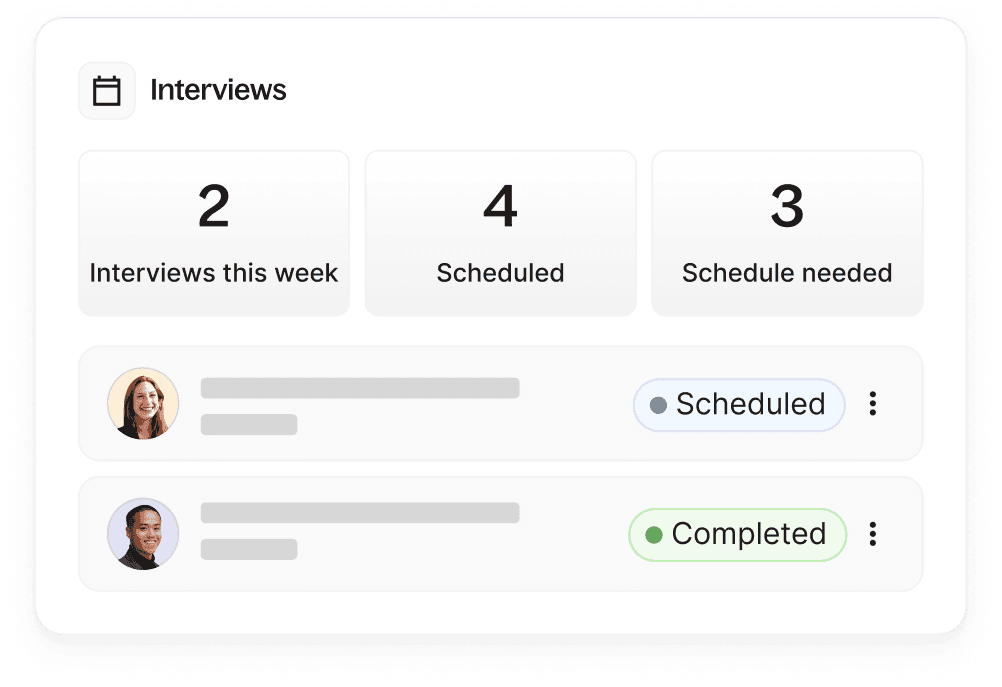
Recruiters can use interview scheduling within the ATS, including scheduling links based on connected interviewer availability. Candidates select a slot and calendars update automatically, with no separate scheduling tool required.
With ATS Pro, Deel's AI Interview Assistant can create a searchable transcript and a transcript-derived summary, including key discussion points, candidate responses to role-specific questions, strengths, gaps, and practical details like notice period and availability. These transcript-derived materials support interviewer review and do not make the hiring decision.
Customers are responsible for obtaining any consent required to record interviews under applicable local laws.
Step four: Move from hire to onboarding without leaving your hiring system
The handoff from hiring tool to HR system is where connected architectures most commonly break down. Once a candidate accepts an offer, HR teams often re-enter that record by hand into a separate onboarding platform. That re-entry is where errors accumulate, compliance documentation gets separated from the hire record, and the candidate's first experience of the company becomes a form-filling exercise.
In Deel, the ATS module can connect to Deel HR's HRIS and onboarding workflows: relevant candidate data can populate connected Deel HR records after an accepted offer, reducing duplicate entry and helping maintain continuity across the handoff. For organizations using external HR systems, Deel supports integrations with selected platforms, so confirm current availability and data flows for your specific system.
For compliance-conscious enterprise buyers, Deel holds ISO 27001 certification and a SOC 2 Type II attestation report at the platform level, and a Data Processing Agreement (DPA) is available to all customers. The ATS compliance rules for global recruitment guide covers what these certifications mean in practice for global hiring teams.
It’s like flipping a switch. As soon as a job is live, we’re live. No delays, no disconnects. Everything from contract signing to candidate review happens in one place, letting us deliver results immediately.
—Nuno Covas,
Co-Founder, Pro5
Deel's HRIS
Manage your global workforce compliantly

What to look for when evaluating a unified hiring platform
Not all platforms that describe themselves as unified deliver on the architecture. When evaluating a platform, apply these six criteria:
| Criterion | What to look for |
|---|---|
| Single candidate record | Sourced and applied candidates share profile information from first touch through offer |
| Marketplace connectivity | Talent marketplace flows into ATS natively, not via a third-party integration or export |
| AI transparency and oversight | Suggested criteria are visible and adjustable, personal identifiers are excluded from matching, and hiring teams make the final decision |
| Security and privacy documentation | Review relevant certifications and their scope, plus access to a DPA for GDPR-regulated data |
| HR system integration depth | Native onboarding connection or verified integrations with your existing HR platform |
| Documented AI controls | Transparency and human-oversight measures for recruitment AI, including how the platform treats candidate scoring under applicable frameworks |
The EU AI Act's high-risk classification for recruitment AI means algorithmic transparency is no longer optional for teams hiring within the EU. Platforms that can demonstrate documented human-oversight requirements and explainability help buyers evaluate whether a system supports their transparency, oversight, and documentation requirements.
See how Deel brings ATS and talent marketplace together
Within Deel, you can connect our ATS with our AI Vetted Marketplace, Talent. When both are enabled, you've got a connected workflow for eligible roles and markets, with platform-level security certifications and documented AI transparency measures available for buyer review.
AI-assisted matching runs against employer-defined criteria with human decision-making retained. Interview scheduling can happen in the ATS workflow, and ATS Pro adds transcript-derived summaries through the AI Interview Assistant. Connected workflows can carry relevant candidate information into Deel HR's HRIS foundation and onboarding, reducing manual re-entry.
Book a demo below to get a walkthrough of what the connected hiring workflow looks like for your team's specific hiring markets and role types.
Deel Hire
Find, hire, and manage anyone, anywhere

FAQs
Does a connected hiring system replace my existing HRIS?
No. Your hiring platform and HRIS work together, not against each other. Our connected hiring system integrates directly with your existing HRIS—no rip-and-replace required. You keep your current setup and gain a unified recruiting workflow that feeds clean candidate data back into your system.
If you decide to move to Deel's HRIS later, we make that transition smooth. But there's no pressure. Many teams run our hiring system alongside their existing HRIS for years. The choice is yours, on your timeline.
Is AI matching GDPR-compliant?
Compliance depends on how the system is configured and on applicable law in your markets. Deel's ATS matching uses visible, adjustable criteria, excludes personal identifiers, and leaves advancement decisions to hiring teams.
Customers should obtain legal advice for their specific use case, and distinguish GDPR requirements from the EU AI Act obligations that apply to high-risk recruitment AI.
Can the talent marketplace surface candidates in specific countries?
Yes — but the level of country-specific control depends on which sourcing path you use. Deel's Talent offers two paths: Talent Partner sourcing, which spans all markets Deel operates in, and the AI Vetted Marketplace, which surfaces best-fit candidates instantly from a pool of 1.5M+ profiles but is currently limited to select roles in the US, UK, and India.
With Talent Partners, partners list their top locations/specialties, and clients are matched based on job requirements — so geography is handled via partner matching rather than a direct search filter.
The AI Vetted Marketplace surfaces candidates from its available countries (US/UK/India) automatically based on the job requisition, but there's no documented direct "filter by country" control across the wider marketplace beyond that footprint.
What happens to candidates who weren't hired?
In a well-structured ATS, declined candidates remain in the system with their stage and feedback attached, creating a talent pipeline for future roles and preventing the data loss common to disconnected sourcing tools.
Does using AI in hiring require candidate disclosure?
Disclosure requirements vary by jurisdiction and are evolving rapidly, particularly within the EU. The EU AI Act's high-risk classification for recruitment AI includes transparency obligations toward candidates and competent authorities. Consult your legal team or data protection officer for specific requirements in your hiring markets.
Jemima is a nomadic writer, journalist, and digital marketer with a decade of experience crafting compelling B2B content for a global audience. She is a strong advocate for equal opportunities and is dedicated to shaping the future of work. At Deel, she specializes in thought-leadership content covering global mobility, cross-border compliance, and workplace culture topics.