Article
8 min read
What Good HRIS Implementation Actually Looks Like: A Week-by-Week Timeline
Global HR

Author
Ellen Simmonds
Last Update
June 04, 2026

Going live on a new HRIS is one of those rare moments in HR where you get to feel the impact immediately. A new hire lands in the system. Their manager can see the team. Compliance documents route automatically instead of sitting in someone's inbox. For a function that usually operates in the background, it's a satisfying moment to point at something and say: that's working now.
The temptation is to declare victory and move on. The teams that get the most out of implementation don't. Not because something went wrong, but because the 90 days after go-live are where the real value compounds. The first automated workflow runs. The first headcount report pulls in seconds. The first review cycle goes out without a single chaser email. None of that happens by accident. It happens because someone mapped it out before day one.
This is what that looks like with Deel HR: week by week, from the data migration that most teams dread to the moment 90 days in when the question stops being "is this working?" and starts being "what do we set up next?"
Deel HR
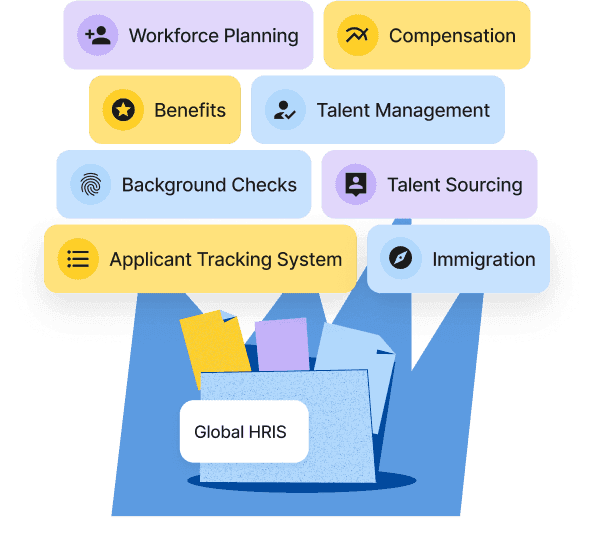
One place for simplified, smarter global HR
Before you start: the week before kick-off
The single biggest predictor of a smooth implementation is what you do before the clock starts. Not technically, because the platform handles the heavy lifting, but organizationally. Who owns this internally? Where does your current data live, and is it clean? Which integrations need to be in place before employees log in for the first time?
The job at this stage is to export your existing employee records, consolidate them into one place, and do a pass for consistency: names, roles, locations, contract types. Messy data going in means manual fixes after go-live, and that's the one outcome worth spending time to avoid. Deel's onboarding team works with you through this stage, helping validate core records before anything moves.
This is also when you meet your dedicated onboarding manager. Not a help center article. A named person who knows your configuration and flags anything that needs attention before it becomes a problem at go-live. That relationship is the structural difference between a Deel implementation and a self-serve tool where migration support is a PDF.
Free guide
Build your HR foundation the right way from day one
Weeks 1–2: Data migration and configuration
With clean data in hand, the migration itself moves quickly. Employee profiles are uploaded, reviewed, and localized to each worker's country of residence. Managers and direct reports are set. Time-off policies are configured. The org chart takes shape.
For most teams, this is the part they've been dreading. It turns out to be the least dramatic phase of the whole process. The migration is the enabling step, not the obstacle. The results on the other side the results on the other side compound fast.
Paperform consolidated payroll, compliance, and onboarding from multiple disconnected systems into a single Deel implementation, recovering nearly a third of a year's worth of HR work in the process.
The cost savings that Deel has enabled would easily go into the tens of thousands of dollars, perhaps even close to $100,000 per year.
—Diony McPherson,
CoFounder and COO, Paperform
Learn how Paperform used Deel to save 104 days of HR work per year.
At BSI Steel, the migration itself set the tone. Rather than discovering issues at go-live, the onboarding manager stayed across every checkpoint throughout the process.
Quick, easy, and well planned. We went live without a single glitch, which I think is phenomenal.
—Chantal Lombaard,
HR Executive, BSI Steel
See how BSI Steel went live on Deel without a single glitch.
Weeks 3–4: Integrations, workflows, and stakeholder prep
With the data foundation in place, this phase is about connecting Deel to the rest of the stack and making sure the people who'll use it every day are ready before it goes live.
On the technical side: integrations with accounting tools, Slack, and any point solutions the team wants to retain. Automated workflows, including onboarding checklists, approval routing, and compliance triggers, get configured here so they're running from the moment the first new hire lands in the system.
For teams rolling out Engage alongside the HRIS, performance cycle configuration typically takes three to four weeks with consultative support available. This is the phase where review templates, competency frameworks, and goal structures get built out, so the talent layer is ready to activate as soon as the foundation is stable.
On the people side: internal comms. What do managers need to know before go-live? What will employees see when they log in for the first time? Who handles questions in the first week? The teams that handle this phase well arrive at go-live with stakeholders who feel informed, not surprised.
For teams that get the stakeholder prep right, the efficiency gains start before go-live. Palm NFT Studio, a fully remote team across seven countries, found that Deel's onboarding process was efficient enough that they never had to add headcount to manage it.
In the onboarding alone, I'd have to hire another person to handle that if it wasn't for Deel.
—Anita Smith,
Head of People, Palm NFT Studio
See how Palm NFT Studio manages a seven-country workforce with Deel.
Go-live: what day one actually looks like
Employees receive an invitation to join the platform and complete a short self-service checklist: banking details, document uploads, benefits enrollment where applicable. Managers log in to a clean view of their teams. HR has a single source of truth for the first time, covering every worker type and every country in one place.
For the HR team, the shift is immediate. Feedier halved its HR admin workload after centralizing 100% of its employee data on Deel. The biggest change was the biggest change being visibility and autonomy for team leaders who previously had to route everything through a single person.
Handling HR tasks in spreadsheets was exhausting. Every update and approval had to go through me. Deel removed that bottleneck, giving team leaders the tools to manage their teams smoothly.
—Wassim Bejjani,
Operations Specialist, Feedier
Discover how Feedier cuts its HR admin workload in half with Deel.
Days 30–90: settling in and expanding
This is where implementation stops being a project and starts being a capability.
By day 30, the first automated workflows have run. Time-off requests are coming through the platform instead of email. New hires are completing their onboarding checklists without HR chasing. The first headcount or payroll report has pulled in minutes rather than the hours it used to take.
Otamiser moved from manually computing holidays and tracking PTO across regions to a fully automated system. The shift freed the team from coordination work and made Deel the operational hub for everything people-related.
I'm in Deel several times a week: payments, time-off approvals, you name it. It's basically my HR command center.
—Bart-Jan Leyts,
CEO, Otamiser
[See how Otamiser automated people operations across multiple regions with Deel.] (https://www.deel.com/case-studies/otamiser/)
By day 90, the question most teams are asking isn't whether the implementation worked. It's what to set up next. Adding Engage for performance and development. Connecting compensation management so review outcomes feed directly into pay decisions. Bringing IT device management onto the same platform so onboarding and offboarding are fully automated end to end. The HRIS foundation makes all of it faster to activate because the data, the workflows, and the people are already in one place.
Deel HR
Build high-performing teams with half the work
The timeline at a glance
| Phase | What happens |
|---|---|
| Pre kick-off | Data export and clean-up, onboarding manager assigned, records validated |
| Weeks 1–2 | Data migration, profile configuration, org structure, time-off policies |
| Weeks 3–4 | Integrations, workflow automation, Engage configuration (if applicable), internal comms |
| Go-live | Employee invitations, self-service onboarding, single source of truth active |
| Days 30–90 | First automated cycles run, reporting live, expansion to additional modules |
Most teams are fully live in 30 to 60 days. Complex configurations with multiple countries, multiple modules, or significant integration work sit at the higher end. Either way, it's a different order of magnitude from the six-to-twelve month timelines that give enterprise HRIS implementations their reputation.
What makes the difference
The implementation horror story is almost always a vendor problem, not a platform problem. Tools that deprioritize onboarding, rely on self-serve documentation, or hand off to a support queue at the first sign of complexity create the outcomes that make HR teams hesitant to switch.
Deel's implementation model is built around the opposite assumption: that a dedicated onboarding manager, proactive checkpoints, and hands-on migration support are the product, not an upsell. The go-live without a glitch that BSI Steel described isn't a lucky outcome. It's the design.
When you're ready to see what that looks like for your team, book a demo with a Deel implementation specialist and walk through the timeline for your specific configuration.
Live Demo
Get a live walkthrough of the Deel platform
Ellen Simmonds is a content marketing manager with a decade of experience in tech, leadership, startups, and the creative industries. A long-time remote worker, she's passionate about WFH productivity hacks and fostering company culture across globally distributed teams. She also writes and speaks on the ethical implementation of AI, advocating for transparency, fairness, and human oversight in emerging technologies to ensure innovation benefits both businesses and society.