Article
9 min read
What Your Hiring Stack May Be Missing — And How to Close the Gaps
Global HR
AI
Global hiring

Author
Jemima Owen-Jones
Last Update
October 28, 2026

Table of Contents
What is a hiring tech stack gap?
The analytics and reporting gap
The user experience and navigation gap
The hiring manager training gap
How hiring stack gaps affect speed, quality, and candidate experience
What good hiring analytics actually look like
How Deel's ATS and Talent sourcing address these gaps
Closing the hiring manager training gap
A hiring stack checklist: questions to ask before you commit
Build a stronger hiring stack with Deel's ATS and Talent
Key takeaways
Most hiring stacks have gaps in analytics, user experience, and hiring manager training that slow decisions and cost top candidates.
The analytics gap is the most common: standard ATS dashboards track recruiter activity rather than the decision-quality metrics TA leadership needs.
Deel's ATS and Talent sourcing close common hiring tech stack gaps as connected modules within Deel HR, not configurations added later.
Most recruiting teams have an ATS. Fewer have one that surfaces the data TA leadership actually needs for a quarterly review: which sourcing channels produce the best hires, where strong candidates drop from the pipeline, and why offers get declined. That disconnect isn't a tool problem. It's a configuration and capability gap that most teams are working around rather than closing.
The gaps that slow hiring most often aren't about missing software. Analytics reporting that answers activity questions instead of strategic ones, interfaces that hiring managers find too complex to engage with consistently, and interview processes that rely on underprepared interviewers are the structural problems most mid-market teams have learned to tolerate. They show up as time-to-fill complaints, quality-of-hire debates, and offer declines that get attributed to market conditions rather than process breakdowns.
This guide defines the three most common gaps in the hiring stack (analytics, user experience (UX), and hiring manager training), explains how they affect hiring speed, quality, and candidate experience, and covers what closing them looks like with the right platform and processes in place.
What is a hiring tech stack gap?
A hiring tech stack gap is any point where the tools, workflows, or skills in a recruiting process fail to give the team what it needs for a key hiring decision.
The gap doesn't have to mean a tool is absent. More often, the tool exists but is misconfigured, siloed, or built for a different type of user. A modern ATS designed for high-volume enterprise hiring may technically be capable of generating a source-quality report, but if producing it requires a data analyst and a custom query, most TA teams will stop asking.
Three gaps appear consistently across organizations at scale:
The analytics gap: the data exists somewhere in the ATS, but the team can't access it in a form that drives decisions.
The UX gap: the platform is technically capable, but the interface is complex enough that hiring managers avoid it, degrading data quality throughout the pipeline.
The training gap: the pipeline is healthy and the tools are working, but strong candidates drop out or get misjudged because interviewers aren't equipped to evaluate them consistently.
Identifying which gaps exist is the first step to closing them.
The analytics and reporting gap
Most ATS platforms collect a lot of data: time stamps, stage transitions, source tags, rejection codes. The problem is that most TA leaders can't access it in a form that answers leadership-level questions.
Gartner research from February 2026 found that only 31% of recruiting functions use labor market data to shape their talent strategies. That's not a lack of curiosity. It reflects how difficult most ATS platforms make it to connect activity data to strategic insight.
The questions that matter to TA leadership include:
Which sourcing channels produce the highest-quality candidates, not just the most applicants?
At which stage is the funnel losing candidates at a higher-than-expected rate?
What are the most common reasons for offer declines, and do those reasons cluster around specific roles or teams?
How does time-to-hire break down by hiring manager, team, and geography?
These aren't exotic analytics questions. They're the basics of running a functional recruiting operation. But most standard ATS dashboards track recruiter activity metrics (requisitions open, resumes reviewed, interviews scheduled) rather than decision-quality metrics. When TA leaders need answers, they export to spreadsheets, run their own queries, or simply report what the dashboard shows rather than what leadership actually asked.
An analytics overhaul that surfaces people analytics as a native platform capability closes this gap. Getting the right questions answered inside the recruiting system matters more than collecting more data.
The four analytics questions your ATS should answer without an export
-
Time-to-hire: Days from approved headcount to accepted offer, filterable by role, team, and geography.
-
Source quality: Which channels produce hires, not just applicants.
-
Funnel drop-off: Where candidates leave the pipeline at higher-than-expected rates.
-
Offer decline reasons: What candidates cite, and whether patterns cluster around specific teams, compensation ranges, or interviewers.
Deel HR
Hire and recruit faster, with less effort
The user experience and navigation gap
ATS platforms built for large enterprise HR teams often weren't designed with hiring managers in mind. They were built for recruiters who live in the system full-time. As those platforms scaled, they added features (approval workflows, compliance fields, granular permissions), and the interface became heavier with each addition.
Low hiring manager engagement with an ATS often results from interface friction rather than a lack of interest. Hiring managers who interact with the platform a few times per quarter frequently fall back to email threads, Slack messages, and ad hoc feedback forms. When they do log in, they record feedback late, skip required fields, or submit ratings without reviewing the candidate's full profile.
A well-designed ATS should be intuitive enough that a hiring manager who opens it twice a month can complete a structured feedback form without a training session. When routine tasks require too many steps to complete, data completeness drops, and incomplete data produces the same result as no data when diagnosing why a pipeline slowed.
The candidate-side effect is equally real. Slow feedback turnaround, missed scheduling windows, and gaps in communication all trace back to hiring manager disengagement from the platform. In competitive roles, a two-day delay in advancing a strong profile is often enough to lose the candidate.
The hiring manager training gap
A healthy pipeline plus poorly structured interviews still produces lost candidates. This gap is industry-wide and tool-agnostic. It shows up regardless of which ATS a team uses or how many sourcing tools are active.
SHRM research consistently finds that many organizations lack formal systems for interviewer training and structured feedback sharing. Hiring managers who haven't interviewed recently may not know which questions to ask, how to calibrate assessments against role requirements, or how to share feedback in a way that moves decisions forward.
The practical consequences are predictable:
Inconsistent evaluation: Interviewers without a shared rubric often reach conflicting conclusions, which delays decisions and increases the risk of bias.
Unstructured questions: Off-script conversations produce feedback that can't be compared across candidates, making final decisions harder to justify.
Late-stage offer declines: Candidates who experience disorganized interviews or long feedback delays often decline offers even when the role itself is strong. The interview process signals what working at the company will look like.
Addressing this gap doesn't require a new platform. It requires structured scorecards, defined competencies for each role, and a consistent expectation that hiring managers complete feedback before a debrief call.
Talent
Find top talent, hire globally

How hiring stack gaps affect speed, quality, and candidate experience
Each gap on its own creates friction. Together, they compound.
A recruiting team without reliable analytics makes sourcing decisions based on channel familiarity rather than data, directs budget toward sources that feel productive rather than demonstrably effective ones, and has no mechanism for identifying where strong candidates are dropping. A team with low hiring manager engagement can't move pipelines at the pace competitive candidates expect, can't hold consistent evaluation standards, and collects feedback that contradicts itself.
SHRM's 2024 Talent Trends research identified time-to-fill and quality-of-hire as the two outcomes recruiting leaders most want to improve. These are also the two outcomes most directly shaped by analytics and hiring manager skill gaps. Teams that can't identify bottlenecks can't improve time-to-fill, and teams without structured evaluation frameworks can't meaningfully track quality-of-hire over time.
The candidate experience effect is often underestimated. When a pipeline slows because hiring managers aren't completing feedback on time, or because a stage-level bottleneck isn't visible in the ATS, every candidate in the queue feels that delay. In a market where candidates evaluate the recruiting process itself when choosing between competing offers, a disorganized or slow interview experience is a real competitive disadvantage.
What hiring stack gaps actually cost
Three gaps, three business outcomes:
Time-to-fill: Without funnel visibility, bottlenecks go undiagnosed and unaddressed.
Quality-of-hire: Without structured evaluation, hiring managers can't compare candidates consistently.
Candidate experience: Without fast feedback loops, strong candidates accept competing offers.
What good hiring analytics actually look like
A TA team with strong analytics capability should be able to answer these questions without a data export or a vendor support ticket:
Time-to-hire: How long does it take from approved headcount to accepted offer, and how does that vary by team, role type, or geography?
Source quality: Which channels produce candidates who advance to offer, not just candidates who apply?
Funnel drop-off: At which stage does the pipeline lose candidates at a higher-than-expected rate, and has that rate changed in the last quarter?
Offer decline reasons: What reasons are candidates giving, and do patterns cluster around specific teams, compensation ranges, or interviewers?
LinkedIn's Future of Recruiting 2024 report found that quality-of-hire had become the top recruiting priority for TA leaders, yet only 25% of TA professionals felt highly confident in their organization's ability to measure it. Organizations can't improve what they can't measure, and confidence in quality-of-hire tracking starts with having the right metrics in the right place.
Deel's ATS surfaces AI-powered analytics covering time-to-hire, offer acceptance rates, candidate-to-offer ratios, funnel drop-off by stage, and source quality. TA leaders can filter results by role, team, or geography and review pipeline health before a leadership call rather than building it from raw exports afterward.
How Deel's ATS and Talent sourcing address these gaps
The analytics, UX, and training gaps share a root cause: hiring tools built primarily for recruiters that get stretched to cover the full hiring workflow for recruiters, hiring managers, TA leadership, and HR operations. Deel's ATS is a module connects recruiting to downstream HR workflows in one connected platform.
For the analytics gap, Deel's ATS tracks time-to-hire, candidate-to-offer ratios, offer acceptance rates, funnel drop-off, and source quality, all filterable by role, team, or geography. The buyer's guide to applicant tracking systems covers what to look for when evaluating reporting depth.
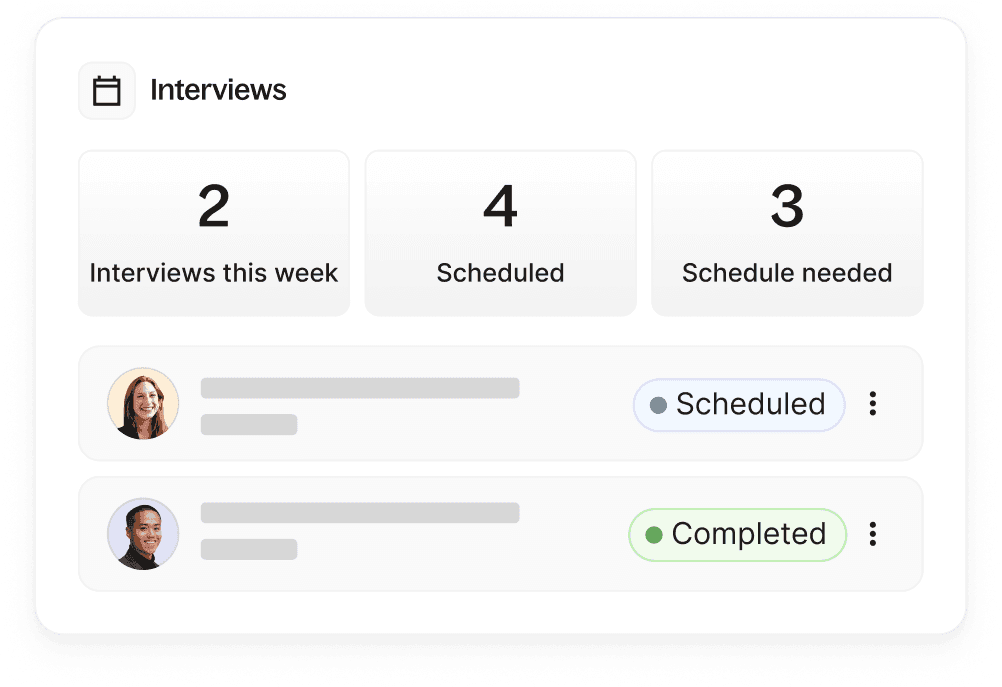
For the UX gap, Deel's ATS provides a recruiting dashboard for managing open roles, candidates, and interview workflows. Structured interview scorecards help hiring managers evaluate candidates against consistent criteria. Scheduling integrates natively with Google Workspace and Microsoft 365, reducing the back-and-forth that typically delays interview confirmation. The AI Interview Assistant records, transcribes, and summarizes interviews directly from the candidate profile, giving interviewers a structured reference when completing their scorecard.
For sourcing, Deel's Talent pulls candidates from internal talent pools and 1,000+ job boards. AI-assisted screening scores candidates against role-specific criteria, so recruiters work from a ranked shortlist rather than a raw applicant count.
When recruiting and HR workflows operate within the same platform, candidate information moves into downstream processes more reliably, which reduces the manual handoffs and duplicate data entry that typically happen at the offer stage.
What Deel's ATS tracks out of the box
Time-to-hire
Offer acceptance rates
Candidate-to-offer ratios
Funnel drop-off by stage
Source quality
All filterable by role, team, or geography. No data exports required.
Closing the hiring manager training gap
ATS functionality alone doesn't solve a training gap. That's a separate investment, and it's worth making deliberately.
The most effective approaches to hiring manager enablement share a few characteristics:
Structured scorecards for every role
Define four to six competencies before the first interview and build a standardized scoring rubric for each. Hiring managers who rate against criteria rather than impressions produce feedback that can be compared, calibrated, and discussed without controversy.
A pre-interview briefing process
Reviewing the candidate's screening notes and role criteria before a first-round interview reduces redundant questioning and missed evaluation areas. Routing pre-brief materials to the interviewer in advance makes this step frictionless rather than optional.
Debrief structure, not just debrief scheduling
A debrief that starts with "what did everyone think?" produces inconsistent feedback. A debrief that starts with individual ratings against defined competencies, then discusses outliers, produces calibrated input that holds up under scrutiny.
Clear feedback timing expectations
Most hiring managers complete interview feedback fastest when the expectation is explicit: submit scores within 24 hours of the interview, before the debrief call. Setting this expectation clearly and following up on late submissions closes most of the late-feedback problem without requiring constant TA attention.
A hiring stack checklist: questions to ask before you commit
Talent acquisition teams auditing an existing ATS or evaluating a new one can use these questions to identify gaps in analytics, user experience, and hiring manager enablement.
Analytics:
Can you see time-to-hire filtered by role, team, and geography without an export?
Does the platform show source quality, meaning which channels produce hires rather than just applicants?
Can you identify funnel drop-off by stage for the current quarter?
Are offer decline reasons captured and reportable?
User experience:
Can a hiring manager complete a structured feedback form in under ten minutes, without training?
Does the platform provide structured interview scorecards with role-relevant evaluation criteria?
Is interview scheduling integrated natively with Google or Microsoft calendar tools?
Hiring manager enablement:
Are structured scorecards defined for each role before interviews begin?
Does the platform support a debrief process based on defined criteria rather than open-ended impressions?
Does the system make it easy for hiring managers to complete and submit feedback promptly?
Integration and scalability:
Does candidate data connect to onboarding and a human resources information system (HRIS) at the point of offer acceptance, without manual re-entry?
Does the platform support hiring across multiple countries or worker types without separate tooling?
A platform that checks fewer than half of these boxes has visible gaps. Most teams find two or three areas where their current ATS falls short, and those gaps typically explain the time-to-fill and quality-of-hire problems that TA leadership gets asked about most.
Deloitte's HR technology evaluation framework recommends starting any tech audit with outcomes rather than features: identify the decisions a stack needs to support, then assess whether current tools actually support them.
Build a stronger hiring stack with Deel's ATS and Talent
Hiring stack gaps rarely announce themselves as tool failures. They show up as time-to-fill problems, quality-of-hire debates, and offer declines that get attributed to "the market" rather than examined as process issues.
The analytics, user experience (UX), and hiring manager training gaps are structural, not situational. Closing them requires both platform capabilities and deliberate process design. Deel ATS and Deel Talent are connected modules within Deel HR that address the analytics and sourcing side of these gaps: built-in reporting, AI-assisted screening, structured interview scorecards, and recruiting workflows that connect to downstream HR processes.
Book a demo below to see how Deel's ATS addresses the specific gaps in your hiring process.
Live Demo
Get a live walkthrough of the Deel platform
FAQs
What is a hiring tech stack gap?
A hiring tech stack gap is any point in a recruiting process where the tools, workflows, or team skills fail to provide the information or capability needed for a key hiring decision, even when the tool itself technically exists.
Which ATS analytics reports matter most for leadership?
Time-to-hire by role and geography, source quality (which channels produce hires, not just applicants), funnel drop-off by stage, and offer decline reasons by team are the four reports that address the most common leadership questions about pipeline performance.
How can teams tell if ATS UX is slowing them down?
Review interview feedback completion rates and average time-to-feedback. If hiring managers are regularly submitting feedback late or skipping required fields, interface friction is the most likely cause rather than disengagement with the process.
How do hiring manager skills affect candidate quality and offer acceptance?
Hiring managers who interview without structured scorecards or shared evaluation criteria produce inconsistent feedback, which delays decisions and increases the risk of losing strong candidates to competitors who move faster. Candidates read the interview process as a signal about the company, and a disorganized experience increases offer declines even when the role and compensation are competitive.
Does Deel ATS integrate with existing sourcing tools?
Deel ATS integrates natively with Google Workspace and Microsoft 365. Through Deel Talent, the sourcing module within Deel HR, teams can source candidates from internal talent pools and 1,000+ job boards.
What does Deel Talent offer beyond a standard ATS?
Deel Talent extends candidate sourcing beyond inbound applications to include internal talent pools and 1,000+ job boards, with AI-assisted screening that scores candidates against role-specific criteria. Combined with Deel ATS's analytics and structured interview capabilities, the two modules support sourcing, screening, and hiring workflows within the same platform.
This article is provided for general informational purposes and should not be treated as HR or legal advice. Consult a qualified professional for guidance specific to your organization's situation.
Jemima is a nomadic writer, journalist, and digital marketer with a decade of experience crafting compelling B2B content for a global audience. She is a strong advocate for equal opportunities and is dedicated to shaping the future of work. At Deel, she specializes in thought-leadership content covering global mobility, cross-border compliance, and workplace culture topics.