Article
5 min read
The Best Global Employee Benefits Platforms in 2026
Global HR
Employee Benefits

Author
Shannon Ongaro
Last Update
October 19, 2026

Key takeaways
Managing employee benefits across multiple countries exposes HR teams to layered compliance risk, including statutory mandates, local enrollment timelines, and currency-denominated deductions.
Selecting the right global benefits platform requires evaluating five dimensions: geographic coverage, payroll integration, compliance infrastructure, employee experience, and vendor support model.
Deel Benefits combines localized benefit packages with the payroll and HR infrastructure your team already uses, eliminating the reconciliation overhead that standalone benefits platforms create.
The global employee benefits software market has matured considerably since 2023. You now have options ranging from local platforms with bolted-on international coverage to purpose-built global workforce platforms where benefits infrastructure is natively connected to payroll. The gap between these two categories is significant, and the wrong choice carries real operational and compliance cost.
This guide evaluates the leading global employee benefits platforms across five core dimensions. It covers Deel, Remote, Oyster HR, and TriNet, with specific assessments of where each one excels and where it falls short.
Disclaimer: Competitor information is based on publicly available sources at the time of writing. Product capabilities, pricing, and coverage may change. Deel makes no representations about the accuracy of third-party product information and recommends verifying details directly with each vendor before making a purchasing decision.
What to look for in a global employee benefits platform
Before comparing vendors, establish your evaluation framework. Platform selection decisions that start with feature demos rather than criteria tend to optimize for the wrong things. The five factors below give you a consistent lens across any vendor conversation.
Payroll integration
Benefits deductions and payroll are operationally inseparable. When they run on different systems, someone has to reconcile them manually, every pay period, for every country. Native payroll-benefits integration eliminates that reconciliation entirely.
API-connected integrations are a reasonable middle ground, but they can introduce sync latency and failure modes. Manual processes, on the other hand, require someone downloading a report and re-entering elections into payroll, which can introduce keying errors that compound across countries and pay periods.
Deel Payroll
Run payroll in Deel. Anywhere. Your way.
Compliance infrastructure
Statutory benefit requirements change, and they don't change on a predictable global schedule. Germany's works council rules, the UK's pension auto-enrollment thresholds, Brazil's annual profit-sharing obligations each update on their own legislative timelines. Ask vendors how country-level compliance configurations are maintained, including who owns it, how changes get flagged, and how quickly updates reach the platform.
Employee experience
Benefits administration that employees can't navigate independently creates support volume for your HR team. Assess enrollment UX, multilingual support, mobile access, and whether employees can compare plan options in their local language and currency before making selections.
Poor employee experience in benefits enrollment is also a retention signal. It tells employees the company didn't invest in making the process work for them.
Vendor support model
Implementation timelines, dedicated customer success management, and in-country expertise vary dramatically across platforms. A vendor that provides a US-based support team for globally distributed benefits plans will have meaningful gaps in local knowledge.
Ask specifically about how escalations are handled for country-level compliance questions and what the SLA is for country-specific configuration requests.
Geographic coverage
Ask vendors to walk you through how coverage works specifically in your priority countries. What's standard in Germany looks nothing like what's available in Singapore or Brazil. Some markets support locally underwritten plans, while others are predominantly broker-routed. Consider how deep their local carrier relationships are and whether they have genuine in-country expertise to support your teams when it matters.
Your five-point evaluation checklist
Before any vendor demo, confirm your priority on each dimension:
Payroll integration: native, API-connected, or manual?
Compliance infrastructure: continuously enforced, or manually updated?
Employee experience: multilingual enrollment and mobile access?
Vendor support: in-country expertise for your key markets?
Geographic coverage: locally underwritten or brokered?
Benefits Administration
Fast, flexible global benefits
The top global employee benefits platforms in 2026
The comparison below covers the platforms HR leaders most frequently evaluate for global benefits administration in 2026. Ratings are editorial assessments based on publicly available product information. Validate specifics with vendor demonstrations before making purchasing decisions.
| Dimension | Deel | Remote | Oyster HR | TriNet |
|---|---|---|---|---|
| Geographic coverage | Strong | Moderate | Moderate | Limited |
| Payroll integration | Strong (native) | Moderate | Limited | Strong (US only) |
| Compliance infrastructure | Strong | Moderate | Moderate | Strong (US only) |
| Employee experience | Strong | Moderate | Moderate | Moderate |
| Vendor support model | Strong | Moderate | Moderate | Moderate |
Deel
Deel Benefits is built into the same platform as Deel Payroll, Deel Hire, and Deel HR, which are natively unified. When an employee enrolls in a health plan, the deduction flows directly into Deel Payroll for that pay cycle. There's no reconciliation step, no middleware, and no separate vendor relationship to manage.
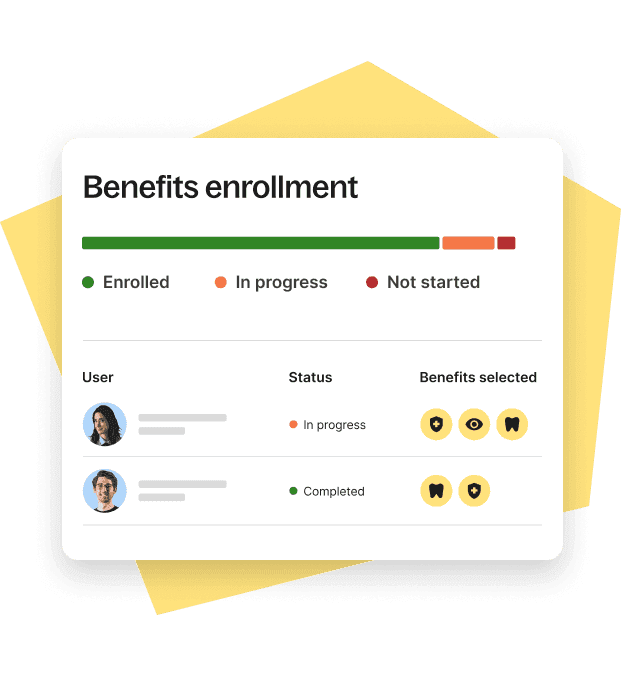
The Benefits Admin capability consolidates plan management, enrollment, and reporting across all countries into a single dashboard. HR teams can see every employee's enrollment status, plan selection, and benefit costs across all active markets in one place.
Country-level compliance requirements are continuously enforced by Deel's in-house compliance team and updated as local regulations change. Coverage extends to 100+ countries with locally underwritten plans across health, life, pension, and disability categories depending on the market.
| Before Deel | After Deel Benefits |
|---|---|
| Multiple broker relationships per country | One global broker network |
| 3-6 months to launch in new countries | Launch in weeks |
| Spreadsheets for cost tracking | Real-time dashboards |
| Different benefits quality by country | Consistent, competitive offerings globally |
| HR spends weeks on enrollment | Automated enrollment workflows |
| Payroll errors from manual deduction entry | Zero deduction errors with direct integration |
Best fit: Companies that want one place to choose, launch, and run benefits for their entire global workforce.
How Bowtie Life Insurance offers competitive, localized benefits through Deel
Bowtie Life Insurance (Bowtie), the first virtual insurer in Hong Kong, is changing the traditional insurance industry. It lets customers select their life protection options directly and quickly
Bowtie leveraged Deel’s exclusive partnerships with top-tier benefit providers, market intelligence tools, and the expertise of over 200 legal professionals to deliver highly competitive compensation and benefits packages.
“With Deel, we could attract top talent globally by offering competitive packages tailored to local market standards, ensuring equitable treatment worldwide.” — Sara Choi, Senior Manager Talent Acquisition & Development, Bowtie
Remote
Remote's core product is employer of record services, and benefits are bundled into that offering in markets where Remote operates its own entities. The employment relationship, payroll, and benefits are all managed under a single legal and operational structure.
Outside Remote's entity markets, benefits are delivered through local partners, and coverage quality varies by country. For global startups concentrating headcount in Remote's entity markets, the bundled model reduces vendor management overhead.
For companies with employees spread across many markets, including Remote's non-entity countries, the partner-delivered benefits add variability that's hard to manage at scale.
Best fit: Startups hiring in Remote's entity markets who want employer of record services and benefits under one contract.
Learn more about how Remote compares to Deel.
Oyster HR
Oyster HR focuses on global employment enablement with benefits offered through local partners in its covered markets. Its strongest coverage is in Europe and select APAC markets. Benefits outside those regions rely on partner networks with variable depth.
The payroll-benefits integration in Oyster's platform is less tightly coupled than a natively unified system, so deduction data needs to move between systems. That reintroduces the reconciliation step most HR teams want to eliminate.
HR leaders comparing Oyster against Deel should ask both vendors about their deduction-to-payroll workflow. With Deel Benefits, enrollment elections sync directly to Deel Payroll in real time: no manual entry, no file transfer, no deduction errors.
Best fit: Companies with European-concentrated headcount who want employer of record services and supplemental benefits in one vendor relationship.
Learn more about how Oyster compares to Deel.
TriNet
TriNet is a professional employer organization (PEO) with limited international capabilities.
"Global" framing in TriNet's materials primarily refers to partner networks rather than owned infrastructure. For companies with employees outside the US, benefits would need to be supplemented elsewhere, adding the integration overhead that a unified platform eliminates.
G2 reviews consistently surface "limited global capabilities" and "opaque pricing" as top concerns among TriNet customers. If your team is US-only today but has international hiring on the roadmap, building your benefits infrastructure on a US-native PEO creates a migration event when that growth begins.
For US-based companies that want to consolidate benefits and payroll in one place as they grow, Deel’s PEO is built for exactly that transition. Deel PEO sits inside the same platform as global payroll: US employees get enterprise-grade benefits and multi-state compliance coverage, and international workers are managed in the same system. When the company is ready to expand beyond the US, there's nothing to rebuild.
Best fit: US-only organizations seeking premium domestic benefits coverage with a PEO co-employment structure.
Learn more about how TriNet and Deel compare.
Free guide
Scale your global benefits strategy
Regional compliance considerations when selecting a benefits platform
Compliance isn't a feature platforms offer. It's an ongoing operational requirement your platform must support. These are the regional patterns that most frequently surface as implementation surprises.
European Union
Germany, the Netherlands, and France each have works council frameworks that give employee representatives co-determination rights over significant changes to working conditions, which can include changes to benefits plans. Introducing a new platform or changing plan structures may require consultation with works council representatives before the change takes effect.
A platform that enables rapid global plan changes needs to be operated with awareness of these consultation requirements in EU markets.
Brazil
Brazil's statutory benefit structure is extensive. Transportation vouchers (Vale Transporte), meal allowances (Vale Refeição), and annual profit sharing (PLR, Participação nos Lucros e Resultados) are mandated under federal law and collective bargaining agreements.
What counts as a "supplemental" benefit in Brazil is a narrower set than in markets like the US or UK. A platform that doesn't clearly distinguish statutory from supplemental in its Brazil configuration creates compliance exposure.
United Kingdom
Workplace pension auto-enrollment applies from the first day of employment for employees aged 22 and over who earn above the earnings threshold. Employers are legally required to enroll eligible employees into a qualifying pension scheme and contribute at the minimum statutory rate.
A global benefits platform operating in the UK must handle pension contribution tracking, not just health and ancillary benefits.
Asia-Pacific
Statutory contribution requirements vary significantly across APAC markets. Singapore's Central Provident Fund (CPF), Australia's Superannuation Guarantee, and Japan's mandatory social insurance contributions each operate under distinct regulatory frameworks with different contribution rates, thresholds, and employer obligations.
Ready to simplify global benefits?
The right global employee benefits platform matches your geographic footprint, integrates with your payroll infrastructure, and handles compliance monitoring so your team doesn't have to.
For organizations already running on Deel, or consolidating HR, payroll, and benefits onto a single platform, Deel Benefits removes the integration overhead that standalone solutions require. Book a demo and walk through your priority markets with the Deel team.
Related Deel resources
Shannon Ongaro is a content marketing manager and trained journalist with over a decade of experience producing content that supports franchisees, small businesses, and global enterprises. Over the years, she’s covered topics such as payroll, HR tech, workplace culture, and more. At Deel, Shannon specializes in thought leadership and global payroll content.