Article
3 min read
How Deel Helps You Build the Infrastructure for EU Pay Transparency
Deel news
Global HR

Author
Deel Team
Last Update
June 23, 2026
The EU Pay Transparency Directive took effect on June 7, 2026. For any company with employees in EU Member States, regardless of where they're headquartered, this changes how compensation works: how you share pay ranges, how you document pay decisions, and how you report on gender gaps.
Most companies will treat this as a reporting problem. The companies that get it right will treat it as the forcing function to fix how compensation actually works across their organization: clearer job architecture, pay decisions that managers can explain and employees can trust, and a structure that makes pay equity the default rather than the remediation.
That's the distinction we built for.
What the EU Directive actually requires
The Pay Transparency Directive introduces structural requirements that affect how companies hire, pay, and communicate about compensation.
Starting June 7, 2026, employers must share salary ranges with candidates before the first interview and can no longer ask about pay history. Workers gain the right to request their individual pay level and the average pay levels, broken down by gender, for workers doing the same work or work of equal value. Pay decisions must be based on objective, gender-neutral criteria and formally documented.
Starting June 2027, companies with 150 or more employees must report on gender pay gaps, covering all remuneration—base and variable or complementary pay (such as bonuses, overtime, performance-linked perks, private pension), with separate reporting for the two categories. Companies with 250 or more employees must report annually; companies with 150 to 249 employees report every three years. Companies with 100 to 149 employees begin reporting in 2031, also every three years.
The obligation follows where the worker is, not where the employer is incorporated. A US company with employees in Germany, France, or Ireland is fully in scope.
The Directive also shifts the burden of proof. If a worker brings a pay discrimination claim, the employer must demonstrate that no discrimination occurred. Without documented criteria and connected data, that's a hard case to make.
Why this is an infrastructure problem, not a compliance exercise
Producing a pay gap report is the end state. But getting there requires a foundation that most companies don't have yet.
It starts with job architecture: a structured, documented system of job families, levels, and job profiles that defines what "work of equal value" means inside your organization. Without that, pay bands are arbitrary and pay decisions aren't defensible.
Then compensation bands: pay ranges by job profile, level, and location that can be shared with candidates, accessed by workers, and updated without a spreadsheet process.
Then pay progression criteria: the objective, gender-neutral criteria for salary increases and career advancement. Performance ratings, tenure, certifications, scope of responsibility, whatever drives pay movement needs to be documented, consistent, and accessible to workers.
Then structured pay cycles: compensation decisions based on performance data and band position, with approval workflows, budget controls, and an audit trail that documents the rationale behind every change.
Then reporting: pay gap analysis on live, connected data, not a spreadsheet stitched together from four different systems.
And finally, training: making sure managers understand how pay decisions work and workers know their rights. The Directive requires employers to inform workers of their right to request pay information annually. That's not a one-off email. It's a repeatable process.
Each layer depends on the one before it. This is a stack, and it needs to be built as one.
How Deel helps you prepare
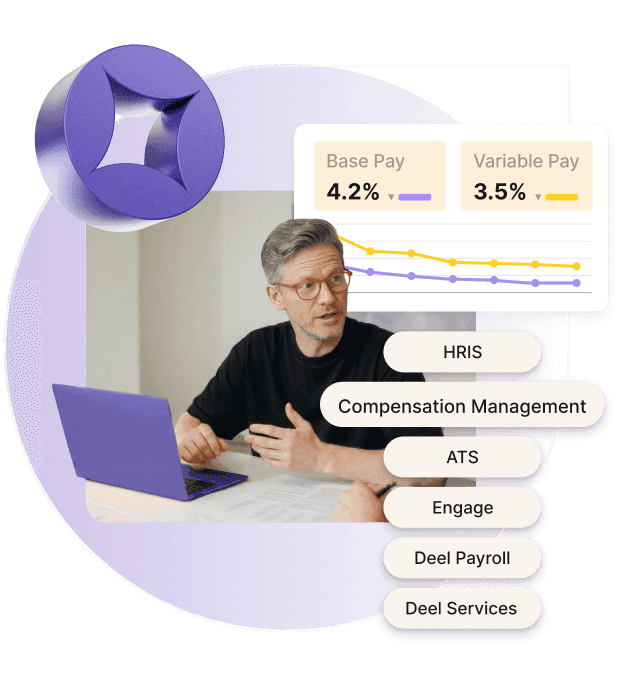
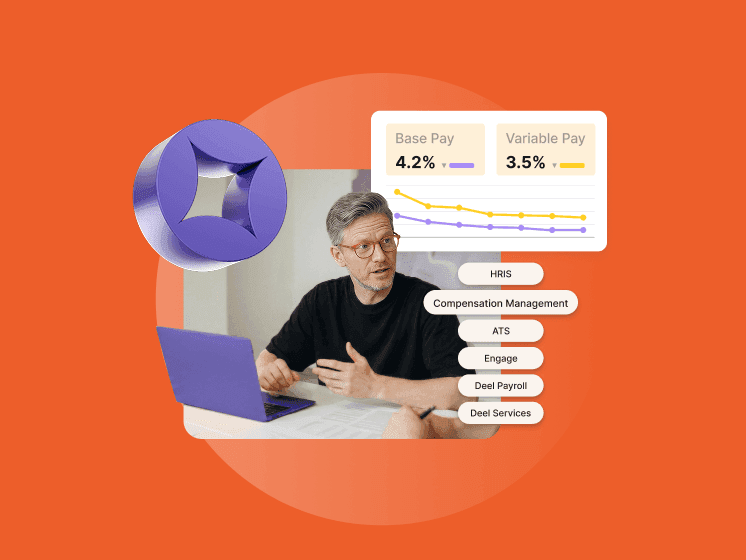
Deel connects the full compensation infrastructure in one platform across 150+ countries. Here's what that looks like in practice.
Job architecture lives in Deel HR's HRIS. Job families, levels, career profiles, and org structure form the structural foundation that everything else builds on.
Compensation bands are built in the Compensation Management module, covering base salary, bonus, and equity by job family, level, and location. Recruiters access ranges when opening a role. Workers see their band through a total rewards portal.
Compensation cycles run on connected workforce and performance data, with approval workflows and budget controls. When a cycle closes, comp adjustment letters document the decision and rationale for every worker.
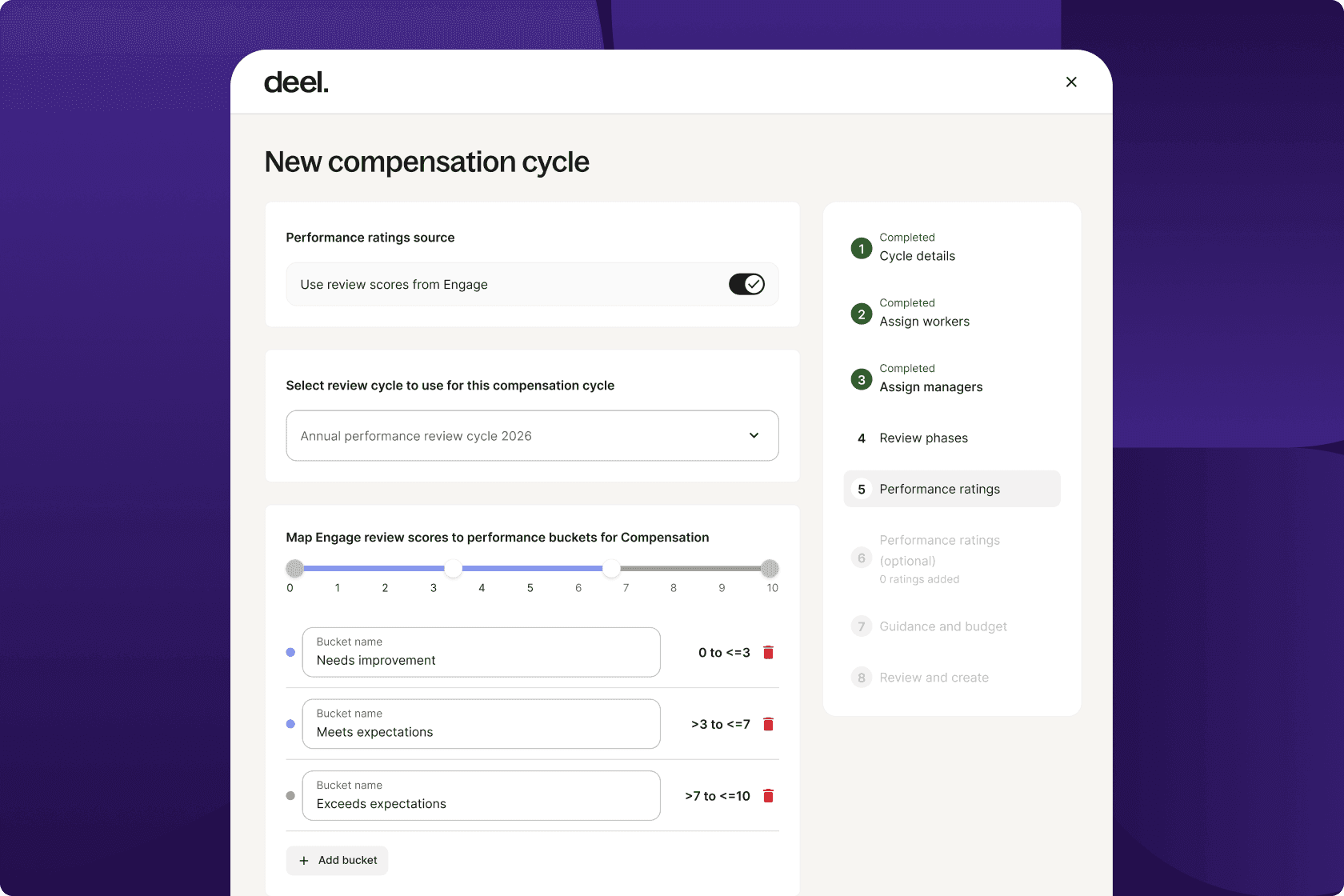
Sync performance scores from Engage to merit cycles
Pay gap reporting draws from the same HRIS and payroll data that runs the rest of the system. Median, quartile, and variable compensation breakdown. No spreadsheet reconciliation. One source of truth.
The Total Rewards Portal gives workers a clear view of how their pay is determined. From My Compensation page in their profile, workers see their job profile, salary band with a plain-language explanation of how it was set, their total cash compensation (base, bonus, allowances), and average salary for similar roles in their organization. HR controls what information is displayed by country, worker type, and employment type, with privacy guardrails in place.
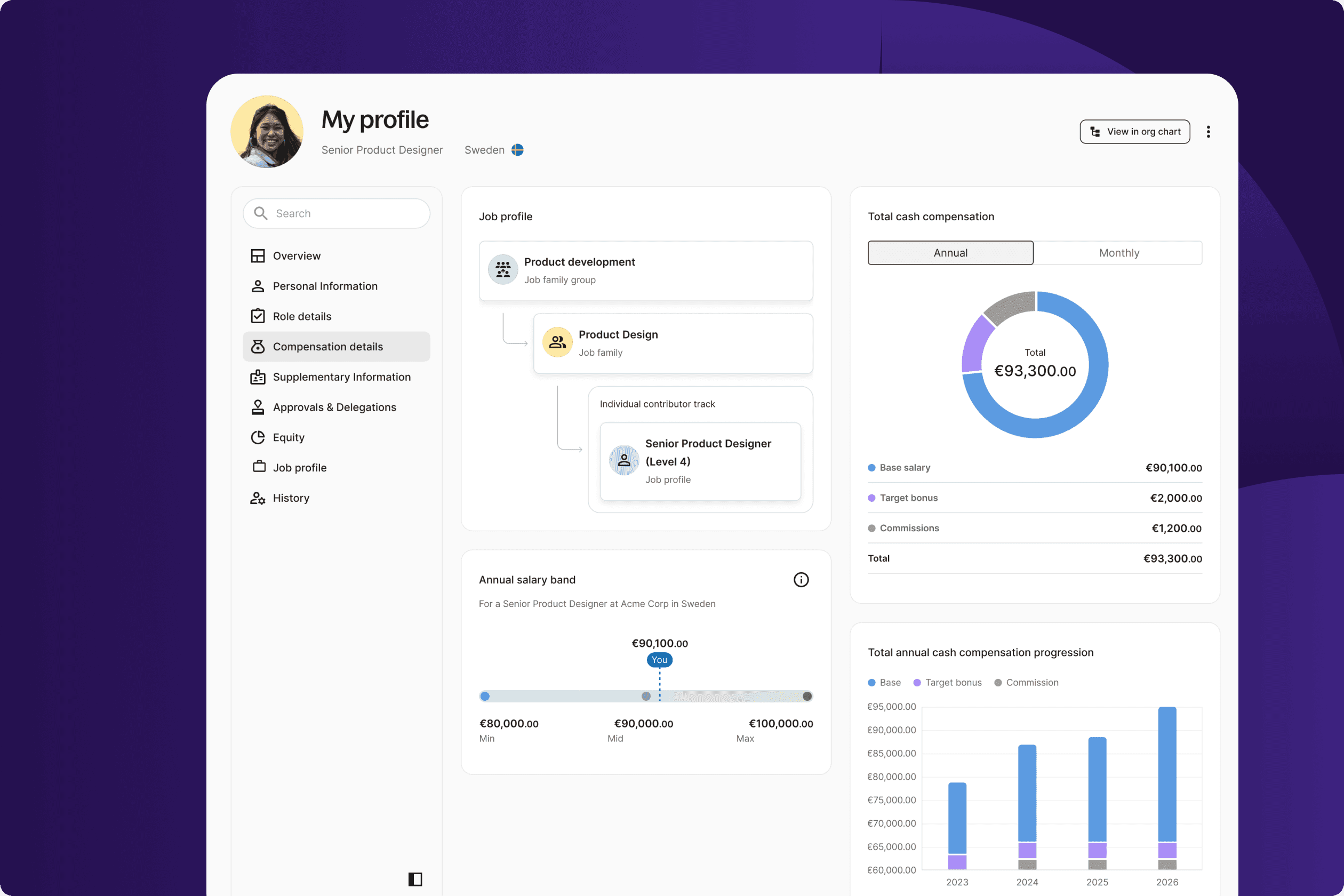
"My Compensation" page for workers on Deel
Manager and worker training runs through Engage's LMS module. Comp philosophy documents, leveling frameworks, cycle explainers, and annual comms on worker rights, all configurable to your actual compensation structure.
Deel consulting services are also available for those needing additional support. Our in-house expert team delivers pay equity audits, job architecture design, salary grid and band setting, manager and HR training, and HR data cleanup.
One platform, not five point solutions
Job architecture informs bands. Bands inform cycles. Cycles inform payroll. Payroll feeds reporting. If any step lives in a different system, you're exporting, reconciling, and hoping the data matches. Deel brings it all onto one platform built on in-house infrastructure. The data that runs your comp cycle is the same data that runs your payroll and feeds your reports.
The timeline is shorter than it feels. Get started with Deel
June 7 is the first deadline, but it's not the only one. The 2027 reporting cycle for companies with 150+ employees is the next pressure point, and the infrastructure to support it takes time to build.
Defining job architecture, building compensation bands, running a first structured cycle, and training managers doesn't happen overnight. The companies that start now will have defensible processes in place when reporting begins. The ones that wait will be building under pressure, with less room for iteration.
Deel accelerates the build. But the build itself is on you. We provide the infrastructure and consulting services to help your team get there. The decisions, the criteria, and the processes are yours.
Ready to get started? Book a call with our consulting team.
EU Compliance with Deel
Tackle pay transparency, all in one place