Article
6 min read
Why Enterprise CHROs Are Moving to Single-Vendor Global HR in 2027
Global HR

Author
Ellen Simmonds
Last Update
September 23, 2026

Table of Contents
The fragmentation tax: What a five–eight vendor HR stack actually costs
Why fragmentation is a strategic risk, not just an IT problem
The consolidation ROI model: Building the business case for the CFO
True single-vendor vs. point-solution aggregator: What the evidence shows
The consolidation imperative: How Deel unifies global HR at enterprise scale
Key takeaways
Enterprises running five to eight HR vendors across multiple countries carry hidden operational costs that never show up in a software budget.
Companies that connect their existing HR system directly to payroll execution can cut payroll errors by 60 to 70 percent, as Bloomreach did after consolidating with Deel.
Deel unifies global payroll and employment data without forcing enterprises to replace the HR systems they've already built their processes around.
This article provides general information, not legal or financial advice. Consult your legal and finance teams on jurisdiction-specific requirements and investment assumptions.
Most enterprises underestimate what fragmented HR systems actually cost. The licensing fees are straightforward. What catches you off guard is the operational burden: salary changes that require manual transfers, approvals bouncing between platforms, reconciliations that finance has to run before they trust the numbers. For a global organization running five to eight HR vendors across ten-plus countries, every transaction becomes a multi-system event.
Data integrity risk compounds with each payroll cycle. Compliance updates get replicated manually or left incomplete. By the time your 2026 budget cycle arrives, consolidation deserves a business case that measures those dependencies, not just the subscriptions you can cancel.
Mapping fragmentation costs, calculating consolidation ROI, and stress-testing whether a single platform can replace your current patchwork requires a different kind of analysis. Deel's experience supporting enterprises across 150+ countries and multiple hiring and payroll models offers a particular lens: where fragmented systems create risk, how consolidation delivers the most value, and what actually changes when you move from vendor sprawl to a unified global workforce platform.
The fragmentation tax: What a five–eight vendor HR stack actually costs
Establishing what fragmentation actually costs your organization requires more than vendor invoices. The true operating cost lives across multiple budgets. Subscriptions appear in HR, integration maintenance gets buried in IT, reconciliation work spans finance and payroll operations, and compliance remediation hides in legal or audit reserves. Building a consolidated business case means bringing all of those costs into one view.
The best way to surface these numbers is to inventory your contracts and the work that happens between systems. For each major process like payroll, hiring, benefits administration, and compliance reporting, document not just the vendors involved but also the connectors, monitoring, manual re-entry, and verification steps your team runs to keep data consistent across platforms. This becomes your baseline.
| Cost category | What to include | Evidence to collect |
|---|---|---|
| License overlap | Duplicate capabilities, unused seats, minimum commitments | Contracts, renewal dates, usage records |
| Integration maintenance | Connectors, monitoring, mapping changes, external support | IT tickets, invoices, engineering hours |
| Manual reconciliation | Re-entry, payroll checks, reporting adjustments | Time samples across representative cycles |
| Errors and compliance exposure | Corrections, remediation work, documented incidents | Incident logs and legal or finance assessments |
Rather than relying on team estimates, ask each process owner to supply actual evidence. Collect time samples from payroll cycles, IT tickets from integration failures, and incident logs from compliance issues. This grounds your baseline in documented reality rather than memory or intuition.
Operating cost breaks down as:
Operating cost = Subscriptions + Integration costs + Administrative time (reconciliation and remediation) + Documented correction work
The key is consistency: allocate shared IT costs the same way in your current model and your proposed consolidated model, so the comparison is apples to apples.
External research from Gartner and trade publications can inform your thinking about where consolidation typically delivers value. Use those sources to prompt investigation of your own economics, not to transfer someone else's savings forecast into your spreadsheet. Your fragmentation profile is unique to your vendor mix, your process maturity, and your organizational complexity.
Make the baseline auditable
The baseline is ready when finance can trace each cost to an owner, a period, and supporting records. Don’t count the same reconciliation work under both integration maintenance and HR administration.
Why fragmentation is a strategic risk, not just an IT problem
Fragmentation constrains the questions your organization can actually answer. When finance and HR disagree about employee populations or compensation dates, your executive leadership team has to resolve data definitions before it can make confident decisions about hiring or restructuring. That specialist capacity—the time spent reconciling discrepancies instead of running workforce scenarios—becomes a constraint on strategic planning itself.
The data coherence gap
A common login across multiple platforms doesn't guarantee a common data model underneath. Different systems classify the same person by legal employer, manager, payment location, or contract type. The result is a report that shows one total from finance and a different total from HR, both generated from what appear to be identical queries.
The only way to address this is to establish an authoritative source for each critical field. Define when those definitions take effect and specify how changes propagate to downstream systems. Then test whether a consolidated report preserves those definitions across direct employees and workers engaged through an employer of record. Real-time updates matter only when the underlying records describe the same thing. If your systems are updating at different speeds or applying different logic to the same employee population, you gain speed without gaining clarity.
Compliance risk at the seams
Fragmentation creates compliance exposure at handoff points. A contract amendment may not reach payroll before the cutoff. An offboarding request may not reach the team responsible for local payments. Each jurisdiction adds distinct requirements and distinct accountable parties to these workflows. When those workflows span multiple systems and vendors, responsibility becomes diffused. No single vendor owns the outcome. The risk accumulates in the gaps between platforms.
Keep control ownership explicit
Failures can also occur within a single provider. Consolidation reduces unnecessary handoffs only when you pair it with accurate inputs, approval controls, local expertise, and clear escalation ownership. Ask who detects an exception, who resolves it, and what evidence confirms completion.
The consolidation ROI model: Building the business case for the CFO
Anchor your ROI model to your own baseline, not industry benchmarks. Compare the vendors and workflows you actually use today against what you'd need going forward.
Separate benefits into categories finance can assess independently:
License savings: Contracts and add-ons you can retire, minus replacement subscriptions. Use realistic termination dates based on actual notice periods.
Administrative capacity: Annual hours saved on reconciliation and manual work, multiplied by fully loaded hourly cost. This becomes a cash saving only if you reduce headcount or avoid a planned hire. Otherwise, it's redirected capacity, not savings. Don't count both the same hours and an avoided hire.
Error avoidance: Documented remediation costs you expect to reduce. Keep potential penalties in a separate, probability-weighted case approved by legal and finance.
Speed to insight: Only value this financially when tied to a defensible business outcome, not a timing benefit you'd have realized anyway.
For a cash-only view:
ROI = (Cumulative cash benefits − Cumulative project costs) ÷ Cumulative project costs × 100
Project costs include implementation, migration, training, and overlapping contracts during transition. Model year one separately: migration costs typically dominate early, while savings compound later. Present downside, base, and upside cases rather than a single estimate.
Before requesting approval:
Agree on baseline costs and benefit owners with finance
Confirm which contracts can end and when
Assign recovered capacity to specific work
Set review dates to compare realized benefits with forecast
Deel HR
One place for simplified, smarter global HR
True single-vendor vs. point-solution aggregator: What the evidence shows
Acquisition history and a shared login screen tell you very little. Operating evidence tells you everything: what happens to your data during a workforce event, and who's accountable when something breaks. A unified platform reduces data transfers and clarifies ownership. An integrated specialist stack can preserve deeper functionality in specific areas, but you retain responsibility for more dependencies between vendors, even behind a shared interface. Ask vendors to show you exactly how a specific employee record moves through their system, not a generic product tour.
For employer of record services, separate legal employment from software functionality. Identify who the legal employer actually is in each jurisdiction, which locations are genuinely supported versus routed through a subcontracted partner, and how employee records flow into your reporting. A module labeled "EOR" isn't proof of local delivery. That depends on whether the vendor owns the legal entity and payroll execution in that country, or routes you through a third party you can't see.
| Criterion | Unified platform: test the promise | Integrated specialist stack: test the trade-off |
|---|---|---|
| Data model | Show authoritative records and effective-dated changes | Show field mapping, synchronization, and reconciliation |
| Functional depth | Demonstrate HRIS, payroll, and engagement requirements | Prove specialist benefits justify integration work |
| Global delivery | Identify local operators and country-specific scope | Assign ownership across regional providers |
| Reporting | Reconcile totals across worker types and entities | Explain refresh delays and definition differences |
| Accountability and exit | Document escalation, export rights, and service dependencies | Document cross-vendor incident ownership and connector support |
Your enterprise EOR evaluation process should identify the legal employer, supported locations, contractual responsibilities, and how employee records reach reporting. Don’t treat a module label as proof of local delivery.
Bloomreach: Consolidate around a working source of truth
Bloomreach faced a version of this problem at scale: a different local payroll provider in every country, each with its own contact, pricing, and password-protected file exchange for sensitive data. After consolidating onto Deel Payroll and connecting it directly to their existing BambooHR system, the company cut payroll errors by 60 to 70 percent and reduced Netherlands payroll preparation from two days down to one. The result wasn't a new HR platform. It was fewer disconnected handoffs between the one they already trusted and the payroll execution behind it.
With our previous provider in the Netherlands, we were sending payroll back every single month. There was always something that wasn't right. In three years on Deel, I've sent payroll back a handful of times, mostly at the beginning. In the last year it never happened.
—Ingrid Horváthová,
Lead People Operations Specialist, Bloomreach
The consolidation imperative: How Deel unifies global HR at enterprise scale
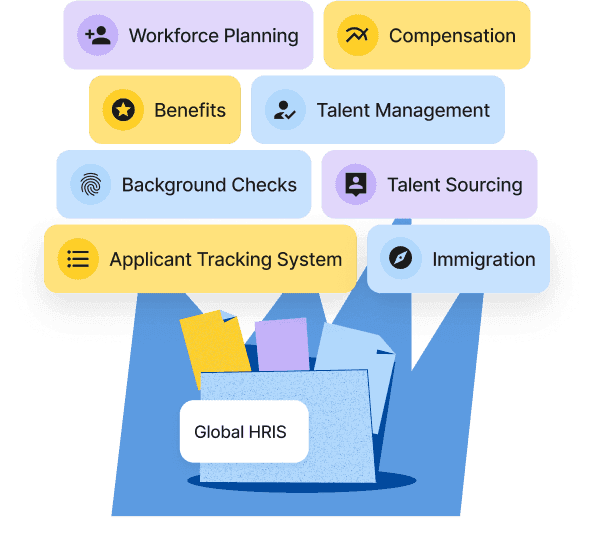
Deel Payroll handles employees through your owned entities, and EOR covers hiring in countries where you don't have one. Both connect to Deel HR, which functions as the coexistence layer between your global payroll and employment data and the systems your teams already rely on, including Workday, SAP, and Oracle. For enterprises with an established HRIS, Deel HR isn't a replacement. It's the connective infrastructure that keeps your source-of-truth platform synchronized with payroll execution across every country you operate in, without forcing a migration off the system your HR team has already built processes around.
Consolidation earns its place in your strategy when it removes measurable reconciliation work while preserving the capabilities and systems your teams already depend on. Book a Deel demo to see how migration works in practice, without disrupting the systems your teams already depend on.
Live Demo
Get a live walkthrough of the Deel platform
FAQs
How long does HR platform consolidation take?
Your timeline depends on country scope, data quality, integrations, contract exits, and testing requirements. Ask for a phased implementation plan with explicit acceptance criteria rather than a universal go-live promise.
How do you control migration risk?
Validate source data, test permissions and integrations, and agree on rollback criteria before moving critical workflows. For payroll, confirm parallel-run requirements and sign-off responsibilities with your implementation team.
How does a single vendor handle compliance across more than ten countries?
Ask the provider to document local delivery, regulatory-update ownership, and escalation responsibilities for each jurisdiction. A common interface doesn’t replace country-specific controls or your responsibilities as a customer.
How should you compare year-one and year-three consolidation ROI?
Include migration and overlapping contracts in year one, then reflect actual adoption and contract retirements in later years. Show cash savings separately from recovered capacity, and review realized benefits against the forecast.
Ellen Simmonds is a content marketing manager with a decade of experience in tech, leadership, startups, and the creative industries. A long-time remote worker, she's passionate about WFH productivity hacks and fostering company culture across globally distributed teams. She also writes and speaks on the ethical implementation of AI, advocating for transparency, fairness, and human oversight in emerging technologies to ensure innovation benefits both businesses and society.