Article
3 min read
EU Pay Transparency Directive in Malta: What's Live, and What's Still Coming
Global HR

Author
Ellen Simmonds
Last Update
August 28, 2026

Key takeaways
The EU Pay Transparency Directive requires employers across member states to disclose pay ranges to candidates, give workers the right to compare their pay, and report gender pay gaps starting in 2027.
Malta transposed the Directive through Legal Notice 173 of 2026, pairing an 8-day response window for pay information requests with criminal, rather than administrative, enforcement.
Deel keeps job architecture and worker-facing pay information connected on one platform, so employers in Malta can respond to information requests fast enough to stay inside the legal window.
Malta published Legal Notice 173 of 2026, the Equal Pay (Transparency and Reporting) Regulations, on June 5, 2026, two days ahead of the EU Pay Transparency Directive's own transposition deadline. The regulations entered into force on June 7, 2026, and unlike other legal notices Malta had published earlier that year, the government skipped the usual two-month transitional period entirely. Obligations applied from day one.
Meeting the deadline is only part of what makes Malta worth covering. The Equal Pay (Transparency and Reporting) Regulations pair an unusually fast timeline for responding to worker requests with an enforcement model built on criminal liability rather than administrative fines. Both details change what "getting this wrong" actually costs.
What the Equal Pay (Transparency and Reporting) Regulations actually are
Malta wasn't starting from a blank page. An earlier partial measure, a Legal Notice published in August 2025, had already given workers the right to request a written comparison of their pay against categories of workers doing the same work. The June 2026 regulations build on that foundation and complete the transposition, made under the Employment and Industrial Relations Act.
The regulations apply to all employers in the public and private sectors, and to every worker with an employment relationship as defined under Maltese law. There's no employer-size floor for the baseline obligation to have compliant pay structures in place, though several of the more specific documentation and reporting requirements scale in with headcount.
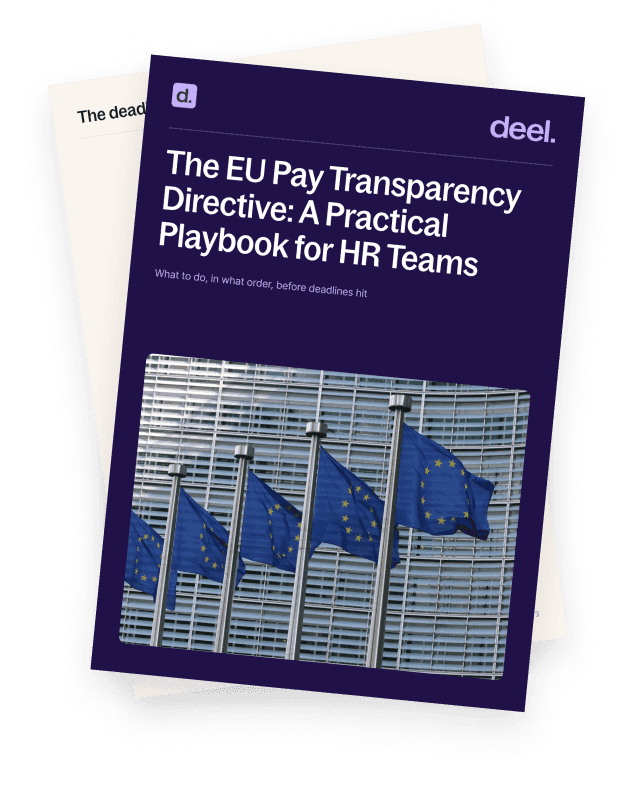
EU Compliance with Deel
EU Pay Transparency Directive: A Practical Playbook for HR
Documentation requirements scale with headcount
Malta ties specific obligations to specific size thresholds, which makes it easier to plan around but also easy to underestimate if you're only tracking one number.
Employers with 25 or more employees must adopt and maintain written pay structures and policies documenting the objective, gender-neutral criteria used to set pay and pay levels. At 50 or more employees, that same documentation requirement extends specifically to pay progression criteria, not just how pay is initially set. At 100 or more employees, employers need to start preparing to collect the data required for gender pay gap reports, and that preparation effectively starts with 2026 data, even though no report is due yet. At 250 or more employees, the first gender pay gap report is due by June 7, 2027.
The pay structures documentation at the 25-employee tier is worth taking seriously even for smaller organizations, since it's the lowest threshold in the regulations and catches a meaningful share of mid-sized employers who might assume documentation requirements only apply at a larger scale.
An 8-day response window
This is the detail most likely to catch employers off guard. The Directive sets a maximum of two months for employers to respond to a worker's request for pay information. Malta compressed that window to 8 days, roughly a tenth of the time the Directive allows.
Missing that window has consequences that escalate quickly. If a request goes unanswered, or is answered inaccurately or incompletely, and stays unresolved 45 days after the original request, the employer commits a criminal offense. There's also an escalation path built in before it gets to that point: an unresolved request can be resubmitted by a worker's representative or union within 12 days of the original deadline, and from there escalated further through the Equality Body.
An 8-day turnaround isn't achievable by pulling numbers together manually once a request lands. It requires the underlying pay information, job classification, and average pay by category to already be organized and accessible before a request ever comes in.
EU Compliance with Deel
Tackle pay transparency, all in one place
Why Malta's enforcement model is different
Malta is the only one of the four states that met the June 7, 2026 deadline, alongside Italy, Slovakia, and Lithuania, to enforce transparency and reporting obligations through criminal penalties rather than administrative fines. Standard contraventions carry a fine on conviction, with sources placing the upper limit at either €5,000 or €7,000 depending on the source; the lower bound of €2,500 is consistent across sources. Prosecution runs directly through the Director of the Department for Industrial and Employment Relations rather than through a civil enforcement body.
Criminal liability doesn't replace an employee's own path to compensation, it runs alongside it. Workers can separately apply to the Industrial Tribunal for full back pay, compensation for lost opportunities, non-material damages, and redress for intersectional discrimination. These are two different tracks that can both apply to the same underlying violation.
The limitation period compounds the exposure. Employees have three years to bring a pay discrimination claim before the Industrial Tribunal, well beyond the standard four-month limitation period that otherwise applies under Maltese employment law. A pay decision made today stays open to challenge for considerably longer than most other employment matters in Malta.
Getting ahead of it
Three things are worth prioritizing based on where your Maltese headcount actually sits.
If you're at 25 or more employees, get pay-setting criteria documented now, since that threshold is lower than many organizations expect and the documentation requirement is already in effect. If you're approaching 100 employees, start organizing the data behind your 2026 pay gap picture now, even though the report itself isn't due until 2027. And regardless of size, build the operational capacity to answer a pay information request inside 8 days, since that clock doesn't pause for anyone still assembling the answer from scratch.
Stay ahead of the next update, in Malta and everywhere else
An 8-day response window only works if the answer is already sitting somewhere accessible rather than something you build from scratch when a request lands. Deel HR keeps job architecture, pay criteria, and worker-facing compensation information connected in one system, so responding to a request is a matter of retrieving an answer that already exists, not assembling one under a deadline.
Book a demo to see how Deel helps you respond to pay transparency obligations fast enough to stay inside the window the law actually gives you.
Live Demo
Get a live walkthrough of the Deel platform
This content is for informational purposes only and does not constitute legal advice. Compensation laws and regulations change frequently, and this article notes specific sections requiring legal confirmation before publication. Businesses should consult qualified legal counsel for jurisdiction-specific guidance.
Ellen Simmonds is a content marketing manager with a decade of experience in tech, leadership, startups, and the creative industries. A long-time remote worker, she's passionate about WFH productivity hacks and fostering company culture across globally distributed teams. She also writes and speaks on the ethical implementation of AI, advocating for transparency, fairness, and human oversight in emerging technologies to ensure innovation benefits both businesses and society.