Article
6 min read
What The State of Global Hiring Tells Early-Stage Founders about Managing a Global Team
Global HR

Author
Ellen Simmonds
Last Update
June 16, 2026

Most founders read the hiring headlines. The fastest-growing cross-border roles. Which countries top-funded startups are moving into? Where the talent is.
But underneath the numbers in Deel's State of Global Hiring Report sits another story. One that isn't really about hiring at all. It's about what happens after you bring someone on: how you pay them, how you structure their role, and whether your people infrastructure can actually keep up with the market you're building in.
Those insights aren’t just important for mid-market organizations and large enterprises. Whether you’re hiring your 20th employee or your 200th, here's what the data means for founders running pre-seed startups.
Insights
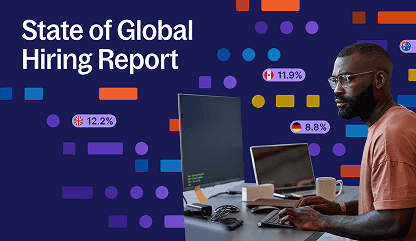
State of Global Hiring Report (2026)
You're fishing in the same talent pool as $100M+ startups
Among startups that raised at least $100 million in funding, software developers made up 28% of all cross-border hires. AI engineers, ICT account managers, and business developers rounded out the top roles. These companies aren't going global to cut costs. They're doing it to access rare, high-value skill sets they can't find at home.
The uncomfortable truth for early-stage founders is that you're competing for the same people. A well-funded startup in San Francisco or London can hire a senior engineer in Warsaw or Nairobi as easily as hiring across town. Global HR infrastructure has made the friction disappear.
The difference isn't who you're targeting. It's whether you've built the infrastructure to manage whoever you hire, wherever they are. Contracts, onboarding, compliance, payroll: if any of that is held together with spreadsheets and email threads, you're at a disadvantage before the first offer letter goes out.
What this means for you in 2026
The talent competition is already global. The question for 2026 isn't whether your next hire might come from another country. It's whether your operations are ready when they do. If you haven’t already:
Audit how your current onboarding and contract process handles someone in a different jurisdiction. If the answer involves a lot of manual steps, that's where you start.
Document your compliance process for at least your top three hiring markets. Not having this written down is a risk that compounds fast.
Map out what "managing" a cross-border hire actually looks like end-to-end for your team today. Every manual step in that process is a place where a better-funded competitor moves faster than you.
Operational readiness isn't something you build after a funding round. It's what makes the funding round possible.
How to run global teams with no HR team
Deel HR gives early-stage teams the same operational foundation that larger, better-funded competitors have already built. You don't need a full People team to run things properly. You just need the right system from the start.
Your compensation framework will break before you think it will
The 2025 data makes one thing very clear: compensation is not a global constant. It's a moving, regional, role-specific variable that shifts faster than most founders realise.
In the US, project managers saw 24.5% compensation growth. COOs followed at 21.6%. In Latin America, COOs saw 99.8% growth for the same role. In Australia and New Zealand, project managers gained 39.6%, while the equivalent role in the UK saw 18.2%. ICT account managers saw salary declines in Latin America, the UK, and Singapore, while demand for the same role remained strong elsewhere.
If you're managing compensation across three or four countries with a shared spreadsheet, you're not benchmarking. You're guessing. And as your team grows, those guesses get more expensive.
The practical problem for founders isn't just getting the numbers wrong. It's those comp decisions made without regional data that create internal inequity, and internal inequity creates attrition. Your best people in undervalued markets notice.
What this means for you in 2026
The regional divergence in the 2025 data isn't a blip. Compensation is moving at different speeds in different markets, and founders who set pay based on gut feel or one-size benchmarks are already falling behind.
Build salary bands by role and region rather than a single global rate. Even a basic framework is better than none, and it becomes the foundation for every comp decision you make at scale.
Run a pay equity check across your current team. If two people in the same role in different countries are paid very differently without a documented rationale, that's a retention and legal risk sitting quietly in your org.
Set a cadence for reviewing compensation. Annual is the floor. For fast-growing markets, twice a year is more realistic.
Getting comp right at 30 people is a spreadsheet problem. Getting it right for 150 people requires infrastructure.
How to build salary bands right early on
Deel Compensation handles salary band management, compensation review cycles, and market benchmarking across 150 countries. It's built specifically for distributed teams of 50 to 1,000 people, designed for exactly the stage you're in now, or heading into fast.
Compensation with Deel HR
Streamline global compensation workflows
New job categories will arrive before your frameworks do
AI trainer roles grew 283% cross-border in 2025. That makes it the single fastest-growing cross-border role on Deel's platform. A few years ago, the role barely existed as a formal category. In 2025, more than 70,000 workers filled it across 600+ organisations.
For founders, this isn't just interesting data about AI. It's a signal about the pace at which entirely new job categories emerge and scale. And it raises a practical question: when a role arrives that has no established career ladder, no clear comp benchmark, and no obvious performance framework, how does your organisation absorb it?
Pay for AI trainers is sharply bifurcated. Around 30% earn between $15 and $20 per hour for annotation work. Another 19% earn $50 to $75 per hour, with 6% earning over $100 per hour for subject matter expertise in fields like medicine, economics, and translation. Two people with the same job title can have wildly different skill profiles and market rates.
If your performance and compensation infrastructure can't flex for that kind of variation, you'll either underpay specialists or overpay generalists.
What this means for you in 2026
New role categories will keep emerging in 2026, and the founders who build flexible performance infrastructure now won't have to scramble when they do.
Review whether your current performance framework can accommodate a role that has no industry benchmark yet. If your review process depends on comparison to established norms, it'll struggle with genuinely new functions.
Separate job titles from competency levels in how you think about performance and pay. A generalist AI trainer and a subject matter expert AI trainer aren't the same role, even if they share a title. Your framework needs to reflect that.
Build career progression criteria that are tied to demonstrated skills rather than tenure or title alone. This is the foundation that makes new role types absorbable without creating internal confusion.
Building that flexibility in early — before your team hits 100 people — is far cheaper than retrofitting it at 150.
How to build a performance infrastructure that scales
Deel HR’s talent management module, Engage, covers the performance infrastructure that makes this manageable: self-reviews, 360-degree feedback, quarterly check-ins, OKR tracking, and career development frameworks built on configurable competency models. When a new role type arrives, you're not starting from scratch.
How your contractors want to be paid is changing
USD appeared in five of the ten most common country-currency payment combinations globally in 2025. In Argentina, more contractors chose to be paid in USD than in their local currency. In Bolivia, payment preferences shifted directly in response to inflation: when inflation rose, contractors moved to USD; when it stabilised, local currency adoption increased.
This isn't a niche trend. It reflects a structural shift in how globally distributed workers think about financial security. For contractors in economically volatile markets, payment currency is a practical hedge, not a preference.
For founders managing a mix of employees and contractors across multiple regions, this has a direct implication. Payment flexibility isn't a perk you add later. It's increasingly an expectation that shapes whether you can attract and retain the right people in certain markets. A contractor in Nairobi or Buenos Aires who can choose their withdrawal currency has a materially different experience from one who can't.
What this means for you in 2026
Currency volatility isn't stabilising in 2026. Contractors in high-inflation markets will continue to prioritise payment flexibility as a baseline expectation, not a bonus.
Ask your contractors in economically volatile markets how they prefer to be paid. You may be losing retention points over something you could fix quickly.
Check whether your current payment infrastructure actually supports USD or alternative currency withdrawals. Many founders assume it does until a contractor asks, and it doesn't.
Factor payment flexibility into how you pitch contractor roles in emerging markets. In some regions, it's as important as the rate itself.
The contractors who have options will choose the company that gives them more of them.
How to pay multi-currency teams
Deel's contractor management platform supports flexible payment options including USD and stablecoin withdrawals, built for exactly this reality.
Deel Payroll
Run payroll in Deel. Anywhere. Your way.
The real lesson isn't about hiring
The 2025 State of Global Hiring Report is packed with hiring data. But read it from a management lens and a different picture emerges.
The companies pulling ahead of their stage aren't just hiring globally faster. They're managing globally better. They have a compensation infrastructure that reflects regional markets. They have performance frameworks that can absorb new role types. They pay their contractors in ways that build trust rather than friction.
Most of that infrastructure gets deferred. Founders tell themselves they'll build it properly at 100 people, or after the next round. By then, the cost of fixing it is far higher than the cost of building it now.
The window to get this right is earlier than most founders think. And it's shorter than it looks.
Download the full State of Global Hiring Report to see the complete data. Or book a demo to see how Deel maps to your current stage.
Live Demo
Get a live walkthrough of the Deel platform
FAQs
What should early-stage startups prioritise for global HR before they reach 100 employees?
Early-stage startups should focus on three things before hitting 100 employees: a documented compliance process for each country they hire in, salary bands that account for regional market differences, and a performance framework flexible enough to accommodate new role types. Getting these in place at 30 to 50 people is significantly cheaper and less disruptive than retrofitting them later.
Why is compensation benchmarking different for global teams than domestic ones?
Compensation growth varies sharply by region and role. The same position can see dramatically different salary growth depending on the market. A project manager in Australia and New Zealand saw 39.6% compensation growth in 2025, while the same role grew 18.2% in the UK. Founders managing global teams need regional benchmarking data, not a single global rate, to stay competitive and avoid internal pay inequity.
How do AI trainer roles affect how startups should structure compensation and performance frameworks?
AI trainer roles grew 283% cross-border in 2025, and pay varies widely within the same job title: from $15 to $20 per hour for annotation work up to over $100 per hour for subject matter experts. This signals a broader pattern where new job categories arrive faster than established benchmarks do. Startups need performance and comp frameworks tied to skills and competency levels rather than job titles alone, so they can absorb genuinely new role types without creating internal confusion.
Why are contractors in emerging markets increasingly choosing to be paid in USD?
In high-inflation markets, contractors use USD as a hedge against local currency volatility. In 2025, USD appeared in five of the ten most common country-currency payment combinations globally. In Argentina, more contractors chose USD over local currency entirely. For founders, this means payment flexibility is becoming a baseline expectation in many markets, not a bonus feature.
What's the risk of deferring HR infrastructure until after a funding round?
The main risk is that problems that are cheap to fix at 30 people become expensive and disruptive at 150. Pay inequity compounds. Manual compliance processes break under volume. Performance frameworks that worked informally create confusion as teams grow. Investors conducting due diligence also expect an organised people infrastructure. Deferring it doesn't eliminate the work. It increases the cost.
How do top-funded startups approach cross-border hiring differently from early-stage ones?
Top-funded startups hire cross-border primarily to access specialised talent, not to reduce costs. Among startups that raised at least $100 million in funding, software developers made up 28% of cross-border hires, followed by AI engineers and technical sales roles. Early-stage startups tend to hire more heavily from lower-cost markets for core operational roles. The distinction matters because it shapes which HR infrastructure you need and how quickly you need to build it.
Ellen Simmonds is a content marketing manager with a decade of experience in tech, leadership, startups, and the creative industries. A long-time remote worker, she's passionate about WFH productivity hacks and fostering company culture across globally distributed teams. She also writes and speaks on the ethical implementation of AI, advocating for transparency, fairness, and human oversight in emerging technologies to ensure innovation benefits both businesses and society.