Article
5 min read
HCM and Payroll Integration: Benefits, Risks, and Best Practices
Global payroll
Global HR

Author
Joanne Lee
Last Update
September 17, 2026
Table of Contents
What is HCM and payroll integration?
5 benefits of HCM and payroll integration for enterprise organizations
How Deel connects your HCM and payroll stack
Key takeaways
Fragmented HCM and payroll systems carry business risks, including compliance gaps, data errors, and vendor overhead that compound as headcount grows.
Most global payroll providers are aggregators, applying a unified UI on top of local sub-vendors.
Deel is not an aggregator. Instead, it's built on owned infrastructure and connects HCM and payroll natively with Workday, SAP, and more, with AI-assisted anomaly detection built into the payroll workflow.
Most global enterprises didn't set out to run payroll across a patchwork of local vendors, disconnected systems, and manual reconciliations. It happened one market expansion, acquisition, and urgent hire at a time.
The result is a fragmented HR and payroll stack that nobody consciously chose. You have data sitting in three different systems, compliance tracked in spreadsheets, and a payroll team spending most of its week on data entry instead of strategy.
On top of that, many vendors that look like consolidated solutions are still aggregators underneath. There’s one login, but the same patchwork of local sub-vendors behind it, just hidden from view, leading to fragmentation, slow issue resolution, and a compliance lag.
Real HCM and payroll integration requires owned infrastructure, not a unified interface on top of outsourced execution. This article covers what that actually delivers and how to evaluate whether your current provider is built that way.
What is HCM and payroll integration?
Human Capital Management (HCM) is the set of processes and tools used to manage the full employee lifecycle, from hiring and onboarding to performance, compensation, and eventually, offboarding. Payroll, while often grouped under HCM, operates as a separate execution layer, running gross-to-net calculations, handling tax filings, and disbursing payments in line with local regulations.
HCM and payroll integration connects these two systems through bi-directional data sync. Employee changes—new hires, compensation updates, benefit enrollments, terminations—move automatically from your HCM into payroll, so payroll data flows back for reporting and headcount analytics with no manual re-entry.
At its most mature, integration means a single system of record for all workforce data, with payroll running as a connected execution layer rather than a siloed back-office function.
5 benefits of HCM and payroll integration for enterprise organizations
1. Reduced total cost of ownership across vendors and internal effort
The cost of fragmented payroll doesn't show up cleanly on a P&L. It hides in vendor management overhead, IT maintenance duplicated across regions, and the cost of fixing errors that shouldn't have happened in the first place.
According to a 2025 Forrester Total Economic Impact study, HR and payroll leaders using Deel reported saving 80% of the time previously spent managing multiple payroll vendors. For a global payroll team, that's the difference between reactive and strategic.
When HCM and payroll run through a connected platform with owned infrastructure, you cut the duplication. Data that already lives in your HRIS doesn't get re-entered somewhere else. Local providers aren't reconciling outputs they can't see, IT stops rebuilding integrations every time you enter a new country, and the aggregator markup disappears. The result is a measurable reduction in total cost of ownership, which is the kind CFOs and Global Payroll Directors can defend at board level.
Watch the video below to see how Deel Payroll’s platform is different from the aggregator model.
2. A single system of record for global workforce data
When HCM and payroll operate in silos, data integrity problems follow. A compensation change processed in your HRIS doesn't reach payroll. A new hire onboarded in one system isn't visible in the other. Every manual sync is an opportunity for error, and in a global organization running payroll across 20 or 50 countries, the exposure adds up quickly.
Connecting them through a unified platform establishes a single system of record: one authoritative source that both systems read from and write to. New hires, salary adjustments, benefit enrollments, and terminations sync in real time, removing the data gaps that cause payroll errors and complicate reporting.
AI-assisted anomaly detection—such as Deel AI—flags inconsistencies before they reach disbursement, adding another layer of data integrity to the workflow.
For enterprises running audit processes or preparing for SOX compliance reviews, this level of data integrity is a governance requirement. A connected system creates the audit trail your finance and legal teams need, without the reconciliation burden currently sitting on your payroll team.
Guide
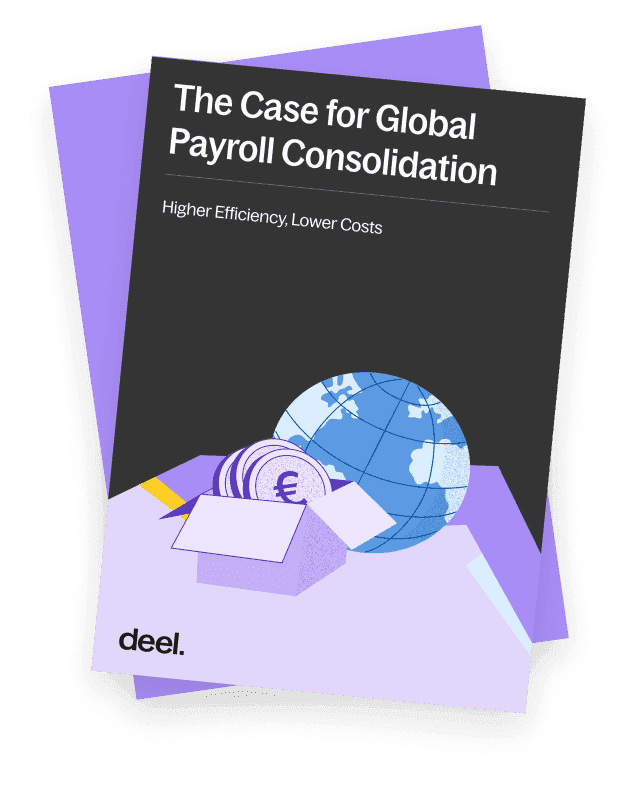
The Case for Global Payroll Consolidation
3. Continuous compliance across every jurisdiction
Tax codes change, employment regulations evolve, and data protection requirements differ by country, and they don't stay static. Managing this manually across disconnected systems, with each local payroll provider operating in its own lane, creates exposure such as permanent establishment (PE) risk, misclassification liability, and the kind of audit failures that surface during M&A due diligence.
The aggregator model has a compliance gap most buyers don't see until it's too late. Your provider receives the regulatory update, then waits on its local sub-vendors to implement it. That lag is where errors happen.
But HCM and payroll integration on owned infrastructure removes that dependency, as regulatory changes are applied at the infrastructure level, across all affected countries at once.
Deel Payroll is built this way. Deel’s payroll engine powers payroll in 50+ countries, with coverage expanding regularly. When a tax rule changes in Germany or a new employment regulation goes live in Brazil, it's updated once and applied everywhere.
Compliance
Unlock Continuous Compliance™ with Deel
4. Operational resilience and employee trust
Payroll accuracy is an operational metric, but it’s also an employee trust metric. Workers notice when they aren't paid correctly, and they draw conclusions about the organization they work for based on that experience. In a global workforce spanning multiple time zones, currencies, and employment structures, the margin for error is narrow.
An integrated HCM and payroll system closes the gaps that cause those errors. When a promotion is approved in your HCM, the compensation adjustment flows into payroll automatically. As a result, there are fewer manual re-entries, missed updates, or retroactive corrections to explain to the person who noticed it on their payslip.
Employees also get direct access to their payslips, tax documents, benefit summaries, and PTO balances through a single platform. For enterprises operating across a dozen countries, that consistency is harder to deliver than it sounds and more valued by employees than most organizations expect.
Deel also supports Anytime Pay, giving workers on-demand access to earned wages before payday. Watch the video below to learn how Deel’s built financial tools into the platform.
5. Workforce data as a strategic asset
Payroll data is usually locked in the back office, but it doesn’t have to be.
When compensation data, workforce structure, and benefit costs are all visible in a connected system, HR and finance leaders can do analysis that isn't possible with siloed data. This includes modeling the true cost of entering a new market, or correlating compensation changes with retention trends before the next review cycle.
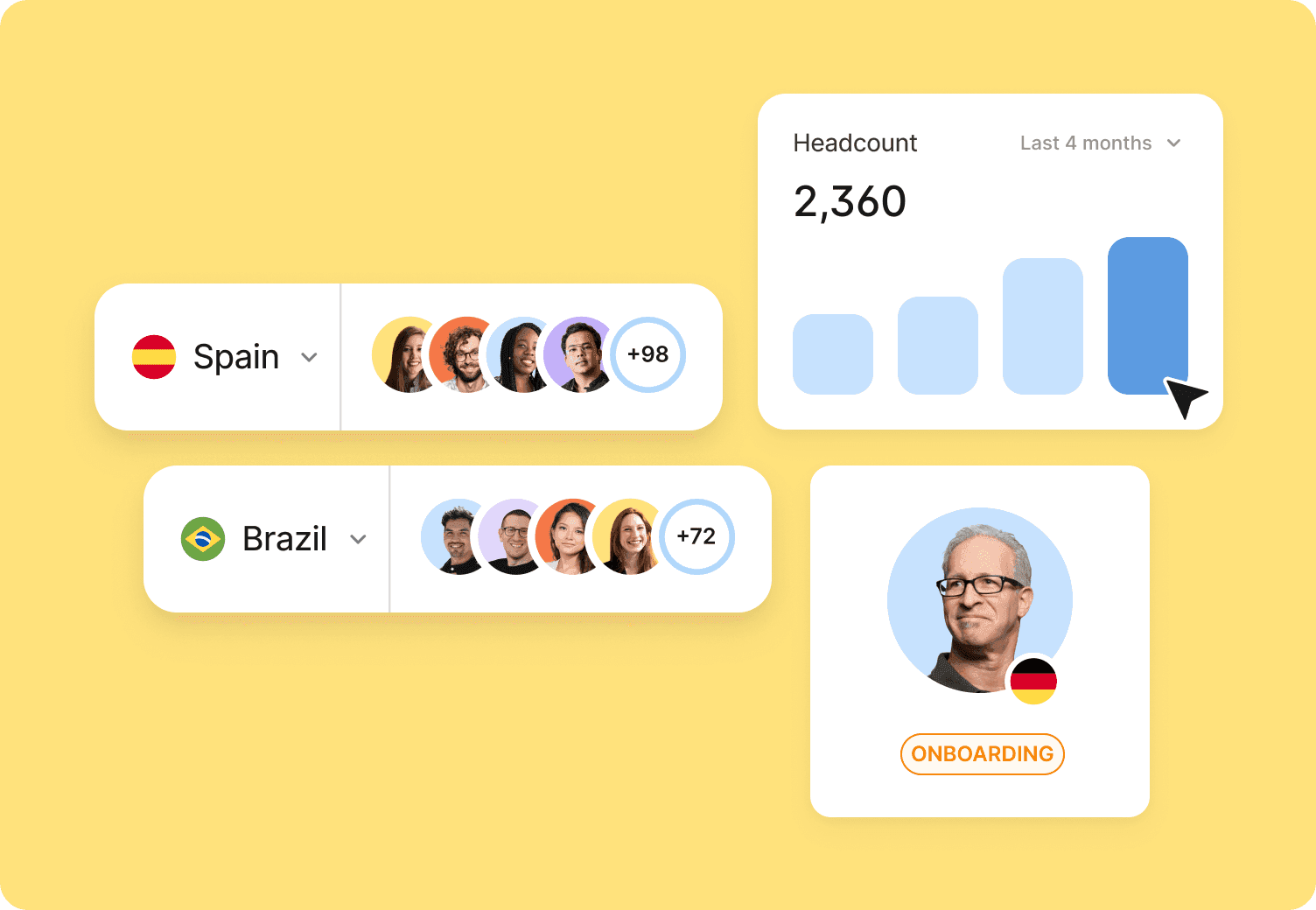
Deel Payroll provides real-time reporting and workforce analytics across every country and entity. Global Payroll Directors and CFOs get the visibility they need to move faster, without waiting for data to be manually assembled from multiple sources.
See also: HCM and Payroll Change Management Guide
We needed a partner with strong technology and the stability to handle our global complexity. Deel’s ability to centralize support and integrate seamlessly with Workday's latest tech made them the clear choice.
—Heather Ashley,
Director of HR Technology, Barings
How Deel connects your HCM and payroll stack
Deel owns its payroll infrastructure and owns entities in 100+ countries, with no opaque third parties.
For enterprises running Workday, SAP SuccessFactors, and more, Deel integrates natively. Deel is a Workday-certified Global Payroll Cloud (GPC) partner, with proven bidirectional integrations across major enterprise HCM platforms. Your HR data flows into Deel Payroll automatically, with payroll outputs and headcount data flowing back into your HRIS for consolidated reporting.
Learn more: Integrating Workday HCM and Payroll
Companies including FICO, Revolut, and Barings run payroll through Deel across multiple countries, entities, and employment types. Deel's operational maturity comes in part from the acquisitions of Safeguard Global and PaySpace, bringing more than 20 years of enterprise payroll execution experience into the platform.
For enterprises that want to consolidate further, Deel HR connects hiring, onboarding, people management, and payroll for organizations that want to rationalize their vendor footprint without a disruptive rip-and-replace.
In both cases, enterprises choose their level of control—you can run payroll in-house using Deel's platform, or hand execution to Deel's team of in-house experts.
Book a demo with Deel's enterprise specialists to see what the integration looks like for your setup.
FAQs
What's the difference between HCM integration and having an all-in-one HR platform?
HCM integration means connecting separate systems through bi-directional data sync, where your HRIS, payroll platform, and time and attendance tools can all stay in place. An all-in-one platform replaces them with a single application.
Many enterprise organizations integrate Deel Payroll with Workday or SAP SuccessFactors without touching their core HRIS. The goal is a single system of record and connected workflows, not necessarily a single application.
Is Deel an aggregator?
No. Aggregators operate by building a unified interface on top of a network of local sub-vendors, so your payroll still runs through third parties. Deel owns its payroll infrastructure, which is what makes bidirectional integration, continuous compliance, and accountability at scale possible. If you're evaluating global payroll providers, this is the right question to ask every vendor.
Does integrating HCM and payroll require replacing our existing HRIS?
No. Deel Payroll integrates natively with Workday, SAP SuccessFactors, and other major enterprise platforms through certified connectors. Your HRIS stays as the system of record for people data. Deel handles payroll execution and feeds data back for reporting. For organizations that want to consolidate further, Deel HR is available, but it's not a requirement.
How does Deel handle compliance across multiple countries?
With Deel, regulatory changes, tax rule updates, and employment law amendments are applied at the infrastructure level, across all affected countries at once. Deel AI flags inconsistencies in payroll data before disbursement, so compliance is not a manual update process or a vendor dependency, but built into how the platform runs.
How long does it typically take to implement Deel Payroll?
It depends on your organization's size, number of countries, and how complex your current setup is. Deel's implementation team handles migration, parallel run, cutover, and care so you're not managing the process alone. Your Deel account team can provide country-specific timelines and implementation methodology documentation during the evaluation.
Joanne Lee is a content marketing professional with 7+ years of experience creating effective social, search, email, and blog content for companies ranging from start-ups to large corporations. She's passionate about finding creative ways to tell a purpose-driven story, staying active at the gym, and diversity and inclusion. At Deel, she specializes in writing about topics related to global payroll and enterprise businesses.