Article
2 min read
The Middle Manager Paradox: Why Flattening Structures Today Impacts Leadership Tomorrow
Global HR

Author
Ellen Simmonds
Last Update
September 10, 2026

Key takeaways
Cuts to middle management promise speed and savings, but the data shows that remaining managers must struggle with wider teams and less support than before.
Employees are trusting their managers less than before. With this relationship damaged, fewer internal candidates are ready for promotion, impacting leadership pipelines.
Deel gives HR real-time visibility into organizational structure and succession readiness, so leadership decisions can act on the latest data and insights.
Middle management used to be a permanent fixture on the org chart, the rung every ambitious employee expected to climb through on the way up. Now, the Great Flattening describes the wave of restructuring in which businesses strip out layers of their middle management, betting instead that AI can take on the coordination work managers used to own.
Gartner seemingly saw this coming, predicting in 2024 that 20% of organizations would use AI to flatten their structure by 2026, eliminating more than half of current middle management positions. But while the logic may make sense from the C-suite's perspective, removing an entire layer from the org chart has consequences that stretch far and wide.
What flattening looks like in real organizations
Real-world companies across industries have already lost huge chunks of their middle management to layoffs. Block, a financial services company, cut 4,000+ jobs in February 2026, shrinking its workforce from over 10,000 to just under 6,000. Similarly, retailer Amazon cut 30,000 corporate roles across two rounds since October 2025 and tech giant Google reported 35% fewer managers overseeing small teams year over year.
Managers that survived the sweep of layoffs are left with increasing responsibilities. Gallup reports that the average number of direct reports per manager has shot up from 10.9 in 2024 to 12.1 in 2025, which is almost a 50% jump since Gallup started tracking this metric in 2013.
What's driving the flattening wave?
Two pressures explain most flattening decisions: the need to cut costs, and the promise of faster decision-making.
Cost comes first for most boards. Manager salaries make up a significant share of payroll, and companies facing tighter margins under continued economic uncertainty need a way to save costs without touching frontline headcount. AI supports the decision. Coordination work like status updates, scheduling, and reporting, once a core part of a manager's job, can now be handed off to AI tools or even agentic team members. As a result, it feels safer to cut this layer now than it would have five years ago.
Faster decision-making is the argument executives make in public. When monday.com cut 20% of its workforce in July 2026, co-CEO Eran Zinman built his memo to employees around exactly this point. He explained that the company’s restructure was the result of work that had dragged on for months because of too many meetings. A flatter structure would empower teams to make decisions and execute them without waiting for approval. Asked whether employees would now be expected to work harder with fewer people around them, Zinman's answer was: "Not harder - better."
Block and Coinbase are taking similar steps. Block's Jack Dorsey has described restructuring the company around a central coordination layer, splitting the roles that remain between individual contributors who are owners of specific outcomes, and player-coaches who combine hands-on work with developing people. Coinbase's Brian Armstrong has taken a slightly different approach, capping management layers at five below the CEO.
Deel HR
One place for simplified, smarter global HR
What organizations lose when the leadership pipeline collapses
While the arguments of reduced costs and faster decision-making look strong on paper, these are short-term moves that could result in long-term regrets. We can expect four consequences from flattening the management layer out of the business plan.
Leadership pipeline collapse. Korn Ferry's Workforce 2025 survey found that 41% of employees say their company cut management layers, and among them, 43% say leadership alignment has suffered while 37% feel directionless without enough guidance. Meanwhile, DSG Global's Workforce Power Index found 66% of HR decision-makers cite succession planning as their top pain point, with a quarter saying they're very concerned; 57% separately cite leadership pipeline development as a top concern.
Forced external hires. When companies cut too deep into their management layer, they lose the internal candidates they'd normally promote, forcing them to source external hires instead. But external senior hires typically cost significantly more than internal promotions. They also carry a higher risk of failure once they're in the role, as they lack institutional knowledge and awareness of cultural norms that internal hires are blessed with.
Culture and retention hit when people see no clear path upward. DDI's Global Leadership Forecast 2025 found trust in immediate managers has fallen to 29%, a 37% decline since 2022. At the same time, the share of high-potential individual contributors intending to leave rose from 13% in 2020 to 21% in 2024, and high-potential employees are 3.7 times more likely to leave when their manager doesn't regularly provide opportunities for growth.
Gen Z engagement crisis. Cutting middle managers removes the people responsible for keeping an organization's most promising employees engaged. Only 6% of Gen Z and millennial workers name reaching a leadership position as their primary career goal, according to Deloitte's 2026 Gen Z and Millennial Survey. And the management jobs that survive flattening come with larger teams and less support than before, making promotion opportunities even less appealing to Gen Z management candidates.
Gain visibility into your company's future leaders
What if company restructuring focused on building your bench of future leaders rather than making reactive layoff decisions during budget season?
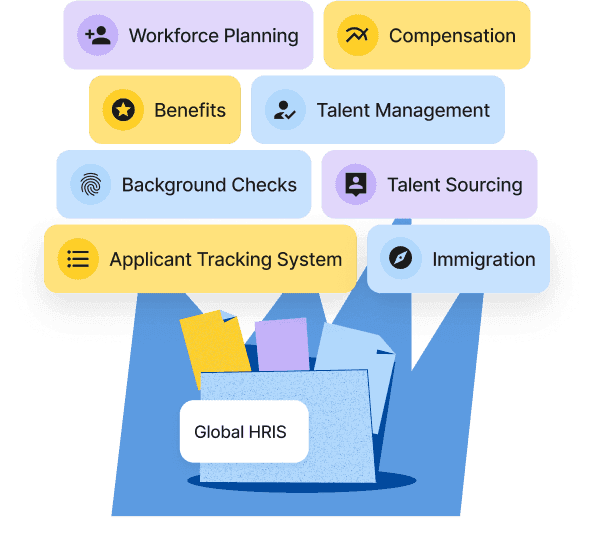
Deel HR brings workforce data and performance history into a single system, giving HR one accurate view of the organization to guide succession decisions.
Map your organizational structure and succession priorities. Deel's HRIS shows reporting lines, tenure, and role history in real time, making it clear which critical roles have a ready successor and which don't.
Identify high-potential managers worth protecting. Performance data and internal talent sourcing show who's outperforming their current role, rather than leaving that call to manager instinct alone.
Make talent decisions with data. Deel's Workforce Planning tools model headcount, skills, and readiness together, so any decision weighs who's prepared to step up alongside cost.
Build a deliberate retention strategy for future leaders. Engage's career management and learning tools connect each successor's development plan directly to the role they're being prepared for, tracked across every country the business operates in.
Run a succession planning audit. Confirm which critical roles already have a ready successor and which don't.
Track organizational health alongside headcount. Leadership alignment and readiness become visible well before a role opens, not after.
Ready to build a leadership pipeline that holds up under pressure? Book a free demo to see how Deel gives HR the visibility to develop future leaders before the organization needs them.
Live Demo
Get a live walkthrough of the Deel platform
FAQs
What is the Great Flattening?
The Great Flattening is the wave of restructuring in which businesses remove layers of middle management, betting that AI can absorb the coordination work managers used to handle. The term grew out of "The Great Unbossing," which described early management cuts starting around 2023, before flattening accelerated with the rise of agentic AI.
Why is middle management being cut?
Companies are cutting middle management largely to save on payroll and speed up execution. AI now handles much of the reporting and progress tracking that once justified a manager's seat, so leaders see fewer approval layers as a legitimate way to move faster and spend less.
How do you protect succession planning during a restructure?
Protecting succession planning during a restructure starts with a real-time view of who's ready for which role, not a rushed assessment after someone resigns. HR teams that track readiness and organizational health continuously can identify high-potential successors early and build development plans before a critical role ever opens.
Ellen Simmonds is a content marketing manager with a decade of experience in tech, leadership, startups, and the creative industries. A long-time remote worker, she's passionate about WFH productivity hacks and fostering company culture across globally distributed teams. She also writes and speaks on the ethical implementation of AI, advocating for transparency, fairness, and human oversight in emerging technologies to ensure innovation benefits both businesses and society.