
Global Work Glossary
- Results for ""
Table of Contents
What is contact information verification?
Why contact information verification matters
How contact information verification works
Warning signs in contact information
Contact information verification vs. related checks
Key facts
Detect identity fraud with Deel Security
FAQ
What is contact information verification?
What is contact information verification?
Contact information verification is the process of confirming that the email address, phone number, and physical address a candidate or worker provides are accurate, reachable, and belong to the person who submitted them.
Organizations run this check to reduce the risk of hiring a candidate who has supplied false or borrowed contact details. False contact information could indicate identity fraud or candidate impersonation fraud, where a person uses another's credentials or a fabricated identity to secure employment.
Why contact information verification matters
When a candidate's email address, phone number, or physical address cannot be traced to a consistent history, it may signal that the information was fabricated or belongs to a different person. Organizations face this risk especially in remote hiring, where they may never meet the applicant before extending an offer.
False contact details also limit the company's ability to reach a worker during onboarding, respond in an emergency, and maintain accurate records throughout the employment relationship.
How contact information verification works
Contact information verification involves several checks to assess whether a person's email address, phone number, and physical address are valid and consistent.
Verifiers check whether an email address is active and not registered through a temporary or disposable domain. They confirm whether a phone number belongs to a personal mobile line rather than a voice over internet protocol (VoIP) service, which can be created anonymously. Verifiers cross-reference physical addresses against public records and the locations the candidate cited in their application.
Where inconsistencies appear, the organization may request additional documentation or escalate to a more detailed review.
Warning signs in contact information
Several patterns could indicate that contact details are false or belong to a different person:
A phone number registered to a VoIP service rather than a personal mobile line
An email address from a temporary or disposable domain with no account history
A physical address that does not match the candidate's claimed location or employment history
Contact details that appear on a fraud watchlist or are associated with multiple identities
A mismatch between the contact information provided and what surfaces in a digital footprint analysis or professional network analysis
Contact information verification vs. related checks
Contact information verification focuses on checking a candidate's contact details, while other checks and fraud-related terms cover different aspects of their application. Here's how they differ and connect:
Identity verification: confirms who the applicant is using government-issued documents and biometric checks, not whether the contact channels they listed are reachable
Employment history verification: confirms past roles and employers, not the contact channels through which those employers can reach the applicant
Document authenticity verification: checks whether submitted documents are genuine, not whether the contact details attached to them are reachable
CV fraud: describes the broader pattern of falsifying application materials, of which false contact details are one component
Key facts
Here are some key facts about contact information verification, the risks it addresses, and how organizations use it.
Contact information verification typically covers email addresses, phone numbers, and physical addresses provided during hiring or onboarding.
VoIP phone numbers and disposable email addresses are common signals that a candidate's contact details may be fraudulent.
False contact details are a known component of synthetic identity fraud, where a fraudster builds a fabricated professional profile.
Verifying contact information across multiple sources helps identify inconsistencies that a single-source check might miss.
Organizations typically run contact information verification as part of a background check and may repeat it when a worker's details change during employment.
Social engineering attacks may rely on false or redirected contact information to intercept communications intended for the real employee.
Detect identity fraud with Deel Security
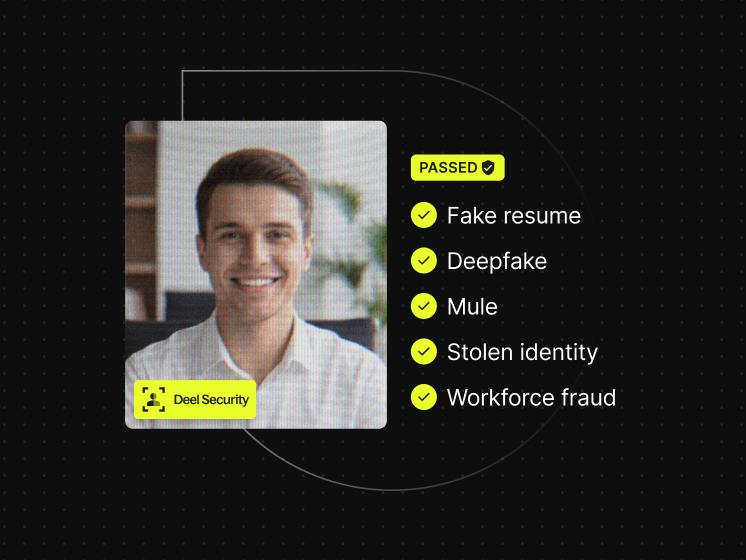
False contact details can make it harder to confirm who a candidate really is. Deel Security helps businesses detect fake candidates, synthetic identities, deepfakes, and impersonation attempts across the full worker lifecycle, from recruitment and onboarding to ongoing employment.
Deel Security integrates with your existing applicant tracking system (ATS), giving HR and security teams access to identity fraud alerts within their hiring workflows. Teams can review potential risks, investigate impersonation attempts, and make more informed hiring decisions.
Book a demo to see how Deel Security helps protect your hiring process from identity fraud.
Deel Security
Hire real people, keep fraud out from hiring to offboarding
FAQ
What types of contact information does verification cover?
Verification covers email addresses, phone numbers, and physical addresses provided at any stage of the application or onboarding process, and may extend to emergency contact details once a worker is employed.
Why is contact information verification relevant for remote hiring?
In remote hiring, an organization may never meet a candidate in person before they extend an offer. Confirming that contact details are accurate and belong to the right person is a key step in checking the applicant's identity.
How does contact information verification differ from identity verification?
Identity verification checks who the person is by examining government-issued documents and biometric data. Contact information verification is narrower: it confirms only whether the specific channels a person lists are real and reachable, not who that person is.
Can contact information verification be run after hiring?
Yes. Organizations may verify or re-verify contact details during onboarding, when a worker requests a change to their profile, or as part of ongoing security monitoring.
What happens when contact information cannot be verified?
When contact details cannot be confirmed, the organization may request additional proof, escalate to a more detailed review, or flag the application for further investigation before proceeding.
This article is for informational purposes only, does not constitute legal or compliance advice, and is not a substitute for guidance from qualified advisers familiar with your organization and jurisdiction.