Article
3 min read
EU Pay Transparency Directive in Slovakia: What's Live, and What's Still Coming
Global HR

Author
Ellen Simmonds
Last Update
August 21, 2026

Key takeaways
The EU Pay Transparency Directive requires employers across member states to disclose pay ranges to candidates, give workers the right to compare their pay, and report gender pay gaps starting in 2027.
Slovakia became the first EU member state to fully transpose the Directive, adopting the Equal Pay Act with obligations that go beyond the Directive's minimum, including same-sex equal pay protections and a soft-skills requirement in job evaluation criteria.
Deel connects job architecture, compensation bands, and payroll data on one platform, so employers in Slovakia can build pay structures and reporting from live data instead of a one-off compliance project.
Slovakia's National Council adopted the Equal Pay Act on April 15, 2026, making it the first EU member state to fully transpose the EU Pay Transparency Directive. The Act entered into force on June 7, 2026, the exact date the Directive itself set as the transposition deadline for all 27 member states.
Being first is one thing. What's more useful for HR and legal teams is what Slovakia's law actually does. The Equal Pay Act doesn't just meet the Directive's floor. It adds obligations the Directive never required: equal pay protections for same-sex comparisons, a soft-skills requirement in job evaluation, and an enforcement structure that reads as mild on the surface and considerably less mild once you look at how it's actually built.
EU Compliance with Deel
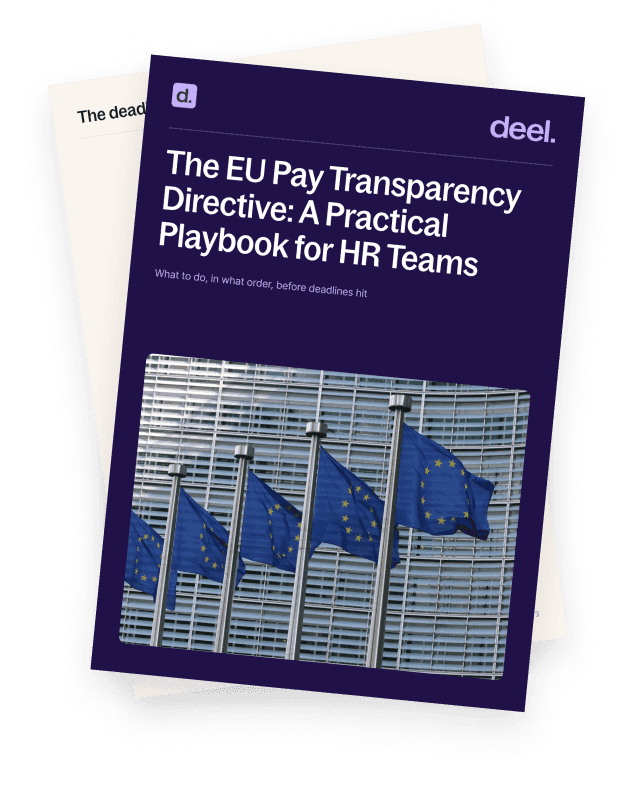
EU Pay Transparency Directive: A Practical Playbook for HR
What the Equal Pay Act actually is
The law has a longer runway than its April adoption date suggests. A draft was published in September 2025 and submitted to Parliament on January 7, 2026, before the National Council adopted it in April.
Two dates matter here, and they're easy to conflate. The Act entered into force on June 7, 2026. But employers have until July 31, 2026 to actually have compliant pay structures in place. The law being in force and an employer being compliant with it aren't the same milestone, and the six-week gap between them is easy to miss if you're only tracking the headline date.
The Act applies broadly: every employment relationship governed by Slovakia's Labour Code, plus equivalent public sector relationships covering state employees, prosecutors, and judges.
What's already in effect
Pay range disclosure has a timing requirement, not just a content requirement. Employers must disclose the pay range or starting salary at a point that allows for informed, transparent negotiation. Including the range in the job posting itself satisfies this. Ranges also can't be drafted so broadly that they stop meaning anything. This builds on an existing rule: employers in Slovakia already had to disclose base salary in job postings under the Employment Services Act. The Equal Pay Act extends that into a full range disclosure requirement.
Salary history questions are banned, though the law leaves room for employers to ask candidates about their own pay expectations. Best practice is to hold off on that question until the range disclosure obligation has already been met, so the negotiation stays genuinely informed rather than anchored to whatever the candidate names first.
Pay structures have to be built on objective, gender-neutral criteria, and agreed with employee representatives where they exist. This isn't a document to draft unilaterally and file away. Where a works council or equivalent body is present, the criteria need their sign-off.
Job evaluation criteria must explicitly account for soft skills. Specifically, social and communication abilities. The Directive refers more generally to skills and effort; Slovakia's law names soft skills directly. For any organization running a job-leveling framework designed elsewhere and applied to Slovakia by default, this is the kind of detail that's easy to miss, since most global job classification frameworks weren't built with this specific requirement in mind.

EU Compliance with Deel
EU Pay Transparency Directive Readiness Checklist
Where Slovakia went further than the Directive
Slovakia's law is often described as "minimal-plus," and the additions are specific enough to matter operationally, not just symbolically.
Same-sex equal pay protections. Slovakia amended its Labour Code so that employees of the same sex performing equal work or work of equal value have an enforceable right to equal pay, not only cross-gender comparisons. This is one of the more substantial departures from the Directive's own text among the states that transposed it early, and it changes what a defensible pay comparison actually needs to cover.
A 30-day response window for clarification requests. The Directive doesn't set a deadline for employers to respond when someone asks for clarification on pay-gap data. Slovakia's law does: 30 days.
A wider set of people who can ask for that clarification. It's not limited to the employee in question. Employee representatives, the Labour Inspectorate, and the Slovak National Center for Human Rights can all request clarification on category-level pay-gap information. This functions as a middle step between the initial report and a formal joint pay assessment, and it means an information request can originate somewhere other than an individual worker's inbox.
The individual right to average pay information has a delayed practical start. Even though the Act is in force from June 7, 2026, employers only have to provide this information for the first time tied to the 2027 reporting cycle. The right exists on paper sooner than it's actually usable in practice.
What's coming in 2027
Reporting phases in by employer size, and the dates are worth tracking precisely.
Employers with 250 or more employees report annually, starting June 7, 2027. Employers with 150 to 249 employees report every three years, also starting June 7, 2027. Employers with 100 to 149 employees join the reporting requirement later, on June 7, 2031, also every three years. Employers with fewer than 100 employees aren't subject to mandatory reporting under the Act.
One deviation worth flagging for anyone building a reporting calendar: the first report due from 150-plus employers on June 7, 2027 only needs to cover August 1, 2026 through December 31, 2026. That's a five-month window, not a full calendar year, which is narrower than what most people assumed the first cycle would require.
Reports go to Slovakia's Ministry of Labour, Social Affairs and Family. Publishing the data on the employer's own website is optional, not mandatory.
Enforcement, and why the headline fine understates it
On paper, the penalty for reporting failures looks modest: a fine between €4,000 and €8,000, weighed against the seriousness, duration, and recurrence of the violation, and imposed within two years of the violation. Compared to some of the fines proposed elsewhere in the EU, that range wouldn't obviously meet the Directive's requirement for penalties to be "effective, proportionate, and dissuasive."
That's not the whole enforcement picture. The Act also amends Slovakia's Labour Inspection Act, giving the Labour Inspectorate the power to fine employers up to €100,000 for broader breaches of the Act's obligations, not just reporting. The modest headline number and the six-figure ceiling both exist in the same law, applying to different kinds of violations.
Worth noting as real-world context, not a prediction: average fines issued by Slovak labour inspectors in 2024 for general labour law violations, unrelated to equal pay specifically, were around €2,300, well below either figure in the Equal Pay Act. How aggressively inspectors actually enforce a brand new law is still an open question. Employees also have a direct route of their own: they can file complaints with the Labour Inspectorate and pursue compensation, including back pay, and retaliation protections mean a dismissal or demotion linked to raising a claim can lead to reinstatement or compensation.
Getting ahead of it
Three things are worth prioritizing now rather than waiting for the July 31 compliance deadline to force the issue.
Review job postings against the range disclosure and timing requirements, since that obligation is already enforceable. Check whether current job evaluation criteria explicitly account for soft skills, since that's a specific requirement Slovakia added and most existing frameworks won't cover by default. And start building toward the 2027 reporting cycle now, particularly if your organization crosses the 150-employee threshold, since the shortened first reporting window means less runway than the June 2027 date implies.
Getting pay structures and reporting data organized ahead of a deadline is easier than reconstructing them under one. A connected compensation strategy that ties job evaluation, pay bands, and reporting together in one system avoids the scramble that comes from stitching data together from separate tools after the fact.
Deel HR
One place for simplified, smarter global HR
Stay ahead of the next update, in Slovakia and everywhere else
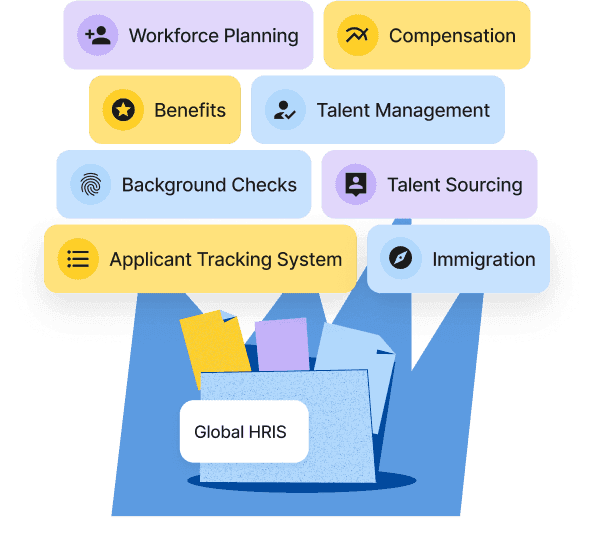
Slovakia moved first, but the requirements it added are a preview of the kind of local variation showing up across the EU as more member states finalize their own laws. Deel HR keeps job architecture and evaluation criteria in one system, and Deel's Compensation Management module connects that structure directly to pay bands and reporting, so a requirement like Slovakia's soft-skills criteria gets built into your job framework once, rather than tracked separately in a spreadsheet.
Book a demo to see how Deel helps you build compliant pay structures and reporting as requirements evolve, country by country.
This content is for informational purposes only and does not constitute legal advice. Compensation laws and regulations change frequently. Businesses should consult qualified legal counsel for jurisdiction-specific guidance.
Live Demo
Get a live walkthrough of the Deel platform

Ellen Simmonds is a content marketing manager with a decade of experience in tech, leadership, startups, and the creative industries. A long-time remote worker, she's passionate about WFH productivity hacks and fostering company culture across globally distributed teams. She also writes and speaks on the ethical implementation of AI, advocating for transparency, fairness, and human oversight in emerging technologies to ensure innovation benefits both businesses and society.