Article
4 min read
EU Working Time Directive: The Employer's Guide to Mandatory Time Tracking
Global HR
Legal & compliance

Author
Jemima Owen-Jones
Last Update
August 24, 2026
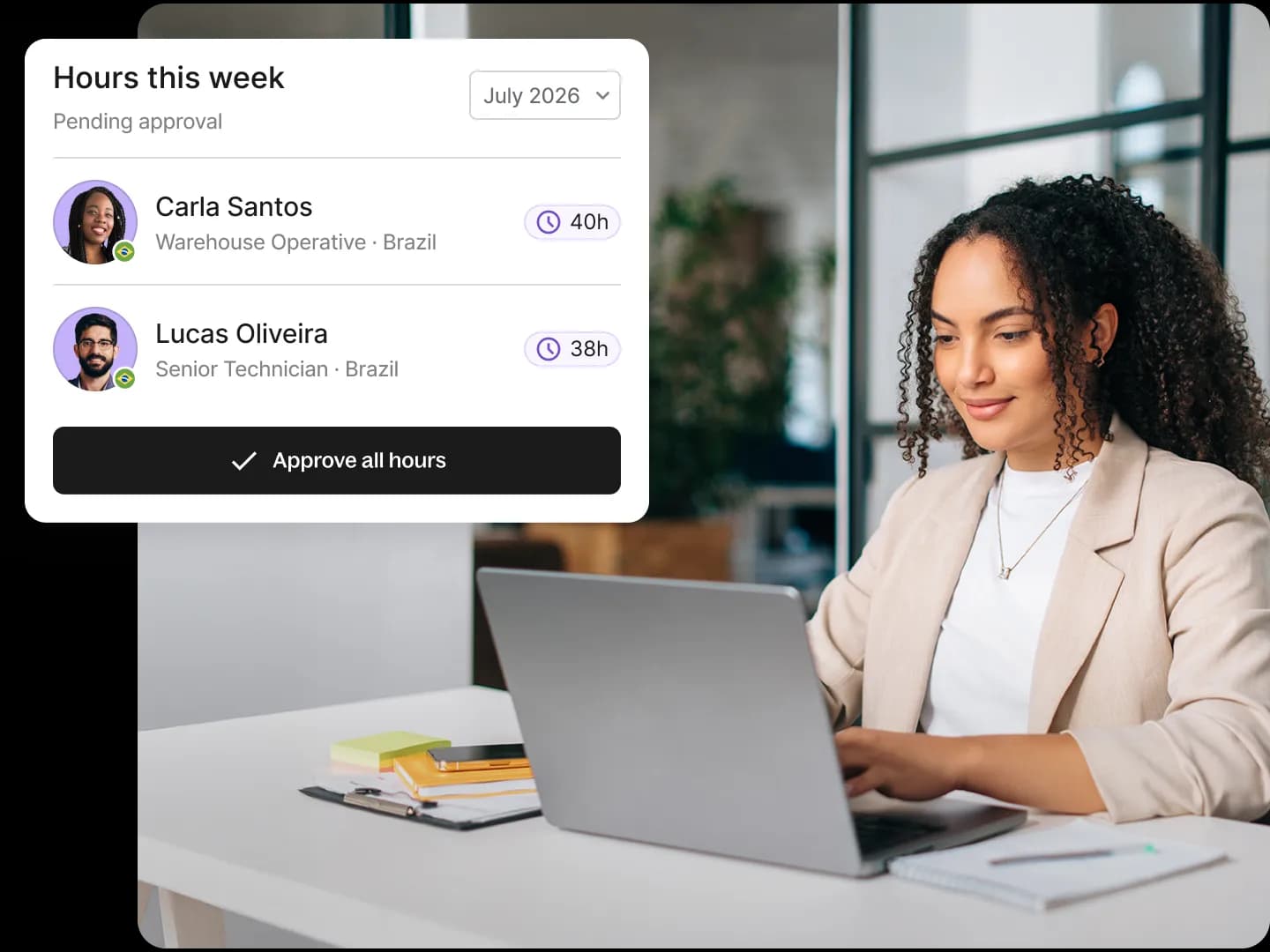
Table of Contents
What is the EU Working Time Directive?
What is the EU Time Tracking Requirement?
A quick history: 1993 - 2019
All 27 EU Member States time tracking requirements
Why this matters now: The compliance risk for employers
Deel's approach: The best way to properly comply
Getting started: Track time accurately with Deel
Key takeaways
Mandatory EU time tracking is enforced across all 27 member states. Manual spreadsheets and fragmented systems don't meet the CJEU's "objective, reliable, accessible" standard—and non-compliance carries penalties up to €62,500+ per infraction.
Only integrated time tracking that syncs directly to payroll can actually prove compliance. Hours tracked in one system and re-entered into another create discrepancies that fail regulatory audits.
Deel helps support compliance configurations for time tracking in select countries. It closes the loop between hours worked and payroll for every worker type, including EOR, direct employee, contractor, and on-site field services worker.
If you're trying to understand what the EU Working Time Directive and 2019 CJEU Mandatory Time Tracking ruling mean for your business, you're in the right place. The regulatory landscape shifted, and employers who aren't aligned are exposed.
You're managing operations across Spain, Germany, France, and beyond—each with different rules, different penalties, and different enforcement aggressiveness. You can't quite tell if your current approach meets the "objective, reliable, accessible" standard. And when a regulator audits your records, gaps between what was tracked and what you can prove become expensive, fast.
The 2019 CCOO v. Deutsche Bank ruling set a single, clear standard: time records must be objective, reliable, and accessible. That triggered stricter enforcement across the EU. This guide breaks down the country-specific requirements, explains why manual and fragmented approaches fail, and shows you the only system that actually works.
Whether you're in compliance, HR, finance, or running the business, this guide is built for you.
Deel has helped thousands of global employers navigate similar shifts. This guide walks you through the ruling, the country requirements with penalties, and how to implement Time Tracking to actually prove compliance.
What is the EU Working Time Directive?
The EU Working Time Directive is a European law that sets minimum standards for working hours, rest periods, and annual leave. First introduced in 1993, it was updated in 2003 and now applies across all EU Member States.
What is the EU Time Tracking Requirement?
The EU Time Tracking Requirement is the rule that enforces the Working Time Directive. In 2019, the European Court of Justice ruled that employers must implement a system to accurately track employee working hours.
A quick history: 1993 - 2019
The EU Working Time Directive has been in place since 1993. For three decades, it's set the baseline for worker protection across Europe:
Maximum 48 hours per week (averaged over 4 months, including overtime)
11 consecutive hours of daily rest and 24 hours of uninterrupted weekly rest minimum
Breaks mandated after 6 hours of work
4 weeks of paid annual leave minimum
Night work capped at 8 hours per 24-hour period
The directive was well-intentioned. But it had one fatal flaw: it didn't require employers to prove they were following it.
For decades, employers kept records however they wanted—or sometimes, not at all. Timesheets were informal. Spreadsheets were inconsistent. Nobody had a system to demonstrate that what workers actually worked matched what the rules required. Regulators had no way to verify compliance.
That gap—between the rules on paper and the ability to prove compliance—is exactly what a 2019 lawsuit closed.
It started when the Spanish subsidiary of Deutsche Bank was discovered underreporting employee hours and underpaying for overtime. The Spanish trade union filed a lawsuit, arguing the bank had violated EU labor law set out by the Working Time Directive and Charter of Fundamental Rights.
In May 2019, the European Court of Justice ruled in favor of the union: all EU employers must track their employees' working hours using an "objective, reliable, and accessible system" for measuring daily working time.
The ruling also established three core timekeeping requirements:
Records – Employers must record each employee's duration of time worked, including daily rest and overtime hours
Accessibility – Timekeeping data must only be accessible to persons with a legitimate interest
Safety – All data must be handled in accordance with GDPR
That one ruling changed everything. It wasn't a new law. It was enforcement of an existing one—backed by the requirement to prove compliance.
Four years later, that enforcement is only tightening. More EU Member States are adding their own rules on top of the directive. Record-keeping requirements now vary significantly by jurisdiction. Penalties for non-compliance are increasing.
Time Tracking
Time tracked. Payroll trusted. Nothing to reconcile.
All 27 EU Member States time tracking requirements
Here's what you need to know about mandatory time tracking in EU Member States and associated territories. The table below covers the countries where recording working hours is legally required, with the specific rules you must follow:
| Country | Key Requirement | Retention | Max Weekly Hours | Penalties | Pre-2019? | Notes |
|---|---|---|---|---|---|---|
| Austria | Daily start/end times + breaks | 3 years | 48h (6-month ref.) | €4,000–€30,000 | ✅ Yes | Had requirement before CJEU ruling; applies per worker |
| Belgium | Start/end times (sector-specific recording) | 1–5 years | 38–47.5h (varies) | €100–€2,000/day | ❌ No | "Plus Minus Account" allows extended reference periods |
| Bulgaria | Daily working hours | 3–4 years | Up to 56h (non-compliant) | €200–€2,000 | ✅ Yes | Reference period exceeds 4-month CJEU standard; flagged by EU Commission |
| Croatia | Daily working hours | 3 years | 48h | €300–€3,000 | ✅ Yes | Pre-2019 requirement; allows opt-out in healthcare/emergency services |
| Cyprus | Records of working hours | 3 years | 48h | €500–€5,000 | ❌ No | No explicit legal recording mandate; opt-out available |
| Czech Republic | Daily hours | 3 years | 48h | €200–€500/day | ❌ No | Removed opt-out for healthcare (July 2020) |
| Denmark | Objective, reliable, accessible system | 5 years | 48h | DKK 50,000 (~€6,700) | ❌ No | New law effective July 1, 2024; employer chooses system type |
| Estonia | Daily working hours | Indefinite (payroll) | 48h | €1,200–€8,000 | ✅ Yes | Pre-2019 requirement; applies per worker |
| Finland | Daily working hours | 7 years (contract law) | 48h | €100–€50,000 | ✅ Yes | Pre-2019 requirement; Working Hours Act § 2 |
| France | Daily records (esp. part-time/overtime) | 3 years | 35h standard; 48h avg. | €1,500–€3,000/employee | ❌ No | Labour Code L3121+; no opt-out; no monetary compensation for missed rest |
| Germany | Objective, reliable, accessible system | 2–3 years | 48h (6-month ref.—flagged) | €3,000–€30,000 | ❌ No | Federal Labour Court ruling (Sept. 2022); legislation pending |
| Greece | Digital Work Card (real-time, electronic) | ERGANI II system | 48h | €500–€5,000 | ❌ No | Law 4808/2021; integrated with government ERGANI II; real-time access |
| Hungary | Daily working hours | 3 years | 48h | €200–€2,000 | ✅ Yes | Pre-2019 requirement; allows opt-out in healthcare/security |
| Ireland | Organization of Working Time Act | 3 years | 48h | €250–€3,000 | ❌ No | Growing enforcement; compliance issues in social care sector noted |
| Italy | Daily attendance records | 2 years | 48h | €150–€2,500/worker/day | ❌ No | Labour Code Article 2107; unions actively monitor |
| Latvia | Working time records | 3 years | 48h | €100–€1,500 | ✅ Yes | Pre-2019 requirement; removed opt-out for medical doctors (Jan. 2022) |
| Lithuania | Daily working hours | 3 years | 48h | €300–€5,000 | ✅ Yes | Pre-2019 requirement; compensatory rest within 14 days (flagged as too long) |
| Luxembourg | Working time records | 5 years | 48h | €500–€3,000 | ✅ Yes | Pre-2019 requirement; no explicit recording mandate in law |
| Malta | Working hours records | 3 years | 48h | €500–€2,000 | ❌ No | No explicit legal recording requirement; opt-out permitted |
| Netherlands | Hours, breaks, leave records | 52 weeks minimum | 60h max/week; 12h max/day | €10,000/employee | ❌ No | Working Hours Act amended; legislation finalization pending |
| Poland | Daily working hours | 3 years | 48h (extends to 6 months in some cases) | €100–€1,000 | ✅ Yes | Pre-2019 requirement; applies per contract (not per worker) |
| Portugal | Record of hours worked | 3 years | 48h | €200–€2,000 | ✅ Yes | Pre-2019 requirement; labor authority monitoring |
| Romania | Daily working hours | 3 years | 48h | €100–€5,000 | ✅ Yes | Pre-2019 requirement; applies per worker |
| Slovakia | Daily working hours | 3 years | 48h (6-month ref. in some sectors) | €300–€3,000 | ✅ Yes | Pre-2019 requirement; on-call duty issues noted |
| Slovenia | Working time records | 3 years | 48h (6-month ref. in some sectors) | €500–€3,000 | ✅ Yes | Pre-2019 requirement; applies per worker |
| Spain | Daily start/end times ("Registro de Jornada") | 4 years | 48h (reference period set at 12 months—flagged) | €6,250–€62,500/infraction | ❌ No | First country to legislate post-CJEU; unions actively monitor; high enforcement |
| Sweden | Working hours records | 3 years | 40h standard + on-call | €1,000–€10,000 | ✅ Yes | Pre-2019 requirement; no explicit recording mandate in law |
Note: All 27 EU member states enforce time tracking requirements following the May 2019 CJEU ruling. Deel Time Tracking is compliant with the EU Working Time Directive in the majority of EU member states. Implementation timelines and penalty severity vary by country—some had requirements in place before 2019; others are still finalizing legislation. Penalties range from €250 (Ireland) to €62,500+ per infraction (Spain), with enforcement tightening across all jurisdictions as of July 1, 2024.
Why this matters now: The compliance risk for employers
Here's the regulatory reality across the EU today:
July 1, 2024 marked the enforcement deadline for time tracking requirements across EU member states. Employers must now record all working hours using a system, though implementation and enforcement practices vary by country
Spain: Unions have legal rights to access time records. Non-compliance can trigger collective complaints and fines up to €62,500+ per infraction
Germany: Labor inspectorates conduct rigorous audits. Records must withstand scrutiny. Federal Labour Court ruling (Sept. 2022) confirmed the obligation; penalties reach €30,000+
France & Italy: Enforcement is tightening. Underpayment liability extends years back. Fines are cumulative across affected workers
Denmark, Ireland, Netherlands: New legislation came into effect July 1, 2024. Growing regulatory activity; penalties increasing
For employers operating in the EU, and other countries with time tracking regulations, this creates three concrete problems:
Fragmented rules across Member States and beyond. Spain tracks differently than Germany; Germany differently than Italy. Rules around record retention, worker notification, union reporting, and regulatory penalties differ significantly across EU jurisdictions. A compliant system in one country may create liability in another.
Manual reconciliation kills efficiency. Hours are tracked in one system, entered into spreadsheets, re-entered into payroll, and reconciled across tools. Discrepancies emerge. Regulators ask to see proof, and mismatched records don't inspire confidence.
Operational burden scales poorly. Chasing missing timesheets, calculating breaks, enforcing maximum hours, managing exceptions—none of this can be done manually at scale. It ties up HR and payroll teams and leaves room for error.
If your hours are tracked in one system and your payroll runs on another, you have a reconciliation problem. If you can't match what was tracked to what was paid, you can't prove compliance. When a regulator asks for proof, a spreadsheet with discrepancies doesn't hold up.
Deel's approach: The best way to properly comply
Deel provides time tracking configurations compliant with the EU Working Time Directive in the majority of EU member states. Only integrated time tracking that syncs directly from verification to payroll can actually prove compliance.
When you activate Time Tracking, here's what happens:
Workers clock in or submit hours via mobile, web, or Slack—with geofenced location verification if on-site work applies
Managers approve shifts in real time, with country-specific working hour rules enforced automatically
Approved hours sync directly to payroll with no re-entry, no spreadsheets, no reconciliation
Every step is logged and auditable. Every clock-in, approval, and correction carries a timestamp and is accessible to workers and regulators on demand
One system of record for both work and pay—eliminating the discrepancies that create compliance liability
This design meets the CJEU's standard in the majority of the EU countries, because there's no gap between tracked hours and paid hours. No manual steps. No re-entry error. No dispute.
Trust signal: Geofencing for location-verified clock-ins
For on-site field, retail, manufacturing, healthcare, or other industry-specific teams, you can set up geofenced work locations. Employees clock in or out only when they're within a designated radius of their assigned site.
How Deel approaches this:
Deel captures location data only at the moment of clock-in, break times, and clock-out—not continuously. Geolocation data is automatically deleted after 90 days. Workers can view their full location history in the app at any time. When geofencing is enabled, your team is notified—transparency is built in.
Why this matters for trust:
Data minimization: Only location data at clock-in and clock-out moments is recorded
Automatic deletion: Records older than 90 days are purged (configurable by country)
Worker transparency: Employees see their own location records and understand compliance flagging
Compliance design: Meets GDPR data protection requirements and global privacy frameworks without surveillance infrastructure
Built for attendance verification, not monitoring: The only data stored is whether the employee was inside a geofence or not, and which work location it was. No location trails. No continuous monitoring
What you get: The business case
Regulatory confidence. When an inspector asks for proof of working hours, you have an audit trail. Digital. Timestamped. Complete. No gaps. No discrepancies. That's what "objective, reliable, accessible" actually means.
Payroll accuracy. Hours approved in Deel sync directly to payroll with no re-entry. No human error. No end-of-cycle scramble to reconcile. Workers get paid accurately for what they actually worked.
Operational efficiency. Managers approve hours in one place. Payroll runs on schedule. No reconciliation meetings. No exception handling for mismatched records. No compliance anxiety.
EU consistency. The same system enforces working time rules in Germany, Spain, France, Italy, and across the EU. You don't manage 10 different time-tracking solutions. You manage one platform.
Getting started: Track time accurately with Deel
Time Tracking is included in all Deel contracts at no additional cost. Geofencing is available to all customer types.
To activate:
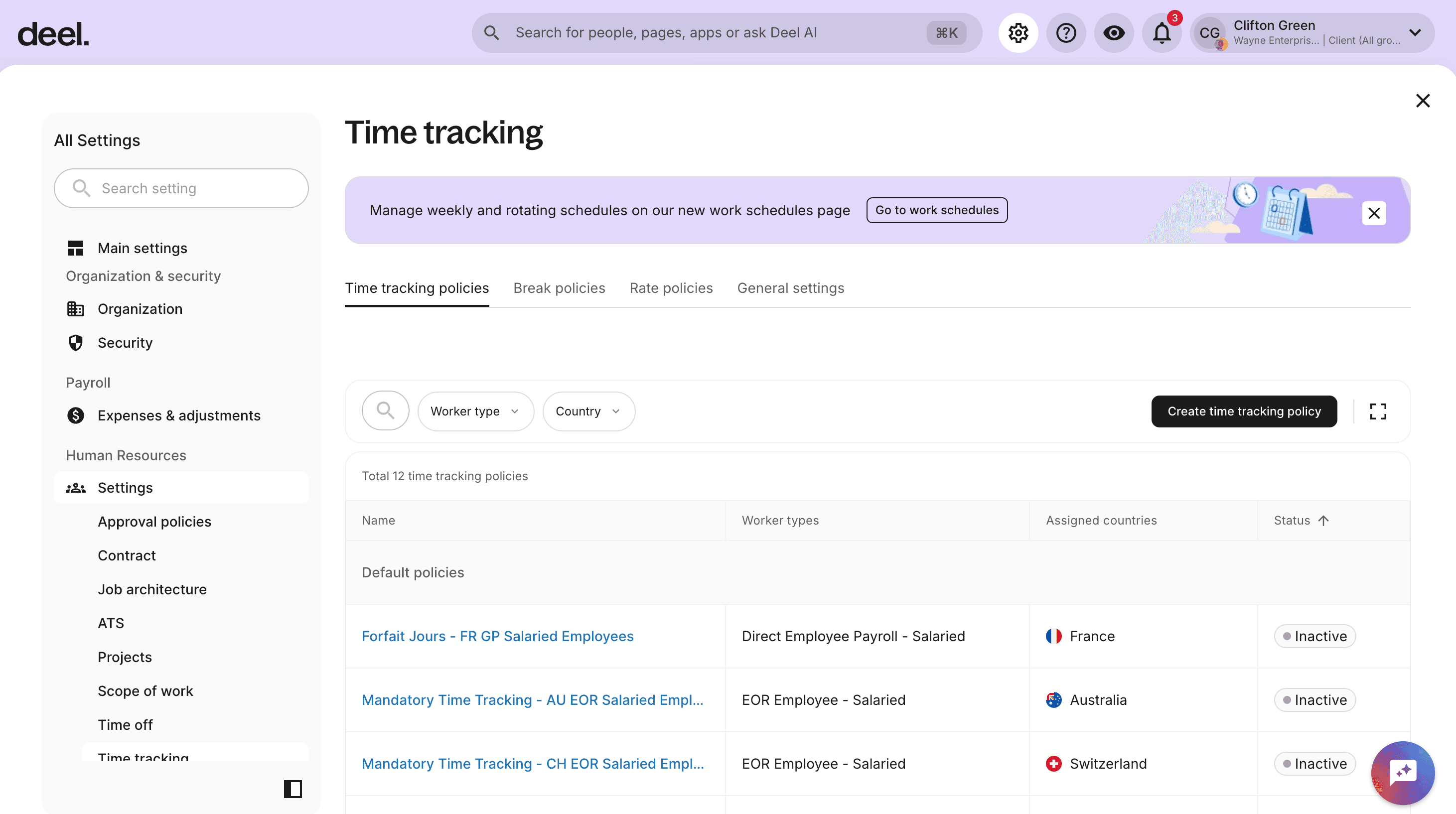
Define your work schedules (fixed, rotating, or geofenced locations)
Set working time limits by country (Deel has statutory defaults for mandatory EU jurisdictions)
Train managers on approval workflows
Workers submit hours via mobile, web, or Slack
Managers approve; hours sync to payroll
Live Demo
Get a live walkthrough of the Deel platform
More resources
FAQs
Does the EU Working Time Directive still apply in the UK?
Short answer: No—not directly. But the UK has its own equivalent.
The EU Working Time Directive no longer applies to the UK after Brexit (January 2020). However, the UK implemented the core provisions of the directive through the Working Time Regulations 1998, which remain in force as domestic law.
For UK employers, the key rules are:
Maximum 48-hour average working week (over a reference period, typically 17 weeks)
Minimum 11 consecutive hours of daily rest
Minimum 24 hours of uninterrupted weekly rest
5.6 weeks (28 days) of paid annual leave per year
Right to opt out of the 48-hour limit (with individual worker agreement)
However: If your company has employees working in EU member states, you must comply with the EU Working Time Directive for those employees, regardless of where your headquarters is located.
Is employee monitoring legal in Europe?
Short answer: Yes—but only if it's done legally and transparently as this heavily regulated by data protection laws, particularly the GDPR and ePrivacy regulations
Employee monitoring is legal in Europe, but it must:
-
Have a legitimate business purpose — The employer must have a clear, documented reason (e.g., compliance, security, productivity management).
-
Comply with GDPR — Data collection must be based on a lawful basis, proportionate, limited to what is necessary, and handled securely. Personal data must be deleted after the legal retention period.
-
Be transparent — Employees must be informed about what is being monitored, how data is used, and how long it's kept and their rights as data subjects. Surprise surveillance is not legal.
-
Respect proportionality — Monitoring must be no more intrusive than necessary to achieve the stated business purpose.
Important: Some EU countries have stricter rules than others:
Portugal, Cyprus, and Denmark have their own regulations on employee monitoring that go beyond GDPR requirements.
Geofencing and location tracking must be minimized and deleted after use. Continuous location monitoring is generally not permitted unless explicitly justified and transparent.
The Deel approach: Time Tracking captures location data only at clock-in and clock-out (not continuously), automatically deletes it after 90 days, and workers can view their own records at any time. This approach helps Deel’s client’s to meet their legal obligations as data controllers.
What are some benefits of time tracking?
Time tracking delivers benefits across three areas:
For employers:
Payroll accuracy: Eliminate errors in wage calculations. Hours sync directly to payroll with no manual re-entry, reducing disputes and late payments
Compliance confidence: When regulators audit your records, you have complete, timestamped proof of hours worked. This is exactly what the CJEU's "objective, reliable, accessible" standard requires
Operational efficiency: No more spreadsheet reconciliation. No more HR teams chasing missing timesheets or resolving discrepancies. Managers approve hours in real time; payroll runs on schedule
Cost control: Prevent time theft, reduce untracked overtime, and optimize workforce allocation across projects and teams
Legal protection: Comprehensive audit trails defend you against wage disputes, labor complaints, and regulatory penalties. A single system of record (not 10 different spreadsheets) proves compliance.
For employees:
Fair compensation: Employees know their hours are accurately recorded and paid. No more disputes over wage calculations
Transparency: Workers see their own time records, understand break deductions, and can verify accuracy. This builds trust
Work-life balance: Accurate tracking of rest periods and maximum working hours ensures employees aren't overworked and receive required breaks
Evidence for disputes: If there's ever a question about pay or hours worked, employees have clear, timestamped records to reference
For the business:
Better decision-making: Real data on how time is spent across projects, teams, and locations helps you allocate resources more effectively
Productivity insights: Visibility into time allocation helps identify bottlenecks, optimize workflows, and spot team member burnout early
Reduced absenteeism: Clearer tracking of attendance patterns helps identify issues and manage them proactively
Profitability: Accurate billable vs. non-billable hour tracking improves project costing and client billing accuracy
Who must comply with the EU Working Time Directive?
All employers with employees working in EU member states, regardless of company size or sector, must comply with the directive. This includes:
Small businesses (2+ employees)
Large multinational corporations
Startup companies
Non-profit organizations
Public sector employers
Exception: A few specific sectors have partial exemptions (e.g., armed forces, police under certain circumstances, some emergency services). But these sectors still must ensure workers receive minimum rest and protection from excessive hours.
What is the penalty for non-compliance with the EU Working Time Directive?
Penalties vary significantly by country and severity of violation:
| Country | Penalty Range |
|---|---|
| Spain | €6,250–€62,500+ per infraction |
| Germany | €3,000–€30,000 per violation |
| France | €1,500–€3,000 per employee per violation |
| Italy | €150–€2,500 per worker per day of violation |
| Netherlands | €10,000 per employee |
| Denmark | DKK 50,000 (~€6,700) |
| Ireland | €250–€3,000 per violation |
Beyond fines:
Legal liability for unpaid wages or overtime
Collective complaints from unions (especially in Spain)
Reputational damage
Labor inspectorate audit and enforcement action
Employee grievances and lawsuits
Key point: Penalties are cumulative. If 10 employees were underpaid due to missing time records, the fine applies per employee, not once per company.
How should I implement time tracking in my organization?
There is one path to comprehensive compliance: Deel Time Tracking. It is the gold standard for EU mandatory time tracking.
Step 1: Choose Deel Time Tracking
Deel Time Tracking is purpose-built for EU compliance across all 27 member states. It meets the CJEU's "objective, reliable, accessible" standard and integrates directly with Deel Payroll, eliminating the reconciliation problems that plague other systems.
Step 2: Configuration is embedded—no setup required
Deel Time Tracking comes with country-specific rules pre-configured for all 27 EU member states. You don't need to manually configure anything—just activate the feature for wherever your team works.
Step 3: Train your team
Managers learn the approval workflow (takes <30 minutes)
Employees clock in via mobile, web, or Slack (intuitive one-click process)
HR learns how to run compliance reports and manage exceptions
Step 4: Activate and monitor
Roll out to your team (usually within 1–2 weeks)
Monitor adoption and address blockers early
Run compliance reports regularly (Deel generates these automatically)
Step 5: Payroll syncs automatically—no manual work
Hours approved in Time Tracking sync directly to Deel Payroll. . No spreadsheets. No re-entry. No reconciliation. What workers log is what they get paid, exactly, with a full audit trail.
Can I choose my own time tracking system under the EU Working Time Directive?
Technically, yes. Practically, you may regret it.
The CJEU and EU directive do not mandate a specific system. Employers can theoretically choose any digital solution as long as it meets three criteria:
Objective: The system records actual hours worked without bias or interpretation
Reliable: The data is accurate, tamper-proof, and audit-ready
Accessible: Employees and regulators can access records on demand
The fatal flaw with other systems:
Most standalone time tracking platforms meet the CJEU standard on paper. But they don't sync with payroll. This creates a serious problem:
Hours are logged in System A (the time tracker)
Hours are manually re-entered into System B (payroll)
Discrepancies emerge between the two systems
When regulators audit, the mismatch becomes your liability
Your team spends hours every month reconciling spreadsheets instead of running payroll
What regulators actually expect:
Digital records with timestamps
Tamper-proof data
Instant access and export capability
Integration with payroll to prove hours match pay (most standalone systems fail here)
The true cost of "choosing your own system":
Ongoing integration work and maintenance
Monthly reconciliation meetings
Risk of audit findings due to mismatches
Higher total cost of ownership (two systems instead of one)
Compliance liability if hours and pay don't align
Why Deel is different: Time Tracking is part of Deel Payroll. Hours sync automatically. Zero re-entry. Zero reconciliation. Zero compliance risk from mismatched records.
If you're considering another system, ask this question: "Does it integrate natively with payroll, or will I need to manually re-enter data?" If it's the latter, you're not actually solving the compliance problem—you're just meeting the letter of the law while creating operational chaos.
Do I need to give employees access to their time records under the EU Working Time Directive?
Yes. This is a legal requirement in most EU jurisdictions.
The directive states:
Employees have the right to access their own time records
Employers cannot charge employees for this access
Records must be provided in a format that's easy to read and verify
Access should be timely (within a few days on request)
Best practice:
Give employees always-on access to their own records via a self-service portal or mobile app
This builds trust, reduces disputes, and demonstrates transparency
Workers can verify accuracy immediately and flag errors early
How long must I keep time tracking records under the EU Working Time Directive?
Retention periods vary by country:
| Country | Retention Period |
|---|---|
| Denmark | 5 years |
| Spain | 4 years |
| Austria, Belgium, Croatia, Czech Republic, Estonia, Hungary, Ireland, Italy, Latvia, Lithuania, Poland, Portugal, Romania, Slovakia, Slovenia | 3 years |
| Germany | 2–3 years |
| Finland | 7 years (under contract law) |
| France | 3 years (payroll-linked) |
Practical note: Most countries tie retention to payroll and tax records, which are typically 5–7 years. Using the longest applicable period (5–7 years) is a safe approach across all EU jurisdictions.
What to keep:
Clock-in and clock-out timestamps
Breaks and rest periods
Approved hours
Any corrections or amendments (with audit trail)
Payroll records showing what was paid
Can I use manual timesheets instead of digital systems under the EU Working Time Directive?
Technically, yes. Practically, no.
The CJEU ruling requires time records to be "objective, reliable, and accessible." Manual timesheets fail this standard because:
Not objective: Handwritten entries are open to interpretation and can be disputed
Not reliable: Paper timesheets are prone to loss, damage, alterations, and human error
Not accessible: Retrieving historical records, verifying data, and sharing with employees/regulators is slow and inefficient
Exception: Spain explicitly permits paper-based "Registro de Jornada" (daily start/end time records). However, even in Spain, records must still meet the CJEU standard: they must be objective, reliable, and accessible. Paper records that meet these requirements are legally compliant, but they carry higher audit risk.
What regulators expect:
Digital records with timestamps
Tamper-proof data (no ability to retroactively edit without audit trail)
Instant access and export capability
Integration with payroll to prove hours match pay
If you're using manual systems, you risk:
Regulatory penalties (especially in Spain, Germany, Italy)
Labor audits that reject your records
Employee disputes over pay
Union complaints (particularly risky in Spain)
Bottom line: Manual timesheets may work for very small teams temporarily, but they don't scale and they don't meet compliance standards. Digital time tracking is the only realistic approach for modern multi-country operations.
What happens if a worker refuses to log their hours under the EU Working Time Directive?
This depends on your jurisdiction and company policy:
General principle:
Workers have a legal right to accurate timekeeping
They also have an obligation to provide accurate information about their hours
Refusing to log hours can create liability for both the employer and the worker
Practical approach:
Make time logging simple and frictionless (mobile app, Slack integration, one-click submission)
Train workers on why it matters (payroll accuracy, legal compliance, their own protection)
Provide reminders and support
If refusal continues, treat it as a disciplinary matter per your company policy
Legal protection:
Keep records of your attempts to collect accurate time data
Document that you provide workers access to their own records
Show you've taken steps to comply with the directive
Is geofencing for time tracking legal under GDPR?
Yes—if done correctly.
Geofencing for time tracking is legal across all EU member states when:
-
It's necessary and proportionate: The employer has a documented reason (e.g., field workers on multiple job sites, retail staff across store locations)
-
Data is minimized: Location is captured only at clock-in and clock-out, not continuously
-
Workers are informed: Employees know geofencing is in place and how it works
-
Data is deleted promptly: Location records are deleted after a short retention period (e.g., 90 days)
-
Workers have transparency: Employees can view their own location records and understand why they're collected
What violates GDPR:
Continuous location tracking throughout the day
Tracking workers off-duty
Monitoring without worker knowledge or consent
Keeping location data indefinitely
Deel's approach: We capture location only at clock-in/clock-out moments, delete after 90 days, and give workers full transparency. This meets GDPR by design and is compliant across all 27 EU member states.
What's the difference between time tracking and employee monitoring?
| Aspect | Time Tracking | Employee Monitoring |
|---|---|---|
| Purpose | Capture hours worked for payroll and compliance | Surveillance of activities, productivity, location, behavior |
| Data captured | Clock-in/out times, breaks, overtime | Keystroke tracking, website visits, location data (continuous), screen captures |
| Duration | Snapshot at clock times | Continuous or frequent (all day) |
| Legal basis | CJEU requirement; compliance obligation | Must have specific, documented business reason |
| Transparency | Standard practice; expected | Must be explicitly disclosed; workers can feel surveilled |
| Data retention | Country-specific (2–7 years typically) | Shorter retention; proportionality required |
Simple way to think about it:
Time tracking = "How many hours did you work?" (answers a payroll/compliance question)
Employee monitoring = "What did you do every minute?" (surveillance)
Deel Time Tracking is focused on attendance verification and payroll accuracy—not surveillance. We capture location data only at clock-in and clock-out (not continuously).
What if my team works across multiple EU countries?
You need a unified time tracking system that understands country-specific rules for all 27 EU member states—and ideally, global coverage beyond the EU.
The challenge:
Spain has a 4-year retention requirement; Germany has 2–3 years
France allows day-based tracking (forfait jours); other countries require hour-by-hour records
Maximum working hours, break rules, and overtime rules differ by country
Penalties for non-compliance are highest in Spain (€62,500+) and Germany (€30,000+)
If you expand beyond EU, you face 27+ additional compliance regimes worldwide
The solution: Use a single platform with built-in country-specific rules for all jurisdictions where you operate. This means:
Define working time limits per country (all defaults pre-configured)
Sync hours to payroll in each country's local system
Run compliance reports by country to verify you're meeting local requirements
Manage global expansion without adding new systems
Deel's advantage: Time Tracking covers all 27 EU member states plus 150+ countries globally. One system, one interface, one audit trail—whether your team is in Spain, Singapore, or anywhere in between. And because Deel supports native time tracking for EOR employees, direct hires, and contractors in a single platform, you don't need to juggle multiple solutions for different worker classifications. You manage one platform that automatically enforces the right rules in the right place, across every employment type.
How do I prove compliance if a regulator audits me?
Regulators will ask for:
-
System documentation: What system do you use? How does it work? Who has access?
-
Sample records: A representative sample of time records (e.g., 20–50 employees for a week)
Clock-in and clock-out timestamps
Breaks and rest periods
Overtime
Any corrections or amendments (with explanation)
Payroll reconciliation: Proof that approved hours match what employees were paid
Compare time tracking records to payroll runs
Show the connection between hours and wages
Audit trail: Evidence that records are tamper-proof
Show who logged each entry, when it was logged, and any changes made
Demonstrate worker and manager approval workflows
Worker access records: Proof that workers can access their own data
Export a sample record showing what workers see
Document how employees request copies
What regulators won't accept:
Handwritten timesheets without supporting documentation
Spreadsheets with unexplained gaps or edits
Payroll records that don't match time records
No system documentation or audit trail
Best practice:
Run compliance reports regularly (monthly or quarterly)
Identify and fix discrepancies before audits
Keep system documentation current
Train your team on proper time logging
What's the cost of non-compliance with the EU Working Time Directive?
Beyond fines, non-compliance creates multiple hidden costs:
| Cost | Impact |
|---|---|
| Regulatory fines | €250–€62,500+ per violation |
| Back wages | Unpaid overtime liability (often 3+ years retroactive) |
| Employee lawsuits | Legal fees + damages + reputational cost |
| Union complaints | Collective action (especially in Spain, Germany, Italy) |
| Operational disruption | Audit time, HR team distraction, management attention |
| Reputational damage | Job applicants may avoid non-compliant companies; media scrutiny |
| System overhaul | Emergency implementation of compliant time tracking (expensive and disruptive) |
Example: A company with 100 employees undertracking by 5 hours/week over a year:
Underpaid wages: 100 employees × 260 weeks/year × 5 hours × local hourly wage = substantial liability
Penalties: Germany: €3,000–€30,000 per violation = potentially €300,000+
Back pay + interest: 3–5 years of unpaid wages
Legal costs: €50,000–€200,000+
Total exposure: €1–5 million for a mid-sized company.
Should I implement time tracking now, or wait to see if enforcement continues?
Implement immediately.
Here's why:
-
The deadline has passed: July 1, 2024 was the enforcement date.
-
Enforcement is intensifying: Labor inspectorates across Europe are stepping up compliance checks. Delays only increase your exposure.
-
Retroactive liability: If audited, you may owe back wages or overtime for years prior. Starting now limits that exposure.
-
It's table stakes: Competitors with compliant systems have an advantage. You're not innovating; you're meeting a legal requirement.
-
Implementation takes time: Choosing a system, configuring it, training your team, and integrating with payroll takes 6–12 weeks. Starting sooner means smoother adoption.
The right approach:
Choose a system that handles all 27 EU jurisdictions
Implement in parallel with your existing process (don't switch overnight)
Train your team early
Go live before the next labor audit happens in your jurisdiction
Why is Deel Time Tracking the right choice for EU compliance with the EU Working Time Directive?
Deel's Time Tracking is built specifically for multi-country compliance:
All 27 EU member states covered — Supports enforcement of country-specific rules
One system, not ten — Single platform for Austria, Spain, Germany, France, Italy, and all others. No integration headaches
Closed-loop payroll — Hours approved in Time Tracking sync directly to Deel Payroll with no manual re-entry, no discrepancies, no reconciliation
CJEU-compliant design — Objective, reliable, accessible records. Worker approval workflows. Full audit trail
Geofencing for field teams — Privacy-first design (location captured only at clock times, deleted after 90 days)
Included at no extra cost — Time Tracking is part of all Deel contracts. Geofencing is available to all customer types
Expert support — Deel's team understands the nuances of each jurisdiction and can guide you through implementation
Jemima is a nomadic writer, journalist, and digital marketer with a decade of experience crafting compelling B2B content for a global audience. She is a strong advocate for equal opportunities and is dedicated to shaping the future of work. At Deel, she specializes in thought-leadership content covering global mobility, cross-border compliance, and workplace culture topics.