Article
6 min read
Time Tracking for Field Service and Deskless Teams: The Global Compliance Gap
Global payroll
Legal & compliance
Global HR

Author
Jemima Owen-Jones
Last Update
July 24, 2026

Table of Contents
Why standard time tracking fails the deskless workforce
The compliance risk most field operations managers underestimate
What the EU requires and why it matters beyond Europe
Three things a field-ready time tracking system must do simultaneously
How different field work environments require different clock-in approaches
What GPS timestamps actually record and what they do not
The hidden cost: manual reconciliation between time and payroll
How to evaluate a time tracking solution for field and deskless teams
Building a compliant time tracking process for distributed field teams
Deel's Time Tracking: built for field teams, compliant across jurisdictions
Key takeaways
Around 80% of the global workforce is deskless, yet most time tracking software was built for people at desks, creating real operational and legal gaps for field-based teams.
The bigger risk is not buddy punching: it is unreconciled hours flowing into multi-country payroll, triggering missed break mandates, incorrect overtime calculations, and audit exposure across jurisdictions.
Deel’s Time Tracking closes the loop from a field worker's mobile clock-in to an automatically reconciled payslip, supporting compliance across multiple countries without manual data re-entry.
This article is provided for general informational purposes and should not be treated as legal or HR advice. Labor laws and overtime requirements change frequently and vary by jurisdiction, sector, and collective bargaining agreement. Consult qualified local legal counsel before making compliance decisions for your workforce.
Most conversations about time tracking for field teams focus on the wrong risk. Buddy punching, unauthorized overtime, and paper timesheets left on a job site are real operational frustrations. But they're not what keeps field operations directors awake at night.
The quiet risk—the one that compounds with every pay cycle—is what happens after the timesheet is submitted. Hours that managers track imperfectly are approved manually, exported from one system, and uploaded into payroll where jurisdiction-specific overtime rules, statutory break requirements, and multi-currency calculations are applied by hand. For companies operating across multiple countries, that process isn't just inefficient. It's a liability.
In 2025, the US Department of Labor recovered over $259M in back wages, with overtime violations accounting for a significant majority of wage and hour cases.
In Europe, the EU Court of Justice mandates objective, reliable time records—paper timesheets and supervisor estimates don't qualify. One small miscalculation across a team of 50 employees compounds into material exposure that can reach back two to five years.
We've helped 40,000+ companies manage distributed workforces across 110+ countries. Working with field operations teams managing rotating crews in oil and gas, construction, mining, and energy sectors, we've seen how the gap between time tracking and payroll becomes a compliance blind spot—one that manual processes can't solve at scale.
This article explains where that gap hides, why standard time tracking fails field teams, and how a platform like Deel's built specifically for distributed workforces closes both the operational and legal exposure.
Why standard time tracking fails the deskless workforce
The tools most companies use for time tracking were built around a core assumption: employees work from a fixed location with reliable internet access.
While that assumption holds for office-based teams, it fails for construction crews, HVAC technicians, home healthcare workers, utility field engineers, cleaning services, and delivery drivers, the people who make up a large majority of the global working population.
Deskless workers make up around 80% of the global workforce according to Emergence Capital, roughly 2.7 billion people. Despite this, enterprise software investment has historically concentrated on the desk-based minority. The result is a persistent mismatch between the tools available and the realities of field work.
The practical failure points show up in predictable ways:
Fixed terminals located too far from worksites: workers fill out timesheets from memory at the end of the week
Mobile interfaces that are afterthoughts: the desktop experience is adequate but the phone experience breaks mid-shift
Limited connectivity options: workers in basements, remote locations, or areas with poor cellular coverage may be unable to clock in accurately, creating gaps in the record
Supervisor-estimated time entries: a common workaround that introduces error and removes audit traceability
Manual export to payroll: teams download time data from one system and upload it to another, introducing reconciliation errors at the transfer point
Each of these creates two kinds of problems simultaneously: operational inaccuracy and compliance exposure.
Time Tracking
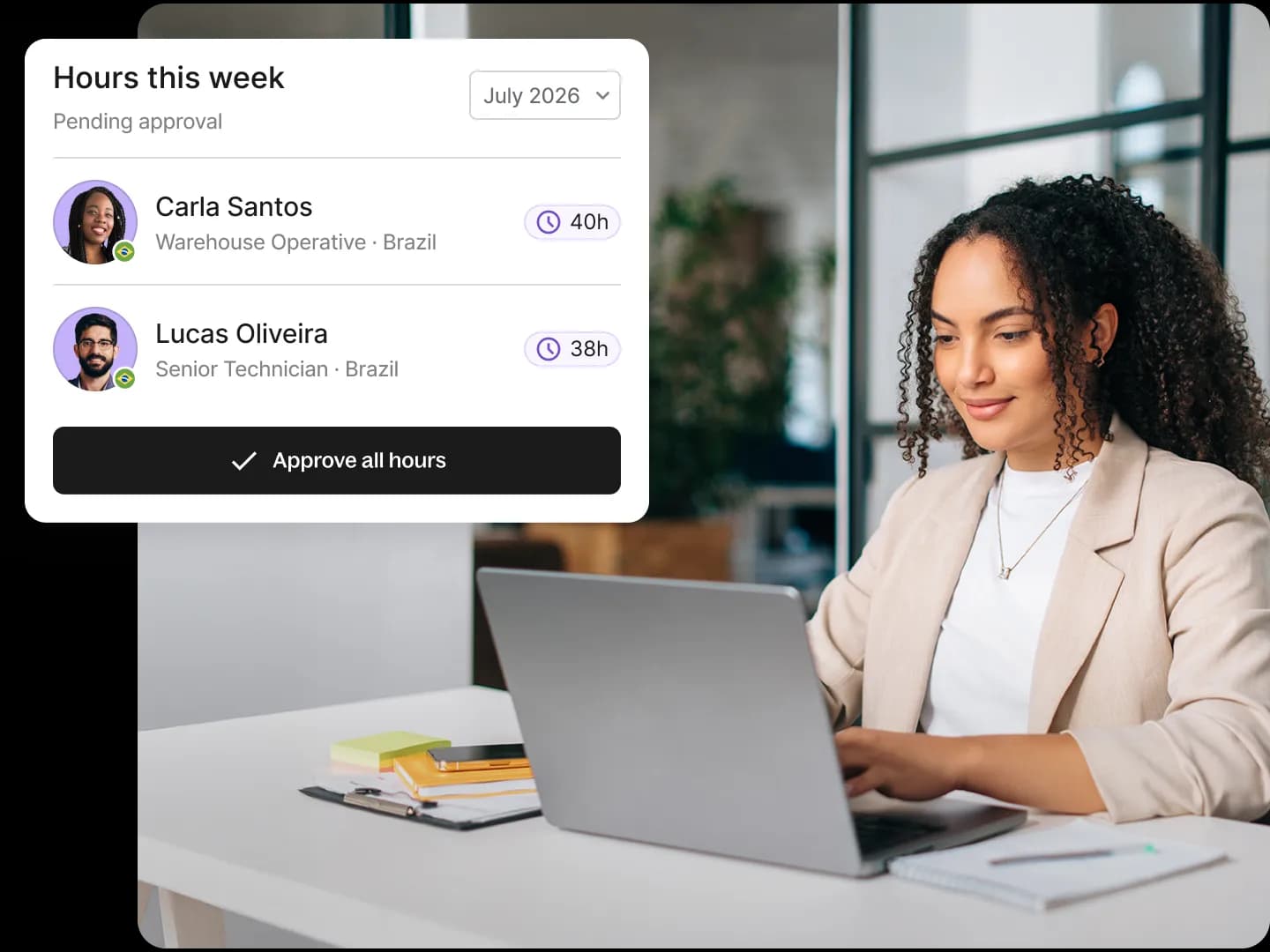
Time tracked. Payroll trusted. Nothing to reconcile.
The compliance risk most field operations managers underestimate
The operational issues (missed punches, buddy punching, scheduling confusion) are visible and feel urgent. The compliance risk is less visible and significantly more expensive when it materializes.
The US Department of Labor's Wage and Hour Division recovered more than $259M in back wages for nearly 177k workers in fiscal year 2025, the highest total since 2019.
Overtime violations account for nearly 80% of all FLSA back-wage cases, and the industries most represented in enforcement data are exactly the ones that rely on deskless workforces: food services, healthcare, and construction.
For companies operating across multiple countries, the exposure is layered. Every jurisdiction has its own rules:
| Jurisdiction | Standard workweek | Overtime trigger | Statutory breaks |
|---|---|---|---|
| United States (federal) | 40 hours/week | 1.5x after 40 hrs | No federal mandate, as state laws vary |
| California | 40 hours/week | 1.5x after eight hrs/day, then 2x after 12 hrs | 30-min unpaid meal break for shifts over five hrs |
| Germany | 40 hours/week | Set by collective bargaining agreement | 30 min (six-plus hrs), 45 min (nine-plus hrs) |
| EU (Working Time Directive) | 48 hours/week | Governed by member state law | 20 min for shifts over six hrs |
| Australia | 38 hours/week | 1.5x for first two hrs, then 2x thereafter (award-dependent) | Governed by Modern Awards |
For field teams on rotating schedules—common in oil and gas, mining, and utility operations—the compliance exposure doubles. A crew working 14 days on/14 days off must have rest periods between each rotation cycle tracked and validated by jurisdiction.
The EU Working Time Directive mandates 11 consecutive rest hours every 24 hours; for rotating crews, this requirement persists across the rotation cycle, not just within a single shift. Similarly, weekly hour limits (e.g., 48 hours/week under EU law) must be calculated correctly when workers are on/off rotations, or they'll trigger phantom overtime violations.
When a field team spans multiple countries, a single timekeeping system that applies uniform rules does not just create inefficiency. It produces incorrect payroll outputs. An overtime calculation that works for a US-based crew will systematically miscalculate for workers in Germany or Australia, where daily and weekly thresholds interact differently.
Back-pay claims can reach back two to five years depending on jurisdiction. In a team of 50 employees, even a small systematic miscalculation compounds into a material liability over multiple pay periods.
The EU time-tracking mandate
In 2019, the European Court of Justice ruled in case C-55/18 that EU member states must require employers to implement an objective, reliable system to measure each worker's daily working time. This legal mandate applies to field and deskless workers, not just office-based staff. Paper timesheets and supervisor estimates do not meet this requirement.
Compliance
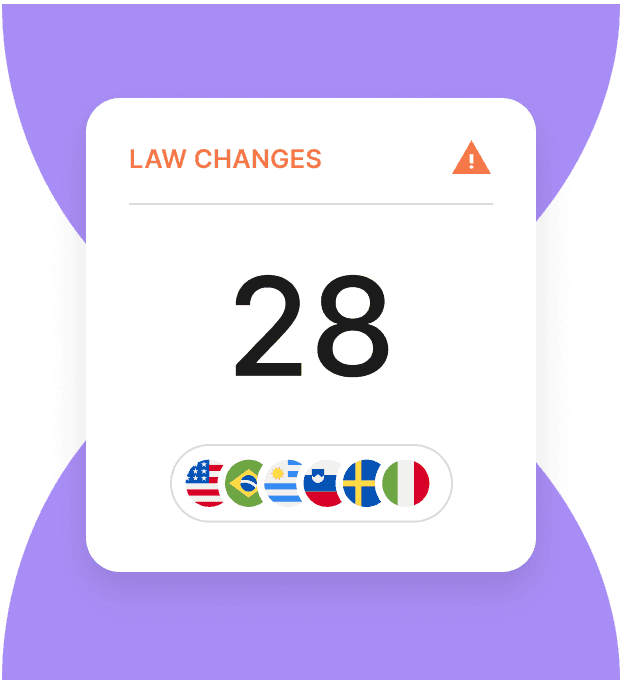
Unlock Continuous Compliance™ with Deel
What the EU requires and why it matters beyond Europe
Germany's implementation of this ruling is among the strictest in Europe. German employers must record daily working hours including overtime, with documented rest periods and a maximum of ten hours of work per day.
For a field service company with technicians in Germany, a GPS-timestamped mobile clock-in is not just a convenience feature. It is the compliance mechanism. Paper timesheets and supervisor estimates do not satisfy the ruling's requirement for an objective, reliable record.
For rotating crews (common in German offshore energy and mine operations), daily limits apply to each shift within the rotation, and rest requirements between rotation cycles must be documented with the same rigor as daily breaks.
The same principle applies at different degrees across the UK (Working Time Regulations), Australia (Fair Work Act), and Canada (varying by province). Compliance rules for global field teams are not uniform, which is precisely why managing them manually at scale is so difficult.
Three things a field-ready time tracking system must do simultaneously
Most tools solve one or two of these requirements. The ones that handle all three at once are significantly rarer.
1. Work anywhere: mobile-first design with strong connectivity options
Field workers do not always have a reliable signal. Construction sites, building basements, remote maintenance locations, and rural job sites all create connectivity gaps. A time tracking system that lacks mobile-first design and reliable connectivity handling creates exactly the kind of missing record that cannot be recovered after the fact.
The right approach prioritizes the mobile experience first, ensuring that workers in remote environments have options for logging accurate time whether connectivity is strong or limited. GPS timestamps are captured at clock-in and clock-out, tied to a physical location or a geofenced job site. For employers who need to demonstrate that a worker was at a specific location at a specific time, both for billing accuracy and regulatory compliance, this point-in-time capture is what matters.
2. Protect workers: compliance rules by jurisdiction
The compliance logic should be embedded in the platform, not left to managers to apply manually. That means:
Overtime thresholds configured by country and state: not a single global rule applied everywhere
Rotation cycle validation: For teams on scheduled rotations, rest periods between cycles and weekly hour limits must be automatically validated against jurisdiction rules
Break requirements documented and reviewable: so managers can identify and address gaps before the pay run closes
Working time limits: maximum daily and weekly hours visible as guardrails for managers, not as after-the-fact surprises
When compliance rules are surfaced in the platform, field managers do not need to memorize the Working Hours Act in Germany or the Fair Work regulations in Australia. The system surfaces the applicable requirements and makes it easier to identify where submissions need review.
3. Connect directly to global payroll: no manual re-entry
The transfer point between time tracking and payroll is where the most common errors occur. When time data has to be exported from one system and imported into another, human error enters the process, and with it, the risk of miscalculated overtime, missed shift differentials, and incorrect pay.
For field teams working across multiple countries and currencies, this problem multiplies. The reliable solution is a direct feed from time tracking into payroll, where approved hours flow automatically into the pay calculation without manual intervention.
For Employer of Record (EOR) arrangements, common in multinational field operations, this integration is especially important. When a field worker in the UAE or South Africa is employed through an EOR, their tracked and approved hours should map directly onto their local-currency payslip without anyone downloading a spreadsheet.
Deel Hire
Hire employees globally with the #1 Employer of Record
How different field work environments require different clock-in approaches
There is no single clock-in method that works for every field environment. The right solution depends on how crews are organized and where they work.
| Work environment | Best clock-in method | Key feature needed |
|---|---|---|
| Solo field technicians (HVAC, maintenance) | Mobile GPS clock-in | GPS timestamp, geofencing |
| Multi-site crews (construction, cleaning) | Mobile GPS + supervisor entry | Location verification, multi-site configuration |
| Fixed remote sites (mining, utilities, oil and gas) | Kiosk or supervisor-managed entry | Reliable sync, crew entry |
| Fixed remote sites with rotating schedules (mining, oil and gas, energy) | Mobile GPS clock-in + supervisor crew management | Rotation tracking, crew-level geofencing, automated rest-period validation |
| Healthcare field workers (home health) | Mobile GPS clock-in | Client location geofencing |
| Delivery and logistics | Mobile GPS clock-in | Route-based geofencing |
The underlying compliance requirements (accurate hours, documented breaks, correct overtime, audit-ready records) apply across all of these environments. The mechanism for capturing those hours varies. A field service platform needs to accommodate multiple clock-in methods while applying consistent compliance logic across all of them.
What GPS timestamps actually record and what they do not
One of the most common questions about mobile GPS time tracking relates to privacy: is location being tracked continuously during the shift?
For well-designed systems, the answer is no. GPS is captured at the moment of clock-in and clock-out, creating a point-in-time record tied to a geofenced job site or a specific client location. It is not continuous tracking throughout the shift.
This distinction matters for two reasons:
First, it protects workers: continuous location monitoring raises separate legal issues under GDPR in Europe, various state privacy laws in the US, and equivalent frameworks globally
Second, it keeps the data useful. A point-in-time location record is exactly what payroll, compliance, and billing need
Employers should inform workers that location is captured at clock-in and consult applicable privacy regulations before deploying location-based tracking. Employers should document this policy in the employment agreement or onboarding materials and limit tracking to active working hours only.
For rotating crews at fixed remote sites (mining compounds, offshore platforms), supervisor-managed or geofenced crew entries often replace individual mobile GPS clock-ins—and the system still needs to capture location and rotation-cycle timing for compliance.
GPS privacy: what employers must do
In most jurisdictions, GPS tracking of employees is legal during work hours, but only when:
Employees are informed in advance that location data is captured at clock-in and clock-out
Tracking is limited to active working hours only
The policy is documented in employment agreements or onboarding materials
Continuous GPS tracking outside working hours raises separate GDPR and state privacy law concerns.
Deel's HRIS
Manage your global workforce compliantly

The hidden cost: manual reconciliation between time and payroll
Beyond the compliance risk, there is a direct operational cost to poor time tracking integration. Field operations managers and payroll teams who rely on manual processes spend significant time per pay period on reconciliation, comparing time entries across systems, resolving discrepancies, calculating overtime by hand, and correcting errors before the pay run closes.
Every manual step in the process introduces a delay and a potential error. For companies running payroll in multiple countries, the overhead multiplies. A German payroll cycle has different deadlines and rules than a US bi-weekly run, which differs again from monthly payroll in the UAE.
A direct integration between time tracking and payroll does not just reduce errors. It changes what payroll teams have to do in the days before a pay run closes. Instead of reconciling data across systems, they review and approve. That shift from reactive to supervisory work is where the real efficiency gain lives.
Explore Deel’s native global payroll engine

How to evaluate a time tracking solution for field and deskless teams
When assessing whether a platform genuinely serves field-based workforces, the right questions to ask are:
On mobile and connectivity capability:
Does the mobile interface work as the primary experience, without requiring a laptop as a fallback?
Does the platform offer reliable clock-in options for workers in areas with limited connectivity?
Is the clock-in process genuinely simple on a phone, or was it designed for a desktop and later adapted for mobile?
On compliance:
Are overtime thresholds configurable by country and state, or is one rule applied globally?
Are break requirements surfaced for manager review, so gaps can be addressed before the pay run closes?
Does the platform maintain audit-ready records that can withstand a regulatory review?
On payroll integration:
Does time data flow directly into payroll, or does it require an export and import step?
For multi-country payroll, does the integration apply jurisdiction-specific rules automatically?
For EOR employees, do approved hours appear on payslips without manual reconciliation?
On privacy and legal compliance:
Is GPS captured point-in-time (clock-in and clock-out only) rather than continuously?
Does the platform support the employee transparency requirements that apply in your jurisdictions?
A platform that answers these questions clearly is built for field work. One that answers them vaguely, or that bundles GPS tracking as a premium add-on, was likely designed for desk-based teams and extended to field use as an afterthought.
Building a compliant time tracking process for distributed field teams
If you are building or rebuilding a time tracking process for field workers across multiple countries, a practical sequence looks like this:
Audit your current methods by country: identify where hours are being estimated, where manual export and import steps exist, and where overtime is being calculated by hand
Map the compliance requirements for each jurisdiction: overtime thresholds, break mandates, record-keeping retention periods (typically three to seven years depending on jurisdiction), and any sector-specific rules
Define your clock-in methods by work environment: mobile GPS for solo field workers, site-based options for large crew environments, and supervisor entry as a documented exception rather than a default
Configure jurisdiction rules in the platform: each country's overtime multipliers, break requirements, and maximum working hours should be set up before launch, not corrected after the first pay run
Connect time tracking directly to payroll: eliminate the manual transfer step and verify that approved hours produce the correct payslip outputs in each country
Document the GPS tracking policy: inform workers at onboarding what data is collected, when it is collected, and how it is used, in the language of their jurisdiction
This process is not a one-time setup. Overtime laws change. New jurisdictions are added. Collective bargaining agreements are renegotiated. A platform that treats compliance as a configurable, updatable layer rather than a static rule set will keep pace with those changes without requiring manual intervention every time a law is updated.
Deel's Time Tracking: built for field teams, compliant across jurisdictions
Deel's Time Tracking is designed for teams that do not work from a fixed desk. The mobile-first clock-in captures a GPS timestamp at the moment of clock-in—not continuously—tied to a configured job-site geofence with a radius as small as 25 meters. The system blocks or flags punches outside the boundary, giving managers clear visibility into which submissions need review.
For hourly workers hired through Deel's EOR, approved time entries flow directly into the payroll cycle. Rather than relying on separate third-party integrations, the single platform natively processes these records, applying the applicable overtime rates and pay rules for the worker's jurisdiction.
The result: payroll administrators spend less time reconciling data and more time reviewing outputs.
Deel supports hourly contracts across the US, UK, UAE, South Africa, Sweden, and Switzerland. For Germany, the platform captures daily working hours and rest period submissions in a format that supports compliance with the Working Hours Act and EU Court of Justice ruling—with managers able to review submissions against statutory thresholds.
Overtime rules are configured by country. Some jurisdictions calculate overtime daily, others weekly, and some do not permit overtime payments at all. For companies managing global payroll alongside field operations, that configuration means compliance logic is applied at the jurisdiction level rather than requiring administrators to know every local rule.
Ready to close the gap between field time tracking and compliant payroll? Book a demo below.
Deel Hire
Find, hire, and manage anyone, anywhere

FAQs
Are employers legally required to track time for field and deskless workers?
In most jurisdictions, yes. The US FLSA requires accurate records of hours worked for all non-exempt employees, regardless of whether they work in an office or in the field.
The EU Court of Justice ruling in 2019 requires EU member states to mandate a reliable daily time recording system for all workers
Australia's Fair Work Act, Germany's Working Hours Act, and most national labor frameworks impose equivalent requirements, with no general exemption for field-based or remote workers
What are the main compliance risks for multi-country field teams?
The most common issues are incorrect overtime calculations (especially when one global rule is applied across all jurisdictions), missing break documentation, off-the-clock work that goes unrecorded, and inadequate record retention.
For teams spanning multiple countries, the risk compounds because overtime thresholds, break requirements, and maximum working hours vary significantly by jurisdiction.
Is GPS time tracking legal for field workers?
GPS location capture is legal in most jurisdictions when it is limited to working hours and when employees are informed in advance that location data is collected at clock-in and clock-out.
Continuous tracking throughout a shift raises different legal questions under GDPR in Europe and various state privacy laws in the US. Employers should consult applicable privacy regulations and document the tracking policy in employment agreements before deployment.
How does time tracking connect to global payroll for EOR employees?
For hourly workers hired through Deel's EOR solution, approved time entries flow into the payroll cycle without requiring a manual export or import step. The applicable overtime rates and pay rules for the worker's jurisdiction are applied at the point of payroll processing, and the results appear on locally compliant payslips.
How does Deel handle different overtime rules across countries?
Deel's Time Tracking applies jurisdiction-specific rules for the countries where it supports hourly contracts. This includes daily versus weekly overtime triggers, different pay multipliers (1.5x, 2x), and countries where overtime compensation takes the form of time off in lieu rather than additional pay. The rules are configured per jurisdiction by the Deel team and applied when hours are approved for payroll.
Related Deel resources
Jemima is a nomadic writer, journalist, and digital marketer with a decade of experience crafting compelling B2B content for a global audience. She is a strong advocate for equal opportunities and is dedicated to shaping the future of work. At Deel, she specializes in thought-leadership content covering global mobility, cross-border compliance, and workplace culture topics.