Article
6 min read
The ROI of Centralized Payroll Systems
Global payroll

Author
Joanne Lee
Last Update
June 09, 2026
Table of Contents
The real cost of decentralized payroll
The ROI of centralized payroll infrastructure
How to transition to centralized payroll
Optimize your global payroll operations with Deel
Key takeaways
Decentralized payroll creates compounding operational, financial, and compliance risk by fragmenting data, obscuring workforce costs, and exposing your organization to audit failures and misclassification liability.
Centralized payroll reduces total cost of ownership (TCO) and eliminates vendor sprawl. In a 2025 Forrester study, Deel Payroll delivered 67% ROI, saving customers 80% of time on vendor management and 60% on payroll processing.
Deel Payroll enables enterprises to pay workers compliantly across 130+ countries and integrates directly with commonly used platforms like Workday, SAP, and NetSuite.
For global enterprises, fragmented payroll isn't just a systems problem. It's a financial black box, a compliance liability, and an operational drag that grows with every new country, acquisition, and regulatory change.
This guide covers how centralizing payroll reduces total cost of ownership, strengthens compliance, and gives finance and HR leaders the real-time visibility they need to run a global workforce with confidence.
The real cost of decentralized payroll
In a decentralized payroll model, enterprises typically manage a patchwork of local payroll vendors, each with its own system, contract, data format, and escalation path. The hidden costs are significant.
Operational fragmentation
Payroll data stored across disconnected systems makes consolidated reporting nearly impossible. HR, finance, and payroll teams spend significant bandwidth manually reconciling data, chasing vendor updates, and firefighting across time zones instead of focusing on strategic work.
Compliance exposure
Global payroll means navigating dozens of overlapping regulatory environments simultaneously. Calculating payroll in Brazil, where social security and labor laws carry strict local nuance, is categorically different from running payroll across 50 states in the US.
For example, you’re required to obtain explicit employee consent in Slovakia to increase overtime hours up to 400 hours a year. Meanwhile, overtime laws in the US vary by each state, and each state has its own rate for overtime minimum wage.
Keeping pace with this kind of granularity across a global workforce, without centralized monitoring, creates real audit and misclassification risk.
Financial opacity
When workforce costs are distributed across 20 or 30 local vendors, finance leaders lose predictability. Usage-based pricing, inconsistent billing formats, and hidden aggregator fees make it nearly impossible to produce accurate GL reporting or forecast total cost of workforce at a regional or global level.
Deel provided the ability to expand into new countries without having to establish separate payroll providers or processes. Now, we can continue to scale without increasing payroll complexity or resources.
—Rob Starkey,
Corporate Controller and Treasurer, Hypertherm Associates
Read more about how Hypertherm standardized payroll processes across 20+ countries with Deel.
Scalability ceiling
Decentralized payroll architectures weren't designed for M&A-driven scale. When your business expands into a new market, acquires a workforce, or restructures entities, a fragmented model compounds complexity rather than absorbing it.
In a 2024 Forrester study, 63% of payroll professionals identified improving workflows across global payroll systems as a top priority, revealing growing intricacies of global payroll and the need for more efficiency.
The ROI of centralized payroll infrastructure
Centralized payroll consolidates all payroll operations into a unified, globally standardized platform with local execution. For enterprises navigating multi-entity, multi-country complexity, this model delivers measurable returns across four dimensions.
Reduced total cost of ownership
Vendor rationalization is the most immediate financial benefit. Consolidating from dozens of local payroll providers to a single enterprise-grade partner eliminates redundant contracts, reduces internal vendor management overhead, and creates predictable, auditable pricing. The 2025 Forrester Total Economic Impact study found that Deel Payroll delivered 67% ROI, with customers saving 80% of the time previously spent managing payroll vendors.
Beyond vendor consolidation, centralized payroll removes the hidden cost of error remediation. When payroll data lives in a single system of record, the accuracy of calculations, deductions, and benefits improves significantly. As a result, this reduces the downstream cost of corrections, compliance penalties, and employee escalations.
Enterprise-grade compliance governance
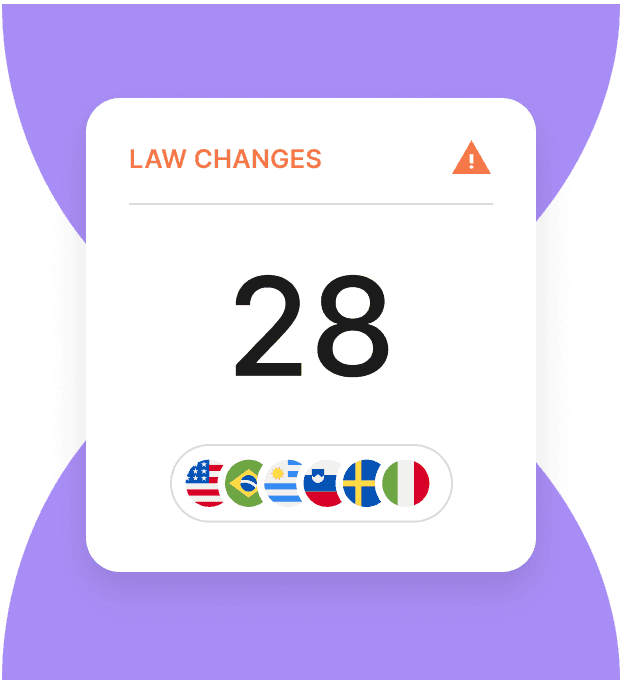
Centralized payroll platforms continuously monitor regulatory requirements across every country of operation, surfacing changes to tax codes, social contributions, and labor laws before they create exposure. This shifts your compliance posture from reactive to governed, reducing the risk of audit failures, SOX control gaps, and misclassification liability.
Compliance
Unlock Continuous Compliance™ with Deel
Audit-ready reporting and financial visibility
A unified platform gives finance and HR leadership a consolidated view of global workforce costs in real time. Rather than manually aggregating reports from multiple vendors, teams gain direct access to people analytics, payroll calculations, compensation insights, and time-off data from a single source of truth.
This level of payroll visibility is essential for SOX readiness, GL standardization, and the kind of workforce cost reporting that survives CFO and board-level scrutiny. It also enables faster, more confident decision-making during high-stakes moments like M&A, restructurings, or new market entry.
Operational resilience and employee trust
Employees expect accurate, on-time pay. For global enterprises, any disruption to that expectation, especially during periods of organizational change, carries real reputational and retention risk. Centralized payroll, supported by a white-glove implementation model and dedicated local expertise, creates the operational resilience needed to protect employee experience regardless of what's changing at the business level.
Centralized systems also enable employee self-service, giving workers direct access to payslips, tax documents, and payroll queries. This alleviates HR admin burden and improves response times for payroll-related issues.
How Directional Pizza saved $74k in annual headcount costs with Deel
Directional Pizza is the largest Pizza Hut franchisee in the UK, offering dine-in, delivery, and takeaway services.
As Directional Pizza expanded into Europe, it experienced fragmented payroll and HR operations after establishing itself as a new entity and acquiring restaurants across the UK, Denmark, and Sweden.
Without a unified payroll and HR system, they faced inefficiency and non-compliance risks. And in such a fast-paced business, the need for an automated solution was urgent.
In just three months, Deel helped Directional Pizza launch HR and payroll in the UK, Denmark, and Sweden. Over 4,000 employees are now on Deel’s unified platform, unlocking scalability and operational efficiency while cutting down costs.
How to transition to centralized payroll
Moving from a fragmented payroll architecture to a centralized model is a strategic undertaking. It requires executive alignment, careful change management, and a vendor capable of supporting enterprise-scale complexity. Here's how global enterprises typically approach it.
1. Audit current payroll operations
Start by documenting every payroll vendor, the countries and entities they cover, the data formats and integration points they rely on, and the gaps and inefficiencies in your current operations.
This audit becomes the foundation for your RFP and your business case for consolidation. Map current-state TCO against what centralized payroll would deliver, including vendor management hours, error remediation costs, and compliance risk exposure.
2. Draft a global payroll RFP
A well-structured RFP forces prospective vendors to demonstrate their capability across the dimensions that matter most to enterprise buyers: owned infrastructure (not aggregated local sub-vendors), bidirectional integration with Workday, enterprise-grade security and compliance, implementation methodology, and dedicated local expertise.
Pay particular attention to how vendors handle the question of third parties. Many global payroll providers rely on a network of local sub-vendors (in-country partners or ICPs) hidden behind a single UI. This aggregator model reintroduces the same fragmentation risk you're trying to eliminate, often with less visibility into who is actually executing payroll on your behalf.

Template
Simplify your vendor search with an RFP template
3. Select an enterprise-grade payroll partner
Evaluate candidates not just on capability, but on operational maturity, service model, and cultural fit with your organization's risk tolerance. Ask for references from enterprises at comparable scale and complexity. You should also ask specifically about how they handle payroll errors, escalations, and compliance gaps when they arise.
Deel is the unquestionable solution to any global payments process. Relying on their robust platform and expert team, I stress less often, work more efficiently, and deliver payroll in confidence—always with the knowledge that employees will get paid, no matter what.
—Valerie Tazelaar,
Payroll Director, FICO
Read more about how FICO improved payroll visibility and compliance through Deel Payroll and our integration with Workday.
4. Execute a governed implementation
Enterprise payroll implementation involves data migration, HRIS integration, parallel payroll runs, and structured user training across multiple countries and business units.
A phased rollout (prioritizing countries by risk, complexity, or strategic importance) typically delivers the strongest results. Expect close collaboration between your HR, payroll, finance, IT, and legal teams throughout. Implementation timelines for global enterprises typically range from three to twelve months depending on scope.
Optimize your global payroll operations with Deel
For enterprises operating across borders, centralized payroll isn't a nice-to-have; it's a prerequisite for the financial control, compliance governance, and operational resilience your business requires at scale.
Deel Payroll enables enterprises to pay every worker type across 130+ countries compliantly and on time. We're a Workday-certified GPC partner, GDPR compliant, and backed by 2,000+ in-house experts who own local execution end to end.
Ready to evaluate what centralized payroll looks like for your organization? Book a consultation with one of our epxerts to discuss your current architecture, your consolidation goals, and what a transition at your scale actually looks like.
Deel Payroll
Run payroll on one platform, globally

Joanne Lee is a content marketing professional with 7+ years of experience creating effective social, search, email, and blog content for companies ranging from start-ups to large corporations. She's passionate about finding creative ways to tell a purpose-driven story, staying active at the gym, and diversity and inclusion. At Deel, she specializes in writing about topics related to global payroll and enterprise businesses.