Article
9 min read
Why Your Best People Leave After a Layoff (And What HR Can Do About It)
Global HR

Author
Ellen Simmonds
Last Update
May 07, 2026

Table of Contents
What the data shows: Global layoffs worsen in 2025/26
The cost that many organizations fail to calculate
The flight risk you may not be tracking
The AI question: restructuring, not replacing
The recovery gap leadership doesn't see
What "done well" actually means
How Deel gives you the infrastructure to manage workforce change at scale
Key takeaways
Over 1.17 million jobs were cut by US employers alone in 2025 — a 54% rise on 2024 — and 87% of HR leaders globally reported their company had already made cuts or planned to. Post-layoff anxiety among remaining employees worsens in the second year, not the first.
The real risk of a layoff isn't who leaves by choice, it's who leaves by decision. High performers have options, and a poorly handled redundancy gives them every reason to use them.
Deel gives HR leaders a real-time view of workforce sentiment, performance, and flight risk before, during, and after a restructure. With the right data infrastructure, you can act on the signals before they become resignations.
When a company announces mass redundancies, the conversation almost always centres on the people leaving: the headcount reduction, the severance packages, the logistics of offboarding. These are all vital for a successful restructuring and should rightly take priority. But what gets far less attention is the larger, slower crisis unfolding among the people who stay. That's the part that will define whether your company recovers.
What the data shows: Global layoffs worsen in 2025/26
2025 was one of the worst years for job cuts since the 2008 financial crisis. More than 1.2 million roles were announced as cut by US employers alone. At the same time, across the UK, Germany, India, and Australia, redundancies rose sharply, driven by a mix of AI-driven restructuring, post-pandemic overcorrection, and economic headwinds that varied by region but pointed in the same direction.
Global layoff snapshot: 2025 in context
| Country | Scale in 2025 | vs. prior year | 2026 outlook |
|---|---|---|---|
| United States | 1.2M announced job cuts through Nov 2025 | +54% | Continuing |
| United Kingdom | 1 in 4 employers planned redundancies in Q1 2025 — highest in a decade outside the pandemic | +19% intent | Rising |
| Germany | 120,000+ industrial jobs lost in the year to Sept 2025; VW alone committed to 35,000 cuts | 4th consecutive year of decline | Worsening |
| Europe (broader) | ~32,600 tech sector jobs cut; major non-tech cuts at Nestlé (16K), Novo Nordisk (9K), Bosch (13K), Volkswagen (7K+) | No single baseline | Ongoing |
| India | ~19,000 tech sector layoffs; TCS alone cut ~12,000; IT firms including Infosys and HCLTech shed ~10,000 combined | Accelerating | No Data |
| Australia | ANZ bank cut 3,500; Qantas subsidiary Jetstar Asia closed (500+ jobs); broader financial and public sector reductions | Rising | Accelerating in tech |
| Global (all sectors) | 87% of HR leaders worldwide reported their company had cut jobs or planned to in 2025 — up from 73% in 2024 | +14pp YoY | No Data |
Note: Data comparability varies significantly by country. This table reflects the best available data per market as of late 2025/early 2026.
In 2026, the pressure isn't easing. Q1 alone saw more than 180,500 job cuts announced globally across all sectors, including automotive giants, Silicon Valley tech firms, logistics companies, and retailers. The data shows 52,050 announced cuts in technology alone, a 40% jump over the same period in 2025, the highest first-quarter total the firm has recorded since 2023.
For HR leaders managing global, distributed workforces, these numbers aren't abstract. They represent decisions being made — sometimes carefully, sometimes under duress — that will shape company culture and talent pipelines for years to come.
The instinct in this environment is to focus on execution: getting the process right, managing legal exposure, handling communications. All of that matters. But the companies that come out of this era stronger aren't the ones that understand what a layoff does to everyone left behind.
Deel's HRIS
Manage your global workforce compliantly

The cost that many organizations fail to calculate
When leadership models the economics of a redundancy, they typically account for severance, accrued leave, and the short-term payroll savings. What rarely makes it into the model is the productivity cost that follows.
Complementary reading:
Research tracking seven companies through layoffs between 2022 and 2024 found that productive time per person fell by nearly an hour a day on average in the months that followed a reduction in force — roughly 18 hours per month, per employee. For a company of 200 people, that's the equivalent of losing several full-time workers' output every single month, with no associated savings.
Then there's the replacement cost. According to Gallup, replacing a single employee runs between half and twice their annual salary once you factor in recruitment, onboarding, and the time to full productivity. Companies don't model that figure because they don't expect voluntary attrition to spike after a layoff. But it does, consistently.
The flight risk you may not be tracking
Here's the dynamic that most redundancy planning misses entirely: the employees most likely to leave after a layoff are the ones you most need to stay. High performers have options. They have active networks, strong CVs, and the lowest tolerance for instability and ambiguity. When a layoff is announced, they likely already have recruiters in their inboxes eager to have a conversation. Unless your organization handles layoffs with clarity and a strong vision for the future, they’ll be taking those calls.
This isn’t anecdotal — it shows up in the data. 65% of employees at companies that have recently conducted layoffs report worrying about their job security, compared to just 24% at companies that haven't made recent cuts. That anxiety doesn't discriminate by performance, and your top performers feel it just as acutely as anyone else. They're just more likely to act on it.
What's more, Glassdoor's review data shows that employee mentions of "layoffs" and "job insecurity" in company ratings are now higher than they were in March 2020, at the onset of the pandemic — suggesting that even workers in stable companies are watching what's happening across the market and taking note of which companies are more stable than others.
The flight risk in your organisation right now may be higher than your engagement data shows. And if you don't have real-time visibility into sentiment, you won't know until someone hands in their notice.
The AI question: restructuring, not replacing
Any honest conversation about the current wave of layoffs has to address the role of AI. It's While AI transformation is driving some of these cuts, the picture is more nuanced than the headlines suggest. HR leaders who understand that nuance will make better workforce decisions than those who don't.
What the data actually shows is a shift in the shape of work, not a wholesale reduction in it. Deel's 2025 State of Global Hiring Report — drawing on data from more than one million workers across 37,000+ companies in 150+ countries — found that AI trainer roles grew 283% cross-border in 2025, making it the single fastest-growing cross-border role on the platform. This is a profession that barely existed two years ago, now employing over 70,000 workers across 600+ organisations.
The same report found that seven of the top ten cross-border roles globally are in sales, marketing, and customer-facing functions — roles defined by human judgment, local knowledge, and relationship-building that remain difficult to automate. And our own data from the Deel platform shows AI-related job growth accelerating faster in non-tech companies than in tech ones, suggesting that AI is expanding and transforming the workforce in new industries, not simply contracting it.
This matters for HR leaders making workforce decisions right now. The companies cutting deepest in certain areas are often simultaneously trying to hire in adjacent, emerging ones. The question worth asking before any redundancy decision is whether the skills you're planning to cut could be redirected toward the capabilities you're planning to build. The answer, more often than leaders assume, is yes.
Further reading:
If you’re interested in how AI is transforming HR and the world of work, dive deeper into the topic with these resources:
The recovery gap leadership doesn't see
Overlooking the ripple effects that layoffs cause across the remaining workforce can lead to significant and quantifiable consequences:
Damaged employee trust
According to a survey of 3,000 HR leaders and over 8,000 employees across seven countries, one in four employees say they lose trust in leadership as a direct result of witnessing a colleague's layoff. That trust doesn't return quickly, and it doesn't return on its own.
Lost momentum and lower engagement
Another survey from July 2025 found that 75% of companies conducted repeat layoffs less than five months apart, leaving teams in a constant state of instability without enough time to rebuild trust or restore momentum. The result is a workforce that's perpetually braced for the next round — which is exactly the condition that drives your highest performers to start looking elsewhere.
Impacted employer brand
With layoffs and job insecurity top of mind, Glassdoor reviews matter more than ever. If your workforce is spreading the word that your organization isn’t a stable place to be, it impacts your ability to attract top talent. In a competitive, global talent marketplace, that matters down the line.
One report found that nearly seven in ten employees would share a negative layoff experience online. Every Glassdoor review written in the weeks after a poorly managed redundancy is a message to your next hire — or your next customer — about who you are as an organisation.
The companies that handle redundancies well protect something harder to rebuild than headcount: trust. Trust with the employees who stayed, who are watching how their colleagues were treated and deciding whether this is still somewhere they want to build a career. Trust with the market, which will remember how you handled this when you’re next looking to hire.
What "done well" actually means
The measure of a well-handled redundancy isn't how efficiently people were let go. It's how the organisation emerges.
That means treating a layoff as a people event from start to finish, including those who were not directly impacted. It means equipping managers to lead through uncertainty rather than leaving them to improvise. It means keeping communication honest, even when the honest answer is "we don't know yet." And it means having the infrastructure to understand how your remaining workforce is actually doing, not how you hope they're doing.
The HR leaders who will define how their organisations come through this era are not the ones who execute cuts most cleanly. They're the ones who understood that the real work starts the morning after.
Deel HR
One place for simplified, smarter global HR
How Deel gives you the infrastructure to manage workforce change at scale
Managing workforce change well isn't just a leadership question. It's also an infrastructure question. When the pressure is on, HR teams without the right systems spend their time firefighting instead of leading. Deel gives people leaders the data, tools, and connected workflows to make smarter decisions before, during, and after a restructure.
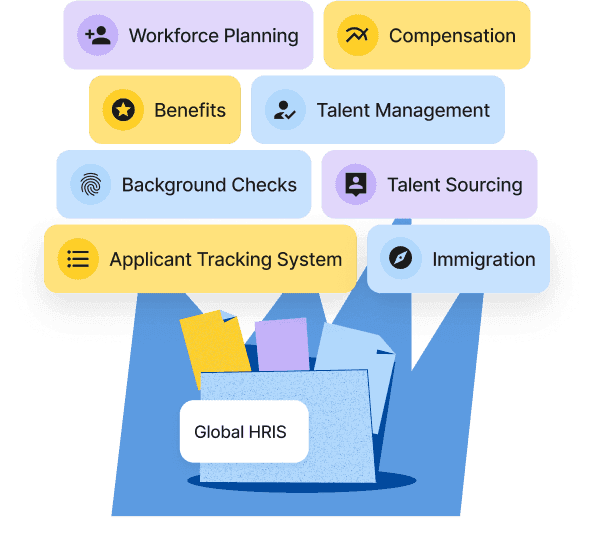
Understand your workforce before you make decisions. Deel’s global HRIS gives you a real-time, unified view of your global headcount — roles, tenure, performance history, and compensation — so decisions about who to retain, redeploy, or let go are grounded in data, not instinct.
Identify flight risk early. Engage's pulse survey and sentiment tools let HR teams track how remaining employees are feeling in real time, so you can spot disengagement before it becomes a resignation, and intervene while there's still time.
Equip managers to lead through disruption. Engage's performance management and 360° feedback tools give managers structured frameworks for difficult conversations, goal-resetting, and team recovery not just during a redundancy cycle, but in the months that follow.
Retrain and redeploy before you cut. Engage's learning management system lets HR leaders build targeted development plans and training programmes that help employees grow into new roles — turning a potential redundancy into an internal transfer.
Model headcount scenarios before committing. Deel’s Workforce Planning lets HR and finance teams model different restructuring scenarios using live compensation and headcount data, so you can present leadership with the real cost of cuts — before the decision is made.
Manage offboarding compliantly, across every jurisdiction. For global teams, Deel handles the complexity of local notice periods, severance requirements, and contractor offboarding across 150+ countries, so nothing falls through the cracks when speed matters most.
Protect your employer brand through the process. Structured, compliant, humane offboarding — tracked and documented in one system — means your reputation with remaining employees and future candidates stays intact.
Facing a restructure? See how Deel helps HR leaders manage workforce change with confidence. Book your 30 minute demo.
Live Demo
Get a live walkthrough of the Deel platform
Ellen Simmonds is a content marketing manager with a decade of experience in tech, leadership, startups, and the creative industries. A long-time remote worker, she's passionate about WFH productivity hacks and fostering company culture across globally distributed teams. She also writes and speaks on the ethical implementation of AI, advocating for transparency, fairness, and human oversight in emerging technologies to ensure innovation benefits both businesses and society.