Article
3 min read
What Delayed Transposition Actually Means for Your EU Pay Transparency Risk
Global HR

Author
Solenne Mercier
Last Update
June 24, 2026

About the author
Solenne Mercier is a French employment lawyer and HR management expert covering France, Belgium, and Switzerland, with a strong focus on pay compliance and HR strategy. After more than a decade practicing law at renowned American and international law firms, she transitioned in-house, holding HR leadership roles in France and Switzerland. Today, she advises multinational companies on cross-border employment, remote work, Employer of Record (EoR) setups, international mobility, pay transparency, and complex labor law compliance in highly regulated markets. Passionate about the future of work, Solenne is particularly focused on the intersection of law, HR, technology, and the digital transformation driven by AI.
June 7, 2026 came and went. Most EU member states hadn't fully transposed the Pay Transparency Directive into national law. France was still in parliamentary consultation. Germany's partial coverage under the Entgelttransparenzgesetz left significant gaps. The Netherlands, and Belgium were mid-process. Poland is making progress, but Italy and Slovakia are currently the only ones fully transposed.
A lot of HR and legal teams drew the obvious conclusion: more time. That conclusion is going to cost some of them.
Late transposition doesn't suspend the Directive. It activates a legal mechanism called consistent interpretation, which requires national courts to read existing domestic employment law in conformity with the Directive from June 7, 2026, with or without a completed national law. Candidates and employees can bring claims today, in any EU member state, under that standard. The scrutiny applied to those claims is already higher.
The risk is live. It just doesn't look like what people expected.
What's already enforceable from June 08th
Some of the Directive's requirements depend on national transposition to function. Three of them don't.
Salary ranges in job postings. Article 5 requires pay information to be shared with candidates before the first interview, either in the job posting itself or communicated clearly before any interview takes place. A job vacancy published without a salary range and without a documented pre-interview disclosure process is a potential violation today. This sits with Talent Acquisition, not Legal.
Questions about previous salary. Asking a candidate about their current or past compensation is prohibited. A single rejected candidate can use this to challenge the entire recruitment process. Interview guides that haven't been updated and hiring managers who haven't been trained are a current liability.
The employee's right to pay information. Any employee can request in writing their individual pay level and the average pay levels broken down by gender for workers doing the same or equivalent work. The employer has two months to respond. A non-response or inadequate response creates a presumption of discrimination, with the burden of proof now landing with the employer and not the employee. Pay confidentiality clauses, meaning those that prevent employees from discussing their own salary, are void by operation of law at national entry into force. Many organizations still have these clauses in active employment contracts.

EU Compliance with Deel
EU Pay Transparency Directive Readiness Checklist
The documentation problem
The Directive reverses the burden of proof in pay discrimination claims. When an employee files a claim, the employer must demonstrate that any pay difference is objectively justified. Without documentation, that defence doesn't hold.
Most organizations are in a weaker position than they realize on this, because of a concept the Directive puts at the center of everything: work of equal value.
Two roles are of equal value when they require the same overall level of demands across four criteria: skills, effort, responsibilities, and working conditions. Job title, department, and business unit are legally irrelevant to that assessment. An HR coordinator and an IT technician operating at the same level of skills and responsibility are potentially comparable. A communications manager and a logistics manager with equivalent cognitive load and decision-making scope may be legally comparable.
Female-dominated roles in HR, communications, and administration have historically been undervalued in terms of effort and responsibility criteria relative to male-dominated roles in IT, engineering, and finance. The Directive requires a reassessment using neutral criteria. For many organizations, that reassessment will surface pay gaps that have never been measured, and for which no justification has ever been documented.
Job architecture is the foundation of a defensible pay decision. A documented framework that maps every role to a family and level, scored against the four equal-value criteria and applied consistently across entities, is what an employer points to when a discrimination claim is filed. Most organizations don't have one built to that standard.
The reporting window
The first pay equality reports for companies with 250 or more employees are due in June 2027. Companies with 150 to 249 employees report on the same deadline and every three years after. Both groups need to produce seven indicators under Article 9: mean and median gender pay gaps in base pay and in variable and complementary components separately, the proportion of each gender receiving variable pay, the distribution of each gender across pay quartiles, and the pay gap broken down by category of worker.
Producing those seven metrics accurately requires an extensive process, with significant preparation. Not because the calculations are complicated, but because the data foundation most organizations currently have isn't sufficient to run them.
What that foundation requires: a single HR record per worker with complete, current data on job profile, level, gender, and employment status; all remuneration components tracked and attributed at the individual worker level, disaggregated by type (a payroll total per worker is not enough); and a job architecture that maps every role to a family and level using documented, gender-neutral criteria for pay decisions and progression, applied consistently across every EU entity.
For organizations operating across multiple member states, that last requirement is particularly demanding. Each entity's data needs to be structured to support its own national report, submitted to its own national authority, under its own transposition timeline. The job architecture needs to be consistent enough across entities that the category definitions hold up within each one.
Most organizations are currently running manual exports and reconciliation across multiple payroll providers and HRIS configurations. That produces results that take weeks and carry a meaningful risk of error. It's not a sustainable basis for one single report, let alone one per entity.
What needs to happen now
There are five workstreams, and they don't all carry the same urgency.
The two immediate actions are the job posting audit and the recruiter briefing. Every active vacancy needs salary range information or a documented pre-interview disclosure process. Every hiring manager needs to understand that salary history questions are prohibited and why. Both can be completed in days.
Within the next four weeks, employment contracts across all EU entities need to be reviewed for pay confidentiality clauses and flagged for amendment.
The highest-complexity workstream is the job classification and job architecture project. Building a documented framework that scores every role across the four equal-value criteria, applies it consistently across entities, and creates a defensible audit trail for pay decisions is not a short exercise. It requires Total Rewards, HR Ops, and Legal working in coordination, and it needs to start now. The litigation exposure from not having this framework in place is the most significant risk in the Directive.
The fifth workstream is an HRIS gap analysis: a structured assessment of whether current data systems can produce what Article 9 reporting actually requires. Clean job families are consistently defined across countries. Compensation data disaggregated by component type at the individual level. A way to segment the workforce by equal work. For most organizations, that assessment will identify remediation work that takes the better part of a year to complete properly.
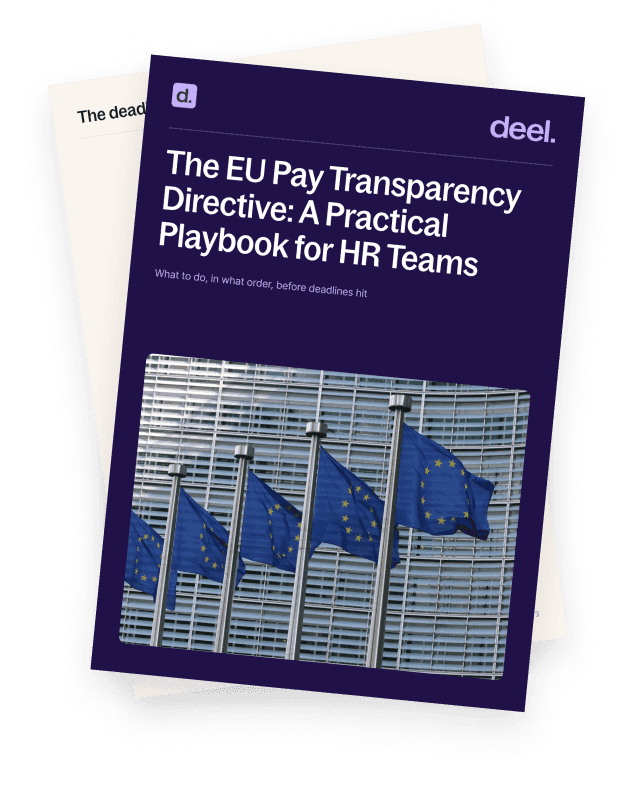
EU Compliance with Deel
EU Pay Transparency Directive: A Practical Playbook for HR
How Deel helps
Deel works with organizations on pay transparency compliance across two layers: the software infrastructure that makes compliance possible, and the consulting work that builds what goes into it.
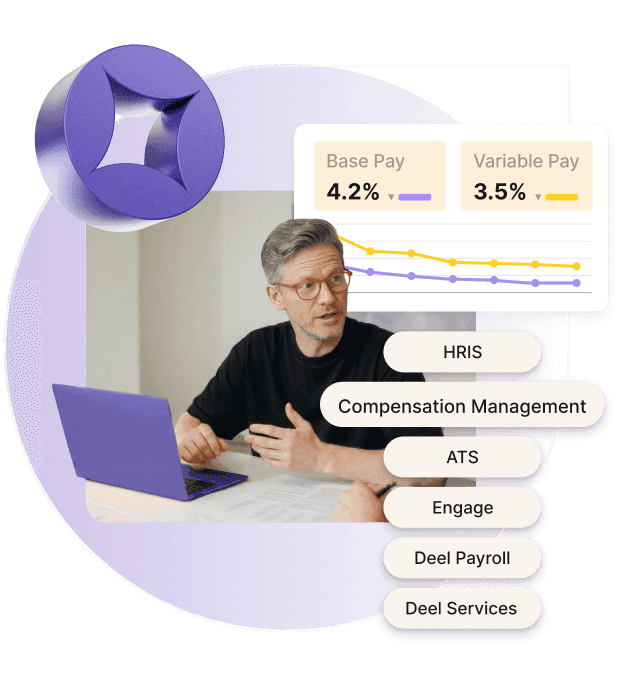
On the software side, Deel connects job architecture, compensation bands, pay gap reporting, and global payroll in one platform across 150+ countries. Job families, levels, and job profiles live in Deel HR's HRIS and feed directly into compensation bands in the Compensation Management module. Pay gap reporting draws from that connected data, so the analysis runs from a single source rather than a reconciled export. For organizations operating across multiple EU member states, each entity's data stays structured and ready to report without rebuilding the process each cycle.
On the consulting side, Deel's specialist team offers pay equity audits, job architecture design, salary grid and band-setting, and HR data and reporting services. Deel's Pay Transparency Advisory covers the full path from data audit to board-ready report, across all EU entities, in a single engagement. It combines in-house legal and compensation expertise with a compliance tool built specifically for Directive 2023/970.
We offer the infrastructure and the expertise to build a defensible position before it's challenged, and to maintain it as national transposition laws continue to develop across each jurisdiction. See what that looks like, with a 30-minute Deel demo.
EU Compliance with Deel
Tackle pay transparency, all in one place
Live Demo
Get a live walkthrough of the Deel platform
Solenne Mercier is a French employment lawyer and HR management expert covering France, Belgium, and Switzerland, with a strong focus on pay compliance and HR strategy. After more than a decade practicing law at renowned American and international law firms, she transitioned in-house, holding HR leadership roles in France and Switzerland. Today, she advises multinational companies on cross-border employment, remote work, Employer of Record (EoR) setups, international mobility, pay transparency, and complex labor law compliance in highly regulated markets. Passionate about the future of work, Solenne is particularly focused on the intersection of law, HR, technology, and the digital transformation driven by AI.