Article
4 min read
EU Pay Transparency Directive in Italy: What's Live, and What's Still Coming
Global HR

Author
Ellen Simmonds
Last Update
August 28, 2026

Key takeaways
The EU Pay Transparency Directive requires employers across member states to disclose pay ranges to candidates, give workers the right to compare their pay, and report gender pay gaps starting in 2027.
Italy met the June 7, 2026 deadline with Legislative Decree No. 96/2026, using existing National Collective Bargaining Agreement classifications as the reference framework for assessing "work of equal value" rather than building a new framework from scratch.
Deel connects job architecture, compensation bands, and payroll data on one platform, so Italian employers can meet these obligations from live data instead of a spreadsheet built for the occasion.
The EU Pay Transparency Directive set a transposition deadline of June 7, 2026 for all 27 member states. Most didn't make it. Italy did.
Legislative Decree No. 96/2026 entered into force on that exact date, making Italy one of just four member states (alongside Slovakia, Lithuania, and Malta) that had a functioning national law in place when the deadline arrived. For any company with employees in Italy, that's not a technicality. The obligations are live now, not pending.
Here's what the decree actually requires, what's already in effect, what's still coming, and where Italy's approach genuinely diverges from the EU-level baseline.
What Legislative Decree No. 96/2026 actually is
Italy's path to this law started with Law No. 15/2024, which authorized the government to transpose the Directive into national legislation. The Council of Ministers preliminarily approved a draft in February 2026, gave it final approval on April 30, and the finished decree was published in the Official Gazette on June 1. It entered into force on June 7, matching the Directive's own deadline.
The decree applies to all public and private employers, regardless of size. It covers fixed-term and open-ended contracts, part-time work, and executive positions. Domestic workers and intermittent (on-call) contracts are excluded.
One detail worth flagging for anyone tracking compliance obligations already in place: this decree doesn't replace Law 162/2021, which has required biennial gender equality reports from employers with 50 or more employees since 2021. The two frameworks now sit side by side. If your organization has been filing under the older law, that requirement hasn't gone away.
EU Compliance with Deel
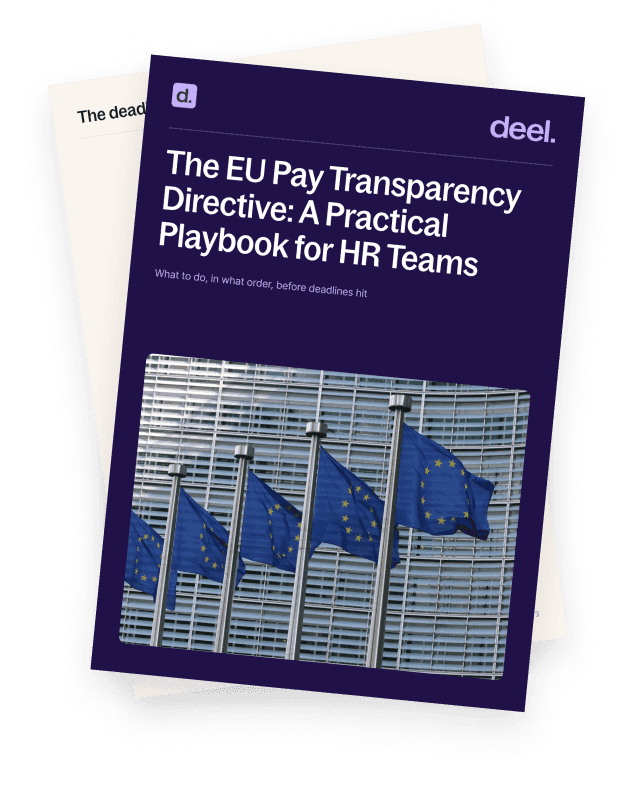
EU Pay Transparency Directive: A Practical Playbook for HR
What's already in effect
A handful of obligations kicked in the moment the decree entered into force, with no phase-in period.
Job postings must state pay. Every vacancy notice now needs the starting salary or salary range, along with the applicable National Collective Bargaining Agreement (NCBA). This is a stricter requirement than a generic range disclosure. Candidates and regulators can check the number against a specific labor agreement.
Salary history questions are banned outright. Employers can't ask candidates about current or past compensation, and that ban extends to third parties. If a recruiter or staffing agency asks on your behalf, that's still a violation.
Pay criteria have to be visible to employees. Pay criteria and progression criteria must be made accessible to employees. All employers must make pay-setting criteria available immediately. Employers with 50 or more employees must also make progression criteria accessible; those with fewer than 50 employees are exempt from the progression transparency requirement.
Employees can request pay comparisons, with limits on both sides. Workers can ask for average pay levels by gender across comparable job categories, and employers have 60 days to respond. To keep this from turning into a flood of individual requests, the law caps each employee to one request every 12 months. Employers also get a practical release valve: instead of answering requests one by one, they can proactively publish anonymized average pay levels by gender and category somewhere employees can access it, such as an intranet or a restricted company portal.
Why Italy's approach is different: NCBAs as the reference point
This is the part of the Italian law that doesn't map cleanly onto what other member states are doing, and it's the detail most worth understanding if your organization runs a single job architecture across multiple countries.
The Directive requires employers to define "work of equal value" using objective, gender-neutral criteria. Italy's decree answers that question by pointing to job classification systems already built into National Collective Bargaining Agreements. Where a NCBA classification applies, it carries a presumption of compliance. Employers don't have to build a job-leveling framework from scratch to satisfy the law; the framework often already exists inside the labor agreement that covers their workforce.
Employers can layer their own classification or leveling systems on top of that, but only as a supplement. The employer's framework has to integrate with the NCBA structure, not substitute for it.
For a company managing job levels and salary bands consistently across countries, this matters in a specific way. A global leveling framework that works cleanly in Germany or the Netherlands doesn't automatically satisfy the Italian standard. It has to reconcile with whichever NCBA applies to the workforce in question, which varies by sector and sometimes by region. Treating salary bands as a single global exercise, without a step that checks them against the relevant Italian labor agreement, is where enterprises tend to get caught out.

EU Compliance with Deel
EU Pay Transparency Directive Readiness Checklist
What's coming in 2027
Gender pay gap reporting isn't live yet, but the groundwork for it is already defined. Reporting will follow Article 9 of the Directive: mean and median gender pay gaps, reported separately for base and variable pay, the share of men and women receiving variable pay, gender distribution across pay quartiles, and gaps broken down by worker category.
Italy’s reporting schedule follows the EU-wide thresholds:: employers with 250 or more employees must report annually starting by June 7, 2027, employers with 150 to 249 employees must report every three years from June 7, 2027, and employers with 100 to 149 employees must report every three years from June 7, 2031. Employers with fewer than 100 employees are not subject to the mandatory reporting requirements under the new decree.. Some operational details are still being finalized: Italy's implementing decrees on methods for collecting, processing, and transmitting reporting data are due within 90 days of the June 7 entry into force.
What is confirmed is the trigger that follows a report: if any worker category shows an unjustified pay gap of 5% or more that isn't corrected within six months, the employer has to run a Joint Pay Assessment with worker representatives and adopt corrective measures within a reasonable timeframe.
Enforcement and what's at stake
Italy didn't write a new penalty schedule specifically for this decree. Instead, violations are handled through the existing Equal Opportunities Code (Legislative Decree 198/2006), Article 41. That framework provides for administrative penalties ranging from €5,000 to €10,000 for proven discriminatory practices. Such violations may also result in revocation of public benefits and, in case of serious or repeat violations, in exclusion from public tenders for up to two years.
Two structural points matter more than the fine amounts themselves. First, the burden of proof is reversed: If a worker alleges facts from which pay discrimination may be presumed (and this may include also the case an employer fails to meet transparency obligations or a pay gap is identified), the burden shifts to the employer to prove discrimination did not occur, not on the worker to prove that it did. Second, retaliation against workers who exercise their rights under the decree is explicitly prohibited, and unions or worker representatives can bring claims by proxy on an employee's behalf, which widens who can act on a potential violation beyond the individual worker.
A new monitoring body inside the Ministry of Labour will collect and publish employer data and report to the European Commission, which means the reporting employers submit doesn't stay internal. It feeds a national picture that regulators and, eventually, the public can see.
Getting ahead of it
For HR and legal teams managing an Italian workforce, three things are worth doing now rather than waiting for the 2027 reporting cycle to force the issue.
Map job postings and hiring workflows against the new disclosure requirements, since those obligations are already enforceable. Audit whether current job classifications reconcile with the applicable NCBA, since that's the standard Italy is actually measuring against. And build the reporting infrastructure early: pulling mean and median pay gaps by category, by gender, and by pay component isn't something to assemble for the first time under deadline pressure in 2027.
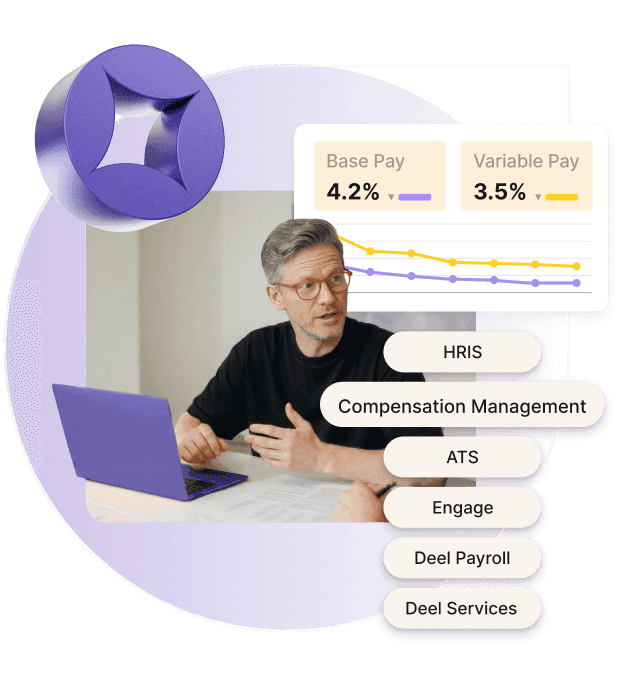
That last piece is where most organizations feel the gap between having a policy and having the underlying compensation strategy and data infrastructure to support it. Deel connects job architecture, compensation bands, and payroll data on one platform, so reporting draws from the same source that runs the rest of compensation, rather than a spreadsheet built for the occasion.
For teams earlier in the process, an eight-step readiness plan covers the groundwork to put in place across Italy and any other member state where you employ people.
EU Compliance with Deel
Tackle pay transparency, all in one place
Stay ahead of the next update, in Italy and everywhere else
Italy won't be the last member state to publish new details on this Directive, and it likely won't be the last set of thresholds to shift as implementing decrees land. Deel HR keeps job architecture, classifications, and compensation data connected in one place, so when a requirement changes in Italy, France, or anywhere else you operate, your team is updating one system instead of chasing down every local nuance separately.
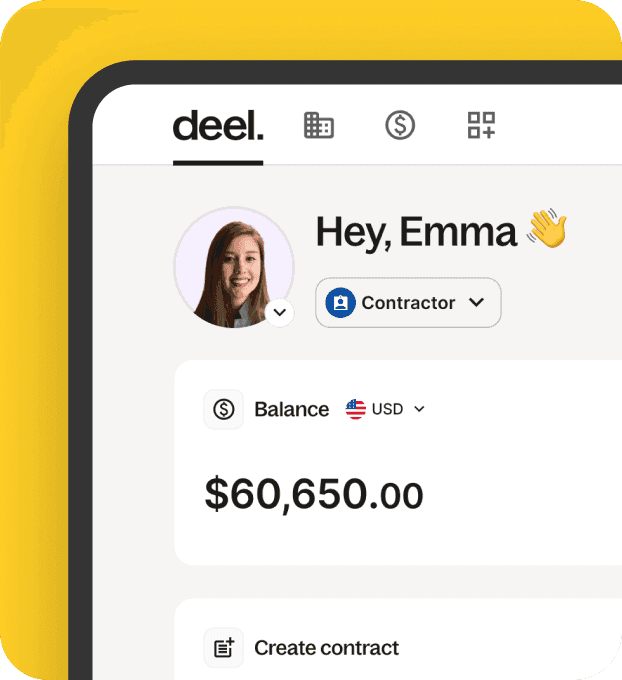
Book a demo to see how Deel HR helps you stay compliant with pay transparency requirements as they evolve, country by country.
Live Demo
Get a live walkthrough of the Deel platform
This content is for informational purposes only and does not constitute legal advice. Compensation laws and regulations change frequently, and this article notes specific sections requiring legal confirmation before publication. Businesses should consult qualified legal counsel for jurisdiction-specific guidance.
Ellen Simmonds is a content marketing manager with a decade of experience in tech, leadership, startups, and the creative industries. A long-time remote worker, she's passionate about WFH productivity hacks and fostering company culture across globally distributed teams. She also writes and speaks on the ethical implementation of AI, advocating for transparency, fairness, and human oversight in emerging technologies to ensure innovation benefits both businesses and society.