Article
7 min read
The Best Recruitment, Hiring, and Onboarding Tools in 2026
Global HR
Global hiring
AI

Author
Jemima Owen-Jones
Last Update
July 15, 2026

Table of Contents
Why fragmented recruiting stacks are a structural problem
Leading recruitment tools in 2026: what they do and where they stop
What to look for in 2026: the tools and features that matter for an integrated worker lifecycle
How Deel connects the full worker lifecycle
Comparing the approaches: where each tool stops
What to evaluate when selecting your 2026 recruiting and onboarding stack
The trend driving consolidation in 2026
Key takeaways
The average organization runs roughly 16 HR and recruiting applications, most of them disconnected, creating data silos that slow hiring and undermine day-one readiness.
Leading ATS platforms like Greenhouse, Ashby, and Lever excel at recruitment but stop at offer acceptance, leaving the hiring-to-onboarding and onbaording-to-payroll handoff to manual workarounds.
Deel connects talent sourcing, ATS, hiring, onboarding, payroll, HR, and IT into one system so candidate data flows through the entire worker lifecycle without re-entry.
Most hiring workflows follow the same pattern: candidates sourced in one platform, screened in another, interviewed through a third. The offer letter generated in a separate document editor, compliance checks handled via email, IT equipment requested on a spreadsheet, and the payroll team waiting for HR to re-enter everything before the first paycheck runs. Each tool does its job in isolation. Somewhere between offer acceptance and day one, the process falls apart.
This is not a niche problem. According to HR.com's 2025 research (cited in Pin's Recruiting Tech Stack Report), the average organization runs roughly 16 HR and recruiting applications, 68% of them operating on disconnected platforms, with roughly 25% average tool adoption across the stack. SHRM research found that organizations are now using more than twice the number of HR technology modules than they were just five years ago, and that more than 60% of purchased software sits largely unused.
In 2026, the question for HR and talent leaders is not which individual tool is best in class, but which combination of tools (or which single platform) keeps candidate data clean, onboarding compliant, and the entire worker lifecycle connected. This guide evaluates the leading recruitment and hiring onboarding tools, what each does well, where each falls short, and how an integrated approach closes the gaps.
Why fragmented recruiting stacks are a structural problem
The typical recruiting tech stack grew by accident. Teams added an ATS when hiring reached a certain volume, bolted on a sourcing tool when the ATS proved too passive, added a scheduling tool when interview coordination ate too much recruiter time, and layered a separate onboarding platform on top when HR complained about the handoff. Each new tool solved a point problem in isolation and compounded the integration debt across the stack.
Research cited by HR Tech Institute found that a majority of recruiting teams use at least three tools on top of their primary ATS, and that number climbs fast in high-volume hiring environments.
When recruiters reconcile conflicting dashboards, they spend time on system maintenance instead of candidate relationships. When the onboarding hand-off from ATS to HRIS requires manual data transfer, errors compound.
The downstream cost is measurable. Research aggregated by Gallup and cited across multiple HR sources finds that only 12% of employees strongly agree their organization does a great job of onboarding new employees.
Early turnover from poor onboarding carries a real price tag: replacing an employee can cost anywhere from 40% to 200% of their annual salary, depending on seniority and specialization.
Fragmentation is an architectural problem, not a product quality problem.
The true cost of early turnover
Replacing an employee can cost anywhere from 40% to 200% of their annual salary, depending on seniority. For senior leadership roles, that figure can reach 200%. Onboarding quality is one of the most controllable variables in first-year retention — source: Gallup, Techjury.

Free template
Streamline your onboarding process today
Leading recruitment tools in 2026: what they do and where they stop
Understanding where each platform ends its coverage is as important as understanding what it covers. The most widely adopted ATS and onboarding tools fall into recognizable categories.
Greenhouse
Greenhouse is the established enterprise ATS choice, built for structured, repeatable hiring at scale. Its strengths include customizable interview plans, DEI-tracking tools, built-in analytics, and a broad third-party integration library. Greenhouse supports the full recruiting workflow from requisition through offer and into onboarding workflows.
Where it stops: Greenhouse's onboarding capability handles document collection and task assignment. It does not run payroll, manage global compliance across jurisdictions, provision IT equipment, or track workers through the post-onboarding lifecycle.
For international hires specifically, Greenhouse does not offer Employer of Record (EOR) services or multi-country payroll, and that gap requires a data export and re-import into whichever downstream system HR uses.
Best for: Mid-to-large companies that need rigorous, configurable hiring workflows and already have a separate HRIS and payroll system.
Ashby
Ashby positions itself as a modern hiring operating system, bundling ATS, CRM, scheduling, and advanced analytics into a single platform. It is particularly well-suited to data-driven, growth-stage teams that want to track conversion rates by source, analyze pipeline health, and run structured hiring without exporting data to external BI tools.
Where it stops: Ashby's coverage ends at the offer. There is no native onboarding workflow, no payroll, and no compliance management for employment across jurisdictions. Its analytics depth (pipeline conversion by source, structured hiring without external BI exports) is strong within recruiting. It does not extend beyond offer acceptance.
Like Greenhouse, Ashby requires separate tools to handle everything that happens after a candidate accepts.
Best for: Growth-stage tech companies with a dedicated recruiting team that wants analytics-led hiring management, starting at around $400/month for the Foundations tier.
Lever
Lever differentiates through its native CRM (NurtureKit), which lets recruiting teams manage passive candidate pipelines without a separate sourcing tool. Practitioners in competitive talent markets consistently rate Lever's interface as the most approachable of the major ATS platforms, and it works well for organizations where employer brand and candidate experience matter.
Where it stops: Lever's onboarding capabilities, by the assessment of many practitioners, stop at digital offer letters. Recruiting-to-HR workflow continuity requires separate tools. For growing companies that want continuity from offer acceptance through day one and beyond, Lever requires an integration layer to connect with HRIS, payroll, and onboarding systems.
Best for: Growth-stage companies prioritizing candidate nurturing and employer brand, where a dedicated recruiting team will actively use the CRM features.
BambooHR
BambooHR covers recruiting, onboarding, and core HRIS for small and mid-sized businesses. Its built-in ATS allows candidate data to flow into the onboarding portal, reducing manual data entry. For domestic hiring in a single jurisdiction, it delivers reasonable lifecycle continuity.
Where it stops: BambooHR was built primarily for the domestic US market. Its capabilities for international hiring, multi-country payroll, global compliance monitoring, and EOR arrangements are limited. BambooHR constrains reporting depth and customization for organizations with complex structures.
Best for: Small and mid-sized businesses hiring domestically, or teams that need a simple, user-friendly HR platform without international complexity.
Workday Recruiting
Workday Recruiting is an enterprise ATS embedded in Workday's Human Capital Management platform. Because it shares data with Workday HR, payroll, and finance, it can work well for organizations already committed to Workday as their core HR system.
Where it stops: Workday's strength is in organizations already standardized on Workday HCM. As a standalone recruiting purchase, it tends to be expensive and configuration-heavy.
Best for: Large enterprises already running Workday for HR, payroll, and finance that want to consolidate within that same platform suite.
Talent
Find top talent, hire globally

What to look for in 2026: the tools and features that matter for an integrated worker lifecycle
If the shortcoming of most recruiting tools is that they end at offer acceptance, the features worth prioritizing are those that bridge the gap between hiring and productive employment. Evaluate platforms on the following criteria.
-
Talent sourcing: Can the platform connect you directly with vetted recruitment agencies and integrated talent marketplaces—or does it force you to manage sourcing separately? Look for performance tracking like applicant volume, time-to-hire, and spend, and verify you only pay when you successfully hire the candidate, not upfront.
-
ATS-to-HRIS data continuity: Does candidate data flow automatically into the HR system when a hire is confirmed, or does someone on the HR team re-enter it manually? Manual re-entry introduces errors and delays day-one readiness.
-
Compliant hiring through EOR or COR: The best platforms don't just warn you about hiring risks—they eliminate them by offering Employer of Record (EOR) and Contractor of Record (COR) as built-in hiring models. When you're expanding internationally or need flexibility on worker classification, you should be able to choose your model and complete the entire process—from offer to compliance to payroll—without leaving the platform.
-
Contract and compliance generation: For international hires in particular, the platform should generate compliant employment agreements for the relevant jurisdiction, not require HR to source local counsel for each new country. Look for onboarding software that integrates with payroll and HRIS without complicated setup.
-
IT provisioning coordination: For distributed teams, equipment logistics is often the most practically disruptive part of onboarding. 43% of employees wait more than one week to get basic workstation logistics and tools. A platform that links HR confirmation to IT provisioning eliminates that bottleneck without requiring a separate ticketing system.
-
Global compliance coverage: If any portion of the workforce is international, the platform needs compliance monitoring across jurisdictions, not just a disclaimer to consult local counsel. This includes understanding contractor versus employee classification, EOR versus direct entity requirements, and local statutory obligations.
-
Post-onboarding continuity: Where does the platform's coverage end? Onboarding that hands off to a separate payroll system, then to a separate performance system, then to a separate learning management system, recreates the fragmentation problem at a slightly later phase of the worker lifecycle.
Deel HR
Hire and recruit faster, with less effort
How Deel connects the full worker lifecycle
The gap that most tools leave, between offer acceptance and productive employment, is where Deel's approach differs structurally from point solutions.
Rather than competing with Greenhouse, Ashby, or Lever for ATS market share, Deel's design premise is that the worker lifecycle is a single system problem, and that solving each phase in isolation produces the fragmentation most HR leaders experience. Deel integrates natively with these leading tools teams already use, and then extends coverage beyond them.
Deel Talent: sourcing before the ATS
For teams that need sourcing capability before the ATS stage, Deel Talent offers two paths: an AI-vetted marketplace of over 1.5 million in-market candidates (currently available for US, UK, and India roles), and a Talent Partner path connecting teams with specialist recruitment agencies for harder-to-fill roles, including a 90-day candidate replacement guarantee. Once a candidate accepts an offer through either path, contracts are pre-filled and onboarding begins within the same platform.
The ATS module: AI-powered hiring built into Deel HR
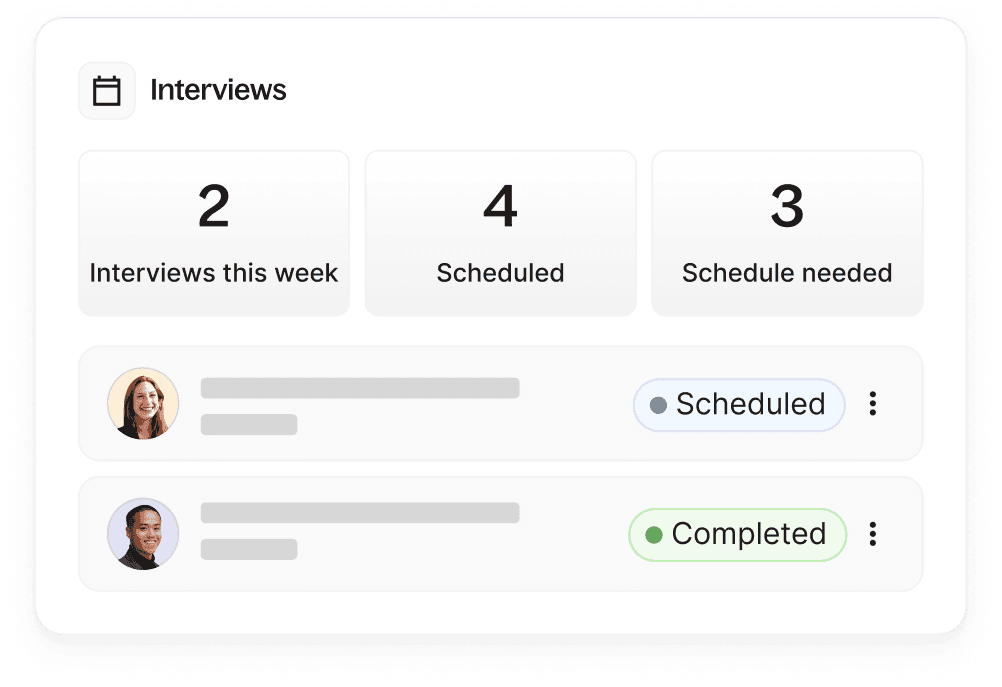
Deel's ATS is an AI-powered hiring module integrated within Deel HR. It includes AI job creation, candidate matching, authenticity screening to flag bad-faith applications, and interview scheduling that connects directly to Google Workspace and Microsoft Outlook, with no separate scheduling tool required. The Pro tier adds an AI Interview Assistant that records interviews with candidate consent, transcribes them, and generates summaries.
The design difference between Deel HR's ATS module and standalone ATS tools is that the candidate record lives in the same system as the HRIS from the start. Confirming the hire creates an HRIS profile with one click, without an export or manual re-entry step.
Native ATS integrations: Greenhouse, Ashby, and Lever
For teams that prefer to keep their existing ATS, Deel integrates natively with all three leading platforms. When a hiring manager checks "Hire through Deel" in Greenhouse, when a job offer is made in Ashby, or when "Hire using Deel" is selected in Lever, candidate information syncs automatically to Deel. Deel creates a draft contract from the candidate's data automatically, without manual transfer. This covers the most disruptive handoff point, between ATS and employment contract, for teams that want to keep best-of-breed recruiting tools without sacrificing onboarding continuity.
For a detailed breakdown of how ATS tools compare at the product level, see Deel's buyer's guide to applicant tracking systems.
Wayfindr scaled global hiring in weeks with Deel
Wayfindr, a logistics startup, needed to hire quickly across multiple markets without the overhead of building separate local HR infrastructure. Using Deel's connected platform, the team was able to onboard new hires compliantly across markets in weeks rather than months — without re-entering candidate data across systems.
Onboarding: compliance, documents, and workflows
Once a candidate moves into onboarding, Deel handles contract generation, document collection, training, benefits administration, visas and work pemits, equipment and IT provisioning, all through the onboarding workflow automation.
Deel's onboarding guidance identifies structured workflows as equally important to the underlying technology for reducing time-to-productivity.
The Engage module extends this further by assigning onboarding learning courses automatically based on role and start date, setting 30/60/90-day milestone goals, and collecting new-hire feedback via surveys at key intervals.
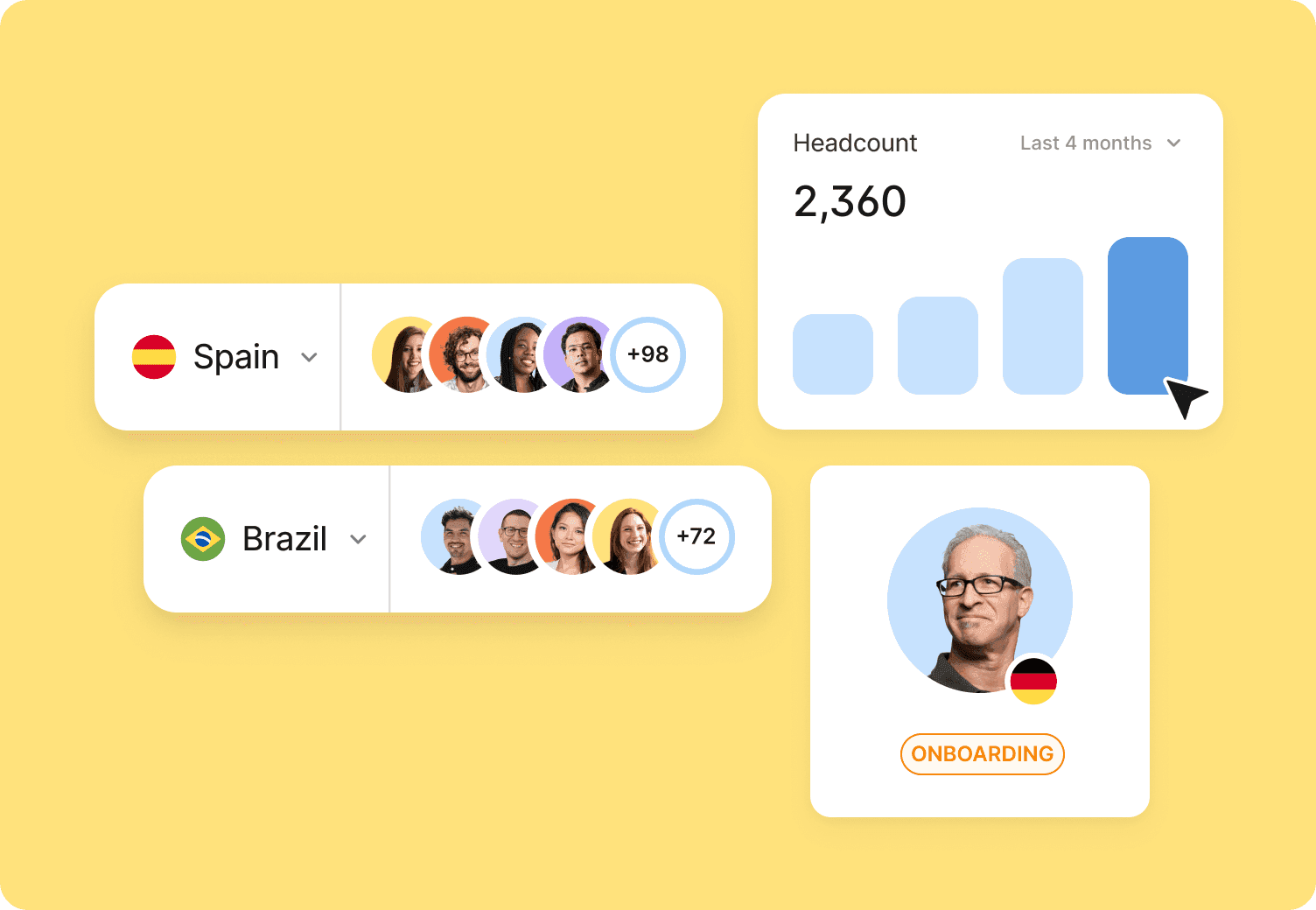
For global hires, Deel's EOR and contractor management capabilities mean that hiring compliance is built into the onboarding process rather than bolted on afterward. A team hiring in Germany, Brazil, and Singapore in the same quarter uses the same workflow across all three, with Deel managing local contract requirements, statutory deductions, and work authorization tracking for each.
See also: Elevate Employee Onboarding & Offboarding Efficiency with Deel
Deel IT: equipment and access from day one
A common failure mode in distributed onboarding is the gap between HR confirming a start date and IT actually provisioning devices and system access. Deel IT manages device lifecycle management, MDM (mobile device management), and endpoint security, with devices linked directly to employee records. When HR confirms a hire, role-based IT policies trigger equipment provisioning automatically. The same system handles offboarding equipment return without a separate ticketing workflow.
The practical impact: new hires arrive with devices, system access, and provisioned software without HR or IT teams having to coordinate manually across separate platforms. Late laptops are a documented cause of remote onboarding failure, and connected IT provisioning removes that variable.
Global payroll and HR continuity
After onboarding, Deel's platform continues through payroll (covering 130+ countries via Deel's in-house payroll engine), performance management and learning (via the Engage module), immigration and mobility support, and compensation management. The candidate sourced through Deel Talent, tracked through Deel's ATS module, onboarded through Deel HR, and provisioned through Deel IT carries the same record through the entire lifecycle without re-entry at any stage.
For HR leaders evaluating whether their international hiring approach needs EOR support, a direct entity, or a combination, Deel's analysis on owned entity versus in-country partner covers the tradeoffs in detail.
Deel's HRIS
Manage your global workforce compliantly

Comparing the approaches: where each tool stops
| Tool | Sourcing | ATS | Hiring | Onboarding | Payroll | IT Provisioning | Global Compliance |
|---|---|---|---|---|---|---|---|
| Greenhouse | Add-on | Yes | No | Partial | No | No | Partial |
| Ashby | CRM + sourcing | Yes | No | No | No | No | No |
| Lever | CRM yes | Yes | No | Offer letter only | No | No | No |
| BambooHR | Limited | Yes | No | Yes (domestic) | US only | No | Limited |
| Deel | Yes - for all worker types, all roles, and all markets where Deel operates globally | Yes | Yes - EOR and COR | Yes | Yes (130+ countries) | Yes | Yes (120+ countries) |
This comparison is not intended to suggest that Greenhouse, Ashby, or Lever are deficient tools. Within recruiting, they are strong platforms that hold their market positions on merit. The point is architectural: teams that need workflow continuity from sourcing to payroll cannot achieve it with any of those platforms alone. They either add Deel as a downstream integration (the ATS integration path) or consolidate onto Deel's full lifecycle platform.
What to evaluate when selecting your 2026 recruiting and onboarding stack
Whether consolidating onto a single platform or keeping best-of-breed tools with strong integrations, the evaluation criteria that most often predict long-term satisfaction are:
Data handoff quality: Does candidate data transfer cleanly from ATS to HRIS to payroll without manual re-entry? Each re-entry step is an error surface
Compliance coverage: Is global compliance built into the workflow, or does it require external counsel and manual tracking per jurisdiction?
IT integration: Is equipment provisioning connected to HR workflows, or is it a separate system that HR has to notify manually?
Post-onboarding support: Does the platform continue to manage the worker after day one, or does it hand off to yet another system for payroll, performance, and learning?
Integration coverage: For tools that stop short of full lifecycle coverage, how clean and maintained are the integrations with downstream systems? Native integrations maintain data fidelity. Zapier-based workarounds tend to break under scale pressure.
For teams evaluating ATS tools specifically for startup and SMB environments, Deel's guide to applicant tracking systems for startups covers what to prioritize at different growth stages.
The trend driving consolidation in 2026
Only 30% of organizations plan to increase HR-tech spend in 2026, down 20 points since 2020. The budget pressure is real, and it is accelerating a shift from stack expansion to stack consolidation. SHRM's coverage of the Torii 2025 SaaS Benchmark Report found that organizations waste over $1 million annually on SaaS tools that were purchased but go largely unused.
The 2026 HR technology question is therefore less "which new tool should we add" and more "which tools are we paying for that do the same thing, and which gaps require a real solution versus a better integration."
For most teams, the most expensive gap is the one between offer acceptance and productive employment, the phase where ATS tools hand off and HRIS tools have not yet started. Closing that gap, whether through native integration or platform consolidation, is where recruiting and onboarding technology delivers the most measurable return.
Hiring the right people is the easy part to articulate and the hardest part to execute consistently. When the tools that support recruiting, onboarding, payroll, IT, and compliance all operate on separate data models, the friction accumulates at every handoff. Deel was built specifically to eliminate those handoffs, connecting talent sourcing, AI-powered hiring, compliant onboarding, and global payroll into a single worker record that travels through the entire lifecycle without re-entry.
Teams evaluating whether to integrate Deel with an existing ATS or consolidate onto the full lifecycle platform can start in the same place: a conversation about where the current workflow breaks, and what a connected system would look like.
Book a demo with Deel below to see the full worker lifecycle platform in practice.
Live Demo
Get a live walkthrough of the Deel platform
FAQs
What is the difference between an ATS and onboarding software?
An ATS (applicant tracking system) manages the recruiting workflow from job posting through offer acceptance. Onboarding software handles what happens after, including contracts, document collection, compliance tasks, and day-one setup. Most ATS tools stop at offer acceptance. Onboarding software picks up from there. The challenge is connecting them cleanly.
Can Deel integrate with Greenhouse, Ashby, or Lever?
Yes. Deel integrates natively with Greenhouse, Ashby, and Lever. When a hire is confirmed in any of those platforms, candidate information syncs automatically to Deel to create a draft contract, without requiring manual data re-entry.
What does Deel IT do for new hire onboarding?
Deel IT manages device provisioning, mobile device management (MDM), and endpoint security. When HR confirms a hire, role-based IT policies trigger equipment provisioning automatically, eliminating the manual coordination between HR and IT that typically causes new hires to arrive without working devices or system access.
How does Deel handle global compliance during onboarding?
Deel monitors compliance across 120+ countries, generates locally compliant employment contracts for each jurisdiction, and manages statutory requirements including work authorization, tax deductions, and mandatory benefits. For teams hiring with Deel's EOR solution, Deel acts as the legal employer in countries where the client does not have a local entity.
Are Deel's sourcing features available globally?
The AI Vetted Marketplace is currently available for roles in the US, UK, and India. Deel's talent sourcing, which connects teams with specialist recruitment agencies, is available for a broader range of markets and role types.
What happens after onboarding in Deel?
After onboarding, workers remain on the same platform. Deel covers payroll (130+ countries), performance management and learning through Engage, immigration and mobility support, compensation management, and IT lifecycle management including offboarding. HR teams do not need to migrate worker data to a separate platform at any post-onboarding stage.
Related Deel resources
This article is provided for general informational purposes and should not be treated as legal or HR advice. Product features, pricing, and availability mentioned for third-party platforms are based on publicly available information as of mid-2026 and may change. Consult each vendor for current specifications.
Jemima is a nomadic writer, journalist, and digital marketer with a decade of experience crafting compelling B2B content for a global audience. She is a strong advocate for equal opportunities and is dedicated to shaping the future of work. At Deel, she specializes in thought-leadership content covering global mobility, cross-border compliance, and workplace culture topics.