Article
9 min read
How to Use Engagement Data to Navigate Layoffs With Deel
Global HR

Author
Ellen Simmonds
Last Update
May 07, 2026

Table of Contents
What does engagement data actually tell you during a restructure?
Why don't most HR teams have this visibility?
What does ROI actually look like for engagement tooling during a restructure?
How does Deel give HR leaders the visibility they're missing?
The restructure is the moment that tests your infrastructure
Key takeaways
Research found a 40% jump in current employees searching for new opportunities after a layoff — disproportionately among key talent. Post-layoff anxiety worsens in year two, not year one.
Most HR teams discover engagement problems at the exit interview — the most expensive place to find them. Real-time engagement data changes the outcome at three critical moments: before the decision, during the restructure, and in the recovery period that follows.
Deel HR, Engage, and Deel Workforce Planning give HR leaders a connected, real-time view of their workforce — so restructuring decisions are informed by data, flight risk is visible before it becomes an exit, and recovery can be tracked rather than assumed.
It's been months since the restructure. The notifications went out cleanly, the communications were handled well, and leadership has declared the process complete. Then, a senior engineer on one of your strongest teams resigns.
Their manager is blindsided. HR pulls the exit interview. The signals were there for months — quieter in meetings, shorter responses, a gradual withdrawal from the projects they used to champion. Nobody saw it because nobody was looking in the right place. The question isn't why it happened, but why it was invisible until it was too late.
This scenario is more common than most HR leaders want to admit, and the data confirms it. Glassdoor's research found that post-layoff anxiety among remaining employees worsens in the second year following a reduction in force, not the first. A study tracking companies through layoffs found that a 40% jump in the number of current employees searching for new opportunities follows a reduction in force, and those job seekers are disproportionately key talent. The signals are always there. The problem is structural: most HR teams don't have the infrastructure to see them in time.
What does engagement data actually tell you during a restructure?
Not all engagement data is created equal — and during a restructure, timing is everything. Here's where visibility changes the outcome.
Before the decision is made
The first place engagement data matters is before a single redundancy notice goes out. Most workforce decisions in a restructure are made from headcount lists and org charts. What they rarely include is a real-time picture of who's already disengaged, who's at flight risk, and where the pockets of strength are that need to be protected.
According to Research.com's 2026 analysis of enterprise engagement software, 65% of organisations confirm that engagement software improves employee productivity and performance — and organisations that measure ROI with engagement data are five times more likely to achieve positive returns. Knowing that a team is already showing signs of low morale before a restructure changes who you retain, how you redeploy, and what you communicate.
Deel HR
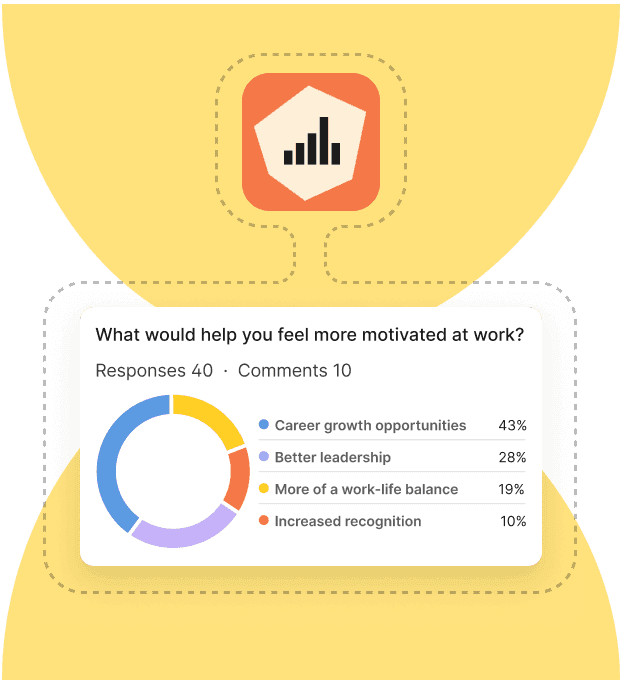
Collect insightful worker feedback
During the restructure
The notification phase is the highest-anxiety moment for remaining employees — and the one HR teams have the least visibility into in real time. Without pulse data, you're relying on managers to surface what they're hearing, filtered through their own stress and uncertainty.
Real-time sentiment tracking during a restructure lets HR intervene before a manageable concern becomes a resignation decision. It also gives you the evidence to go back to leadership when the recovery timeline is being misread — which, as we've established across this series, it almost always is.
Catch up on the rest of our mini-series on handling layoffs without risking employee engagement:
After the dust settles
This is where most HR teams lose the thread entirely. The restructure is declared complete, attention moves elsewhere, and the slow erosion of engagement among remaining employees goes untracked until it shows up as voluntary attrition.
Glassdoor's analysis of companies that conducted layoffs found that anxiety keyword prevalence in employee reviews increases 64% in the six months after a reduction in force — and worsens in the second year, not the first. Without a system tracking sentiment over time, HR leaders have no way to know whether their teams are recovering or quietly unravelling.
Why don't most HR teams have this visibility?
It's rarely a question of awareness. Most CHROs understand that engagement data matters. The barrier is almost always implementation: the perceived effort of standing up a new tool, integrating it with existing systems, and getting adoption across a global team that's already under pressure.
That concern is legitimate, but it's being weighed against the wrong number. According to UKG's analysis of HR technology ROI, the hidden value drivers of engagement tooling (reduced attrition, faster recovery, better decision-making) consistently outweigh the visible implementation costs, particularly when the alternative is making restructuring decisions without reliable data.
To put it more concretely, Gallup estimates replacing a single employee costs between half and two times their annual salary. For a senior engineer on a £90,000 salary, that's up to £180,000 in replacement cost, for one departure. If engagement data catches one flight risk signal early enough to intervene, it has already paid for itself many times over. The ROI question isn't "can we justify this?" It's "can we afford not to?"
We built our first NPS in 15 minutes, and the last pulse survey was a complete success…We saved two full months on performance reviews the very first year. Deel HR has everything. We went from cobbling forms together to running reviews, learning, and surveys in one click.
—Lucía Rodriguez,
Head of HR, Ladonware
See how Landonware took their HR stack from a patchwork of vendors to a scalable people platform, with Deel.
What does ROI actually look like for engagement tooling during a restructure?
The mistake most HR leaders make when evaluating engagement tools is measuring input costs against abstract outcomes. The ROI of engagement data during a restructure is concrete and calculable — it shows up in four places:
Retention of key talent. Every senior departure avoided is a direct cost saving. The earlier you identify flight risk, the more options you have before the decision is made: a development conversation, a role adjustment, or a manager check-in.
Faster productivity recovery. Teams with clear goal-resetting and active sentiment monitoring recover faster post-restructure. Employers using performance management tools are 28% more likely to report positive ROI from their HR technology investments, which is a direct reflection of the productivity gains that come from equipping managers with real data rather than instinct.
Smarter redistribution decisions. Engagement and performance data surfaces internal mobility opportunities that headcount lists miss entirely. Redeploying a strong performer into a new role costs a fraction of replacing them externally, and preserves institutional knowledge that walks out the door with every exit.
Reduced rehire cost. The companies that cut deepest often rehire soonest — at higher cost, through agencies, for roles that look suspiciously similar to the ones they eliminated. Engagement data that informs the original decision reduces the likelihood of that cycle repeating.
Deel HR
One place for simplified, smarter global HR
How does Deel give HR leaders the visibility they're missing?
Whether you're new to Deel, or already have access but haven't activated it for workforce change scenarios, the capabilities map directly onto the gaps this article has outlined.
Pulse surveys that surface what one-to-ones won't
Not every employee will tell their manager how they're really feeling. Engage's configurable pulse surveys give HR leaders a direct, anonymous line to team sentiment — deployable at any point in a restructure cycle, not just during annual review periods. The data is real-time, trackable over time, and actionable before it becomes a resignation.
Performance and 360° feedback that informs retention decisions
When a restructure forces difficult decisions about who to retain, performance data should be driving those calls — not recency bias or proximity to leadership. Engage's performance management tools give HR leaders a documented, structured view of contribution across the team, before decisions are made and in the recovery period that follows.
Learning and development pathways that turn restructures into mobility opportunities
The alternative to cutting a role isn't always hiring for a new one. Engage's LMS lets HR leaders build targeted upskilling programmes that help employees grow into adjacent roles — reducing the headcount impact of a restructure while retaining institutional knowledge. For global teams, this is particularly valuable: the person with the right skills for a new direction may already be on your payroll in a different market.
Manager effectiveness tracking that catches the ripple effect early
Managers are the primary channel through which restructure anxiety either gets contained or amplified. Engage's 360° feedback and manager effectiveness data lets HR leaders identify which managers are struggling — before their teams start showing flight risk signals of their own.
A connected data layer that ties it all together
Engage sits within the Deel platform, which means the engagement and performance data doesn't live in a separate system that HR has to triangulate against payroll, contracts, and headcount data. For global teams managing restructures across multiple jurisdictions, that connected view isn't a nice-to-have. It's what makes timely intervention possible.
Culture is hard when you have a relatively small team across seven countries and different time zones. With Deel, we have one set of processes that support our culture, whether you’re in El Salvador, Italy, or Mexico.
—Bart-Jan Leyts,
Founder, Otamiser
The restructure is the moment that tests your infrastructure
Every HR leader knows what good looks like in a restructure: decisions grounded in data, managers equipped to lead, remaining employees who feel seen and supported, and a recovery that happens faster than leadership expects.
The gap between knowing what good looks like and being able to execute it is almost always an infrastructure gap. The teams that come out of restructures stronger aren't the ones with better instincts. They're the ones who could see what was happening in real time and act on it before it became irreversible.
Engage is how you close that gap — whether you're preparing for a restructure, navigating one now, or making sure you're never caught without visibility again. See how Engage can give your HR team the data it needs before, during, and after a restructure.
Platform Tour
Transform employee learning
Live Demo
Get a live walkthrough of the Deel platform
FAQs
What is pulse survey data used for during a layoff?
Pulse surveys give HR leaders a real-time, anonymous view of how remaining employees are feeling at key moments in a restructure — immediately after notification, in the weeks that follow, and during the recovery period. The data helps HR identify where morale is fragile, which teams need additional support, and where flight risk is building before it shows up as a resignation.
How do I know if my team is disengaged after a layoff?
The most reliable signals are behavioural, not verbal: reduced participation in meetings, fewer proactive contributions, shorter responses, and withdrawal from team relationships. Engagement tools like pulse surveys and 360° feedback make these patterns visible at a team level, so HR and managers can intervene early rather than discovering the problem at an exit interview.
What's the ROI of engagement software during a restructure?
The most direct ROI comes from retained talent. Replacing a single senior employee costs between 50% and 200% of their annual salary — catching one flight risk signal early enough to intervene can pay for an engagement tool many times over. Additional ROI shows up in faster productivity recovery, smarter redistribution decisions, and reduced rehire cost from over-cutting.
Can engagement tools work for remote and global teams?
Yes — and for distributed teams, they're arguably more important than for co-located ones. Remote employees have fewer informal touchpoints with managers and leadership, which means early warning signals are harder to spot without structured data. Engage is built for global teams on the Deel platform, meaning pulse data and performance insights are available across geographies, employment types, and time zones in a single connected view.
How long does it take to get value from Engage after implementation?
Faster than most HR leaders expect. Pulse surveys can be deployed within days of setup, and the first cycle of data gives HR a baseline view of team sentiment that's immediately actionable. For teams already on Deel, integration is significantly simpler — the workforce data is already there, and Engage connects directly to it without requiring a separate implementation project.
Ellen Simmonds is a content marketing manager with a decade of experience in tech, leadership, startups, and the creative industries. A long-time remote worker, she's passionate about WFH productivity hacks and fostering company culture across globally distributed teams. She also writes and speaks on the ethical implementation of AI, advocating for transparency, fairness, and human oversight in emerging technologies to ensure innovation benefits both businesses and society.