Article
6 min read
The Importance of Modernizing Talent Management: From Spreadsheets to AI
Global HR

Author
Ellen Simmonds
Last Update
May 25, 2026

Your payroll runs. Headcount is tracked. You've got an HRIS in place and the basics under control. But if you zoom in on the talent management layer — the way you develop, engage, and retain your people — things start to look a lot less organized. Performance reviews live in a spreadsheet that gets dusted off once a year. Learning content sits in a Drive folder nobody opens. Career development happens in a manager's head, if it happens at all. And your latest engagement data comes from an eight-month-old survey.
None of this feels catastrophic, but it's creating gaps you may not see until you bring your attention back to talent management. Unlike a broken payroll run, a broken talent management process doesn't trigger an alert; it just quietly costs you your best people.
Here's how to recognize the signs, understand what's actually at stake, and make the shift from manual to modern.
Six signs your talent management has outgrown your tools
These aren't edge cases. They're what most HR teams at growing companies are living with right now.
1. Performance reviews are a once-a-year email chain
Someone sends a template in December. Managers fill it in (or don't). You collect the responses, try to reconcile them, and wonder why half of them look nothing alike. There's little record of what was discussed, no consistency across teams, and no connection to what anyone is actually working toward.
The result: performance data you can't act on, and employees who feel like the review process exists for HR's benefit, not theirs.
2. Your learning content lives in a folder no one opens
You've got training materials somewhere. Maybe it's a Drive folder, maybe it's a Notion page, maybe it's a mix of both plus a few Loom videos someone recorded two years ago. Nobody's tracking who's completed what. Nothing connects to a development plan. There's no way to know whether any of it is moving the needle.
According to LinkedIn's Workplace Learning Report, 90% of organizations name L&D opportunities as their top retention strategy, and companies with a strong learning culture see retention rates twice as high as those without. If your learning content is invisible, it might as well not exist, leaving you vulnerable to attrition and slowed employee growth.
3. Career paths are inconsistent
Ask most employees at a growing company what 'senior' looks like in their role, or what it takes to get from where they are to the next level. Many can't tell you, because no one's written it down. Job levels aren't documented, and growth frameworks don't exist or aren't shared transparently.
Even if you do have an established job architecture, it’s difficult to know when an employee meets the requirements to move up the ladder. With no consistent system, much of a person’s career growth depends on their manager, making promotions sporadic and sometimes unfair High performers don't always quit loudly. Often, they just stop believing growth is possible and start looking elsewhere. By the time you know there's a problem, they're already out the door.
Complementary reading:
4. Onboarding depends on who runs it
Your onboarding checklist is a Google Doc. Your onboarding process is partly that doc, partly tribal knowledge, and partly whoever has time that week. Two new hires who start the same month might have completely different experiences, from inconsistent or delayed access, to missing introductions and varying clarity about what's expected of them.
Poor onboarding slows time-to-productivity, hurts early retention, and sets the tone for everything that follows. Employees who have a poor onboarding experience are twice as likely to quit, and it’s a mistake to treat it like an afterthought.
5. Your engagement data is always three months old
You run an annual engagement survey, but by the time the results are in, analyzed, and actioned, the moment has passed. The team members who flagged disengagement six months ago have already decided how they feel about the company.
Real engagement insight requires real-time data — not a retrospective snapshot that tells you what was true before your last all-hands. Frequent pulse surveys can tell you more about what your employees really feel.
6. Goals, performance, and development are three separate conversations
OKRs live in one tool, performance data lives in a spreadsheet, and development plans — if they exist at all — live somewhere else entirely. Managers context-switch between systems to piece together a picture of how someone's doing, and nothing is connected in a meaningful way. Fair and strategic decisions about promotions, raises, and development investment rely on a shared source of truth. Without that, talent management becomes less efficient, and stunts employee growth.
Why this costs more than it looks like
Manual talent management feels manageable until it isn't. The costs are real — they just don't show up on a dashboard.
Replacing an employee typically costs between 50% and 200% of their annual salary, when you factor in recruiting, onboarding, and lost productivity.
High performers leave when they can't see a path forward — and they rarely cite that as the reason. Exit interviews undercount this significantly.
Inconsistent performance cycles create pay equity exposure. If different managers apply different standards, you accumulate risk over time, especially across geographies with different employment laws.
Managers spend time on admin instead of actually developing their teams. When performance reviews are a manual process, managers spend their energy formatting spreadsheets rather than having meaningful conversations.
Without connected data, HR can't be strategic. If your performance data, engagement scores, and learning completion rates all live in different places, you can't see patterns, can't forecast risk, and can't prioritize where to invest.
Top organizations are joining the shift to modern talent management. They're running continuous performance cycles, connecting L&D to career growth, and making workforce decisions backed by real data. All without extra admin time, largely thanks to AI.
What modern talent management actually looks like
When your talent management processes are properly set up, the system does most of the heavy lifting. Workflows trigger automatically, insights surface without anyone having to pull a report, and managers spend their time on conversations rather than admin.
Here's what that looks like in practice:
Onboarding workflows trigger automatically the moment an offer is accepted. IT provisioning, introductory check-ins, training assignments, and 30-60-90 day milestones all run without anyone managing a checklist. Every new hire gets the same structured experience, regardless of team or location.
Performance feedback flows continuously, not in annual bursts. AI helps managers write better feedback, flags when check-ins are overdue, and surfaces patterns across review cycles that would take hours to find manually.
Learning is personalized, and assigned intelligently. Based on role, career path, and performance data, the right content reaches the right people at the right time, and completion is tracked automatically.
Engagement is monitored in real time. Pulse surveys run on automated cadences, and AI analyzes sentiment across the org — surfacing flight risk signals, team-level trends, and recommended actions before problems become expensive.
Career paths are visible and connected to real data. Employees can see what growth looks like at your company, and managers can see exactly where someone is on that path, without digging through spreadsheets or guessing.
AI connects the dots across all of it. When performance, learning, engagement, and career data all live in the same system, AI can identify patterns no human would catch at scale: who's at risk of leaving, where skill gaps are emerging, which managers are developing their teams and which aren't.
How to make the transition
You don't need to rebuild everything at once. The teams that make this shift successfully do it in phases by automating the highest-risk processes first, then layering in AI-powered insight once the data foundation is in place.
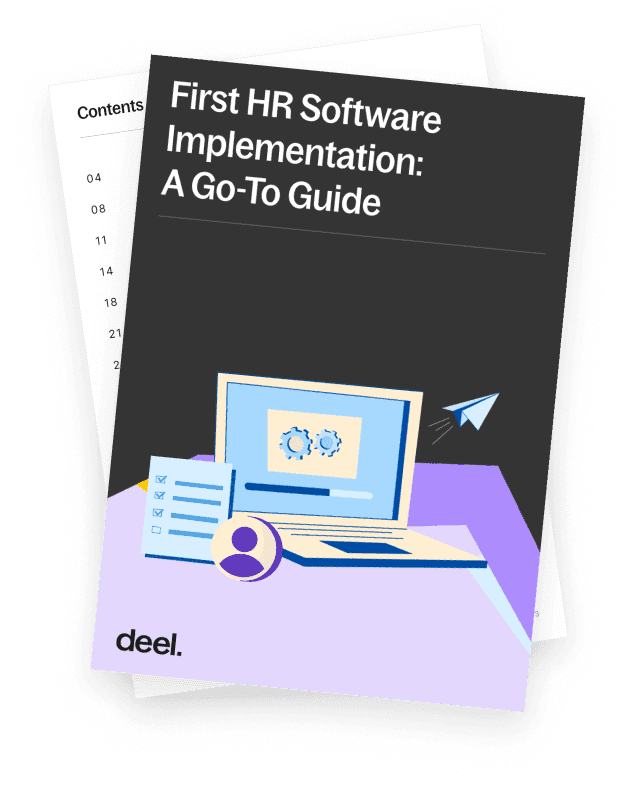
Free guide
Build your HR foundation the right way from day one
1. Map what you're actually running on
Before you automate anything, you need a clear picture of what you're replacing. Document every talent touchpoint — performance reviews, learning materials, onboarding checklists, engagement surveys, career frameworks. List the tools, docs, folders, and manual steps involved. Most HR teams are surprised by how much tribal knowledge and manual effort is quietly holding things together.
2. Prioritize by risk, then by automation potential
Start with the processes that cause the most damage when they break and are most straightforward to automate. For most growing companies that's onboarding (high consistency requirement, easy to template and trigger automatically) and performance management (high stakes, currently too manual to run well at scale).
3. Build the case in language leadership cares about
Frame the shift in business terms, not HR terms. What does a poor onboarding experience cost in early attrition? What's the risk exposure from inconsistent performance cycles? What would it mean to have AI flag a flight risk before you lose someone? The ROI of automation and AI in talent management becomes obvious once you cost the alternative properly.
4. Establish your job architecture first
Job architecture is the data foundation that makes AI useful. Before AI can recommend the right learning content, flag a development gap, or identify who's ready for a promotion, it needs to know what roles exist and what good looks like in each one. Get your job levels and competency frameworks documented first, and everything else becomes manageable.
Free template
Create actionable competency frameworks effortlessly
5. Automate the repetitive before you optimize the complex
Start with what's easiest to automate and highest-volume: onboarding task triggers, survey cadences, review reminders, and role-based learning assignments. Once those workflows run themselves, you free up the attention needed to act on the more nuanced signals AI surfaces — engagement risk, skill gaps, performance trends.
6. Bring managers in early
Managers are both the biggest beneficiaries and the biggest adoption risk. Show them specifically how automation removes work from their plate, like no more chasing review submissions, no more building check-in agendas from scratch, and AI-drafted feedback suggestions they can edit rather than write from zero. When managers see the system working for them, adoption follows.
Complementary reading:
7. Let connected data do the work
The real payoff comes when performance, learning, engagement, and career data all flow into the same system. At that point, AI can identify patterns across your entire workforce that no human could spot at scale. Who's disengaging before they even know it. Where skill gaps are forming. Which teams are thriving and why. That's the shift from reactive HR to something genuinely strategic.
How AI-powered talent management software works
Most talent management tools give you a place to store data. Modern, AI-powered talent management software, like Deel HR’s Engage module, goes a step further and uses that data to do something. It automates the processes that drain HR's time, and surfaces the insights that make people decisions smarter.
Here's where AI makes the biggest difference.
Deel HR
Help your team reach its fullest potential
It takes the admin out of performance reviews
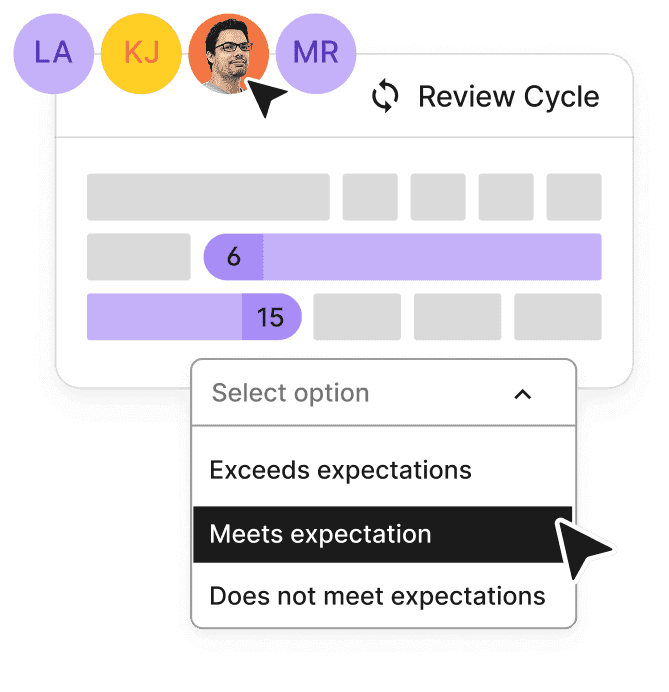
Engage automates the mechanics of running review cycles — scheduling, reminders, form routing, calibration — so HR isn't chasing submissions or manually collating results. Managers get AI-assisted feedback suggestions they can edit rather than write from scratch, and competency frameworks link to reviews with one click. As a result, review cycles run on time, with consistent quality across every team and region.
Once reviews are complete, AI does the analysis. Skills matrices, 9-box grids, and radar charts surface automatically, showing HR and managers where high-potential employees are, where development gaps exist, and where performance is inconsistent across teams.
It makes learning relevant, not just available
Teams can use Engage to quickly build and assign learning programs tied to each person's role, career path, and performance data. Time spent building comprehensive learning courses can be cut down to as little as 30 minutes, thanks to our AI tools.
The real value here lies in learning content that doesn’t exist in a silo, but connects directly to employee growth. A skill gap identified in a review becomes a learning assignment. A career goal triggers relevant content automatically. Employees get development that's genuinely connected to where they're going, and managers can see what's being completed and whether it's moving the needle, without chasing anyone for updates.
With Deel, you get the added benefit of your learning content living in the same platform that your employees use to request PTO, download their payslips, and sign contracts. It’s all under one login, and it’s at their fingertips, instead of living in a drive they’ve forgotten how to access.
It turns career development from a conversation into a system
Engage lets you build and publish career progression frameworks that define what's expected at each level and what it takes to move forward. AI connects those frameworks to 360-degree feedback and skills assessments, so employees they see exactly where they stand on their career path, and what specific development actions would close the gap. For HR, that means career conversations are grounded in data, making conversations fairer and clearer.
It connects the dots across your whole workforce
Consolidation is king for modern talent management, and the real payoff is what happens when performance, learning, engagement, and career data all live on the same platform as your HRIS. AI can work across the full picture: identifying which managers are genuinely developing their teams, where skill gaps are forming before they affect output, how engagement trends correlate with performance and retention. Nothing needs to be exported, reconciled, or synced, and the insight you get is the kind that's simply impossible to generate from disconnected tools.
Deel HR has everything. We went from cobbling forms together to running reviews, learning, and surveys in one click.
—Lucía Rodriguez,
Head of HR, Ladonware
See how Landonware used Engage to automate talent management, from creating learning courses in just half an hour, to building and launching their first company-wide NPS survey in just fifteen minutes.
From reactive to intentional with Engage
Top organizations are joining the shift to modern talent management. They're running continuous performance cycles, connecting L&D to career growth, and catching disengagement signals before they become resignation letters.
The shift doesn't require a big, disruptive rollout. It starts with automating one broken process at a time, like the onboarding checklist that lives in a doc, the annual review email chain, or the engagement survey that takes three months to action. Each automation creates space to focus on what actually moves people strategy forward.
And as the data compounds, AI starts doing work that wasn't possible before: spotting patterns across your whole workforce, flagging risk before it's visible, and surfacing the right action at the right time. That's the difference between HR that reacts and HR that leads.
Engage is built for teams ready to make that shift, and because it runs inside the same platform you already use to manage and pay your people, there's no new system to implement, no data to migrate, and no integrations to maintain.
If you’re interested in seeing how it works, contact your Deel Account Manager or book your 30-minute demo.
Live Demo
Get a live walkthrough of the Deel platform
FAQs
How do I know if my talent management processes have outgrown my tools?
The clearest signs are when consistency breaks down at scale — performance reviews that run differently across teams, onboarding experiences that depend on who's available, learning content nobody tracks, and engagement data that's always several months old. If your talent processes rely on someone remembering to do something, or on a spreadsheet that lives in one person's Drive, you've outgrown your tools.
What's the difference between an HRIS and talent management software?
An HRIS is your system of record. It stores people data, manages contracts, tracks time off, and runs core HR workflows. Talent management software handles what happens after someone is hired: how they're developed, how their performance is managed, how engaged they are, and whether they can see a future at your company. The two work best when they're connected. When they're separate systems, you get data silos, manual handoffs, and a workforce picture that's never quite complete.
Where should I start when modernizing talent management?
Start by mapping everything you're currently running manually, then prioritize by risk. For most growing companies, performance management and onboarding carry the highest risk when they're inconsistent — so those are usually the right places to begin. Get your job architecture documented first: clear role levels and competency frameworks are the foundation that makes performance reviews meaningful, learning relevant, and career development legible to employees.
How do I get managers to actually use a new system?
Show them what's in it for them specifically. Managers don't resist tools, they resist tools that add work without reducing it. If a system automates review scheduling, surfaces feedback quality issues, and gives them a clear view of how their team is developing without extra effort, adoption tends to follow. Involve them early in the rollout, address their specific workflows, and focus initial training on the two or three things that will save them the most time.
How does AI improve talent management?
AI improves talent management in two ways: it automates the processes that drain HR and manager time, review scheduling, learning assignments, survey cadences, onboarding task triggers, and it surfaces patterns in the data that would be impossible to find manually. Which employees are showing early signs of disengagement. Where skill gaps are forming across teams. Which managers are developing their people and which aren't. The value compounds as the data does: the longer everything runs in one connected system, the sharper the insight.
Is AI in talent management just about saving time?
Saving time is the entry point, not the destination. Automating admin frees HR to focus on strategy rather than process management, but the bigger shift is what becomes possible when AI works across connected talent data. Predicting retention risk before someone hands in their notice. Identifying which learning investments are moving performance. Spotting leadership patterns that affect team engagement. That's not efficiency. That's a fundamentally different way of making decisions about your people.
How does Engage connect to the rest of Deel HR?
Engage runs on the same worker record as Deel HR's HRIS, which means performance, learning, and engagement data all live in the same system as your core people data. Performance insights flow into compensation planning. Engagement trends connect to workforce planning. Learning completion ties to development goals and career progression. Nothing needs to be exported or synced — and because everything runs on one clean dataset, AI can work across the full picture rather than just one slice of it.
How is Engage different from other talent management tools?
Standalone tools work fine, but they're separate from your HRIS, which means performance data, engagement scores, and people data live in different systems and need to be reconciled manually. Engage is built inside Deel HR, so the data is connected from day one. Performance reviews inform compensation decisions. Engagement data surfaces in workforce planning. And because there's no integration to maintain, there's no lag, no manual export, and no version of the truth that's slightly out of date.
Ellen Simmonds is a content marketing manager with a decade of experience in tech, leadership, startups, and the creative industries. A long-time remote worker, she's passionate about WFH productivity hacks and fostering company culture across globally distributed teams. She also writes and speaks on the ethical implementation of AI, advocating for transparency, fairness, and human oversight in emerging technologies to ensure innovation benefits both businesses and society.