Article
5 min read
The Best HRIS: How to Choose the Right One for Your Company
Global HR

Author
Lorelei Trisca
Last Update
September 08, 2026

Table of Contents
What should an HRIS include today?
Top HRIS platforms analyzed
The best HRIS platforms: Summary table
What makes an HRIS the best for your company?
Leverage the best HRIS for global-first companies
Key takeaways
HRIS platforms provide centralized records, workflows, and compliance for your people’s data, unlike stand-alone tools or broader HR suites that may lack relevance or focus.
The best HRIS for your organization aligns with your growth stage, workforce structure, and specific operational needs.
A well-chosen HRIS simplifies complexity, supports growth, and scales as your organization evolves.
A Human Resource Information System (HRIS) is your organization’s central system of record for all your people’s data.
Modern HRIS platforms help streamline HR processes, improve compliance, and enhance visibility. As your organization grows, especially across regions and time zones, a centralized, connected HRIS is essential for maintaining consistency, boosting efficiency, and supporting strategic decision-making at scale.
What should an HRIS include today?
To support your day-to-day HR operations and long-term workforce planning, your HRIS should cover:
Onboarding workflows: Streamline digital processes for new hire documentation, task assignments, provisioning, and orientation.
Document management: Secure storage and easy access to contracts, agreements, tax forms, and compliance documents.
Time-off tracking: Automated leave requests and approvals, policy configuration by location, and calendar visibility.
Org chart and employee directory: Dynamic views of your team structure, reporting lines, and roles, especially for hybrid or distributed teams.
Compensation records: Centralized tracking of salary, bonuses, equity, and adjustments, with visibility across departments and locations.
Optional, but increasingly important features
The best HRIS solutions also include features that drive engagement and support growth:
Performance management: Goal setting, feedback, and review cycles to support your people’s development and accountability.
Benefits administration: Enrolment and tracking of your people’s healthcare, retirement, and other perks, especially across borders.
Compliance workflows: Automated alerts, region-specific contract templates, and data governance to support compliance with local labor laws.
Why stand-alone tools and broader HR suites aren’t substitutes for a true HRIS
While some companies rely on tools like payroll platforms or benefits software as proxies for an HRIS, these are not true HRISs. They are designed for specific functions, such as processing payments or managing leave, rather than the full lifecycle of people data, onboarding, document handling, and compliance across multiple jurisdictions.
Similarly, broader HR platforms like Human Resource Management Systems (HRMS) go beyond core HR functions, including performance management, learning and development, and succession planning. These can be more complex and expensive than required for organizing and streamlining global people operations.
An HRIS serves as a centralized, compliant, and scalable foundation for managing global teams. It organizes people data, automates workflows, and builds in compliance at every stage.
Top HRIS platforms analyzed
We’ve analyzed seven top HRIS platforms to help you find the best fit for your organization based on features, support, scalability, implementation, and global capabilities.
1. Deel HRIS
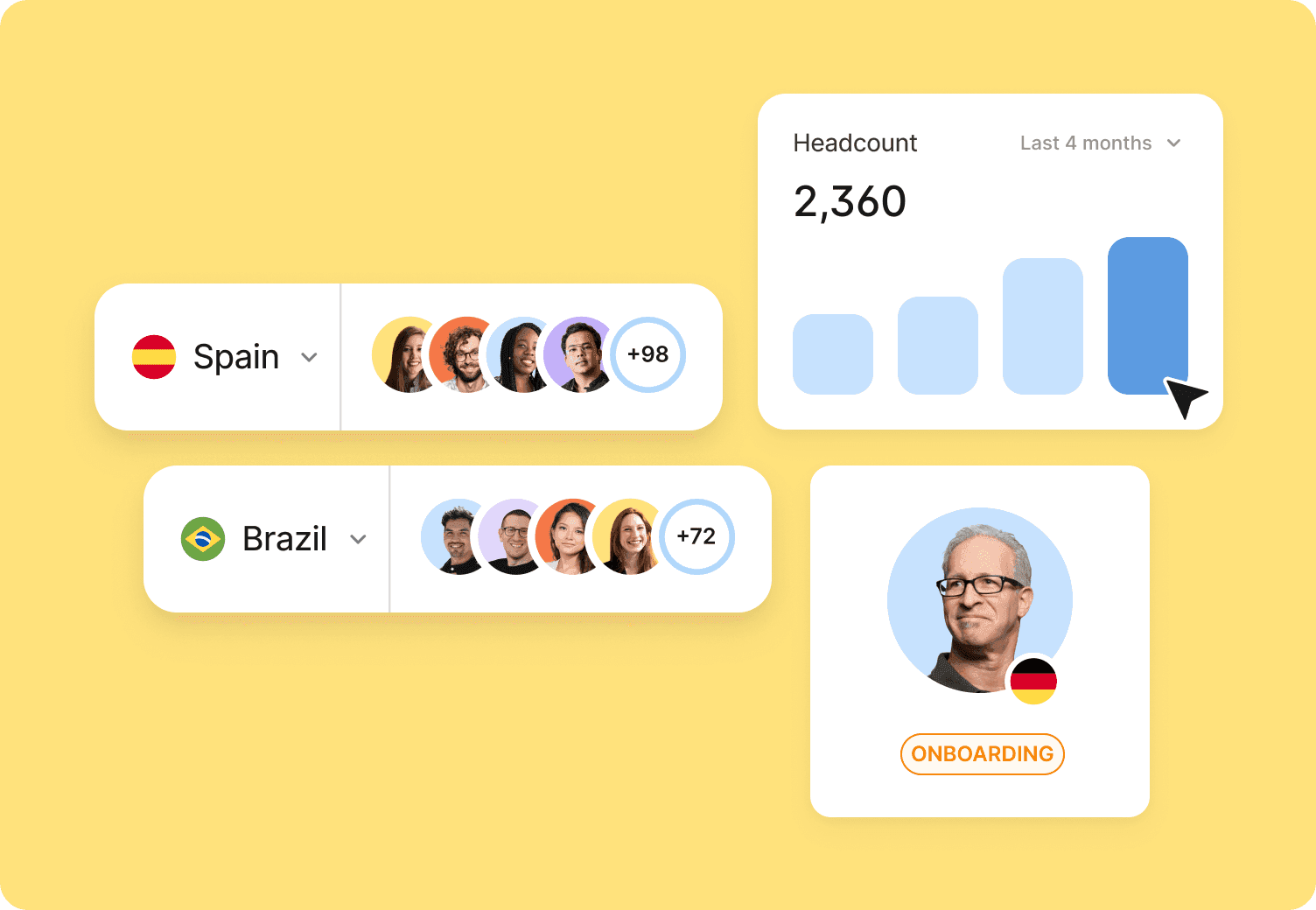
Deel’s Global HRIS is a unified system of record for contractors, direct employees, and EOR workers across 150 countries. It centralizes core HR functions, including automated onboarding, document management, self-service time-off, expense workflows, org charts, employee directories, and reporting.
Other features
Built-in support for local compliance with unique tax and employment regulations worldwide, including payroll and employment laws in the US
Versatile IT and device management module to provision staff software accounts and manage access to IT resources efficiently
Add Deel HR, for talent management, compensation management, workforce planning, and more
Add Deel Payroll for native multi-currency payroll
Deel integrates with a variety of tools across HR, Accounting, Payroll, and Legal categories, designed to simplify your workflow and allow for a centralized management system.
Pros
Seamless global coverage, with support for 150+ countries and localization using in-house legal teams
Rapid onboarding, within 2–3 business days
Easy-to-use and accessible functionality
A unified platform for contractor and employee HR, with consistent UI and workflows across worker types
Industry-leading customer support, with expert teams, prompt responses, and involvement from senior team members when required
Strong automation for pre- and onboarding, with self-service expense, time tracking, and documentation flow
Before Deel, our employees would have to submit their expenses in an Excel file, send it to us, and let us push the receipts through. Now, they have access to Deel, and the entire process is automated.
—Izacco Scattolin Neto,
Senior Recruitment & HR Administrator, Amilon
Cons
Performance management and advanced HR modules (e.g., L&D, 360 reviews) require the Engage add-on module
Third-party integrations are more limited compared to some peers
Customization can be constrained due to limited UI personalization capabilities: “I do wish there were a few more options when it comes to customizing contracts or choosing how to get paid”
Best for
Fast-scaling global or remote-first companies that need compliance-first HRIS across multiple countries with minimal setup
Companies hiring contractors and full-time employees in parallel and seeking a unified HR experience
Organizations expanding to international offices without forming local entities
Implementation and support
Fast launch, often within days, and 24/7 live chat support
Extensive help documentation are available for self-service
Free access to the customer education program, Deel Academy
Exceptional support through dedicated account teams for higher-volume or enterprise clients, and expert, proactive, personalized support for all clients
Since day one, we have always received very fast and hands-on support. It has felt like we have been dealing with experts for each specific subject, also getting the support of Deel’s executive team when needed. We have been blown away.
—Amir Podensky,
CEO & Co-founder, Strada
Pricing
Deel HRIS pricing starts at $5 per worker, per month
There are no hidden fees
Deel offers transparent, modular pricing for all paid solutions, where clients pay only for active workers or selected services
Deel HR modules, such as Engage, can be purchased individually and added as needed.
Fully managed, global payroll starts at $29 per employee per month, with US management payroll starting at $24 per employee per month.
HiBob is a modern HRIS platform that describes itself as a "people management platform." HiBob offers an all-in-one HRIS that provides out-of-the-box onboarding, time and attendance tracking, performance management, and compensation management.
Key features:
People analytics and reporting
Recruiting and onboarding management
Native payroll for the US and UK (with a "Payroll Hub" to centralize data for other international regions)
Benefits management
Pros:
Integrates with popular business software like Slack and Microsoft Teams
Collects and tracks signatures electronically
Provides a single hub for centralizing team members’ records and data
Cons
Limited support for complex shift scheduling or hourly workers: “Lack of options for shift patterns, still have a few problems occurring.”
Importing employee data during setup can be difficult: “Importing our data was an incredibly painful process.”
Does not offer EOR services: Instead, HiBob requires you to have a local legal entity to use their platform for direct employees.
Cumbersome document filing approach: “The filing of documents is difficult, and doesn’t link to individual profiles.”
Best for
Mid-size companies (approximately 100 to 1,000 people) scaling globally that value a modern, engaging HRIS
Growth-focused firms, not yet ready for heavy ERP/HCM systems
Late-stage startups and mid-market companies operating across multiple countries
Implementation and support
There’s a dedicated support team during implementation, and ongoing users enjoy responsive support and training resources
An implementation fee of 10–20% of annual software spend may apply for onboarding assistance
Strong international support and compliance knowledge
Pricing
Subscription-based with no free plan, but with a demo available
Pricing in the US is estimated to range from $16–25 per worker, per month, depending on modules
There’s no public price list, and interested users must contact Bob for a quote
3. Personio
Personio is an all-in-one HR platform tailored to small and medium businesses, especially in Europe. It covers core HR tasks, like worker database management, time off tracking, attendance, and onboarding. It also has built-in support for local compliance in some jurisdictions, such as GDPR and EU labor laws.
Other features
A modern, highly actionable interface with clear to-do lists and reminders, helping to streamline daily HR processes
An integration marketplace with 100+ integrations to tools such as Culture Amp, Greenhouse, and Lattice
Solid applicant tracking and recruitment support, with e-signature and document management capabilities
Pros
Excels at localization and compliance, handling different languages, local holidays, and region-specific labor regulations, particularly within Europe
Strong absence management and onboarding features
Responsive customer service, with a high proportion of staff dedicated to support
Intuitive and clean user interface
Competitively priced for its feature set
Cons
Primarily focused on European markets with associated limitations, e.g., payroll functionality is limited to the UK, Ireland, and Germany (customers outside these jurisdictions must export Personio’s payroll reports to other systems)
Lacks advanced workforce management tools, such as shift scheduling and complex time-tracking for hourly workers
Some newer features, like compensation planning and engagement surveys, are still maturing
Features and add-ons increase costs for growing companies
Best for
Small and medium-sized white-collar workforces in Europe, especially those based in the DACH region or the UK and Ireland
Organizations wanting strong compliance and HR fundamentals on a budget
Implementation and support
Strong implementation support, with guidance on data migration, setup, and efficient rollout
Extensive documentation, training webinars, and dedicated customer success managers during onboarding
Pricing
No publicly viewable fixed pricing, but typical costs are estimated at $10–14 per worker, per month
Modular pricing system with a core HR module and additional (optional) add-ons
Custom quotes required, particularly for US companies
4. BambooHR
BambooHR is an all-in-one HR package known for its simplicity and core HR capabilities. It centralizes worker information in a single database, offering features like time-off management, basic time tracking, an ATS, electronic signatures, and onboarding/offboarding workflows.
Other features
Optional add-on modules, such as payroll (in the US), benefits administration, performance management, and eNPS survey tools
Integration marketplace with 125+ integrations
Versatile interface with easy PTO/holiday management and peer recognition features
Pros
Ease of use for administrators, workers, and non-technical staff
Modern, uncluttered, and intuitive user interface that promotes self-service
Strong customer service with dedicated support reps and quick issue resolution
Competitively priced for small businesses
Rich integration ecosystem with flexibility to fit with a variety of tech stacks
Cons
Lacks advanced functionality, e.g., no built-in payroll and limited reporting features: “Bamboo looks great but was too simple for us.”
Not suited for complex timekeeping, e.g., across different cost centres: “If your needs aren’t super complex in terms of payroll and timekeeping, I thought Bamboo was pretty good … but not really up to handling complex CBA or cost center requirements around timekeeping and payroll.”
Limited scalability, working best for organisations with fewer than 500 staff: “Caveat that I don’t know if Bamboo would work as good for companies over 500.”
Limited support for international customization
Best for
Small and medium-sized businesses looking for an easy-to-implement, user-friendly HRIS, particularly startups and organizations with 20–300 staff
Organizations seeking a solid HR foundation, e.g., tracking workers, PTO, basic HR workflows, and light recruiting, without too much complexity
Industries with relatively straightforward HR processes, e.g., tech startups, nonprofits, and professional services
Growing companies needing quick deployment and a shallow learning curve
Implementation and support
Fast and straightforward implementation
Good customer support during onboarding, including dedicated implementation consultants and online resources
Dedicated, ongoing support through phone, email, or chat
Pricing
No free version, with plans starting at around $10 per worker, per month, for the Core package
Add-ons for payroll, performance, or advanced HR functions incur additional costs
5. Rippling
Rippling is an HR platform that unifies payroll, IT management, HR software, and other functions in one system.
Other features
Full-service payroll processing, including automated tax filings and multi-country payroll capabilities
Benefits administration with integrated insurance and 401 (k) management
Time and attendance tracking
Core HR management functionality, including ATS, onboarding/offboarding workflows, and performance management tools
Extensive integration marketplace with easy connectivity to third-party apps
Pros
Comprehensive all-in-one solution with the potential to replace multiple tools, e.g., HRIS, payroll system, and IT device management
Powerful automation capabilities across HR and IT functions
Intuitive, modern interface
Highly scalable for small-to-medium organizations
Custom workflow builder
Cons
Complexity and depth of features can be overwhelming for some users, requiring a steeper learning curve than simpler HRIS systems: “It can feel overwhelming at first … some parts of the platform aren’t super intuitive, and we had to lean on support or documentation more than expected during setup.”
Mixed reviews for customer support and implementation, which can be slow or unresponsive at times: “I was surprised to find out that we were working with the head of the implementation team because of how poor our experience was.”
Not ideal for organizations with complex payroll setups, e.g., multiple entities or countries: “Rippling claimed they excelled at global payroll, but it felt like they had never dealt with a multiple entity / multiple country setup before.”
Best for
Tech-savvy small-to-medium companies, especially those that are growing or looking to streamline operations
Organizations wanting to manage HR and IT together efficiently
Organizations that value automation and are comfortable with cloud software
Companies with distributed or remote workforces
Implementation and support
Cloud-based subscription service, with plug-and-play implementation based on configuring various modules
Limited support during onboarding, with ongoing support available on a tiered basis, starting with email and chats at lower tiers
Limited on-the-ground expertise in each country’s HR compliance
Pricing
No free tier or free trial available
Reported to start from $8 per worker, per month for the base platform
Modular pricing, which can get expensive as modules are added
6. Workday HCM
Workday is an enterprise-grade human capital management (HCM) suite known for its breadth and depth. It encompasses several HR functions in a single platform, including core HR records, recruiting (ATS), onboarding, payroll, benefits, and performance management.
Other features
Finance, planning, and time tracking capabilities
Comprehensive reporting and people analytics, with real-time dashboards and industry benchmarking
Built-in AI features for generating insights and recommendations
Multi-currency, multi-language, and global HR integrations
Pros
Comprehensive functionality in one place, supporting a unified system for up to hundreds of thousands of workers
Highly configurable to company-specific processes and industry practices
Built-in integration with 600+ third-party solutions
User-friendly interface with a modern look, customizable dashboards, and a functional self-service mobile app
Sophisticated analytics and planning tools, providing insights into diversity metrics, retention risk, and compensation benchmarking
Cons
One of the highest-priced and most complex HRIS solutions available, lacking pricing transparency or free trials
Requires significant implementation effort, with the associated risk of inefficiencies: “Workday, if you can get through implementation without wanting to jump off a bridge … especially if you’re growing headcount.”
The recruiting module has limited functionality and a cumbersome candidate experience relative to competitors: “Not Workday, especially if you want to hire people … it’s the worst candidate experience, you’ll lose good candidates.”
Limited flexibility without additional customization: “Date and hierarchically-driven dependencies that are monolithic and inflexible.”
Best for
Large enterprises and fast-scaling big businesses, typically those with 1,000+ staff
Companies operating in multiple countries and complex industries
Organizations wanting a unified, user-friendly platform to manage employee records, HR, and finance functions
Implementation and support
Significant implementation cost and effort, often requiring certified consultants, third-party integrators, or dedicated Workday project staff
Implementation timelines can take several months, often 6–12 months for large organizations
Good support, but better suited for large organizations
Comprehensive knowledge database and user community
Pricing
No free tiers or transparent pricing, entirely quote-based, and expensive
Cost can range from hundreds of thousands to millions of dollars per year for larger enterprises
7. ADP Workforce Now
ADP offers a wide range of HR and payroll products. Its flagship mid-market HRIS is Workforce Now (WFN), an all-in-one human resources management system covering HR, payroll, benefits, time tracking, talent management, and compliance.
Other features
Centralized onboarding, offboarding, and performance reviews
Automated payroll processing
Compliance monitoring
Real-time analytics and reporting
Self-service mobile access
Pros
Industry-leading payroll expertise and scalability, supporting complex payroll scenarios
Automated workflows to boost productivity
Robust compliance handling
Custom reporting using real-time worker data
Cons
Performance and compensation management are sold as add-ons
Onboarding can be challenging for certain modules: “The Healthcare portion is terrible when it comes to setting up new hires.”
Implementation and support can be difficult relative to competitors: “From the beginning, the implementation lacked structure, and customer support was virtually nonexistent.”
Entry-level package lacks benefits administration
Less functional than newer HRIS platforms: “Did not deliver the functionality or support we were promised.”
Best for
Midsized or larger organizations prioritizing payroll and compliance
Organizations looking for a “one-stop shop” HRIS solution
US-centric companies or those with moderate international exposure
Implementation and support
Implementation is typically offered at a fixed cost, but supported by an implementation manager at no additional cost
Offers a well-defined onboarding process supported by a wealth of documentation and free training resources (online and instructor-led)
Pricing
No public pricing, based on customized quotes
Estimated as starting from around $100 per month plus $8 per worker, per month
The best HRIS platforms: Summary table
The key features, limitations, and ideal use cases of the seven leading HRIS platforms are summarized below:
| HRIS | Stand-out features | Global ready? | Limitations | Best suited for |
|---|---|---|---|---|
| Deel | - Unified HRIS for direct, contractor, and EOR workers - Automated localized compliance - Time tracking - Workflow management - Offered at no additional cost for Deel customers |
Yes. 150+ countries with built-in compliance. | Fewer integrations compared to peers, advanced HR features like performance management and payroll require add-ons, and some UI customization constraints | Fast-scaling global or remote-first companies seeking a global, compliance-first, and easy-to-use HRIS |
| HiBob | - Strong engagement tools - Custom workflows - 100+ integrations - Social media-style directory |
Yes. Multi-country friendly. | No native payroll in all regions, limited support for hourly or shift work, setup can be clunky | Mid-market firms scaling globally that want a modern, people-centric HRIS |
| Personio | - EU-focused compliance - Clean UI - Local holiday tracking - Strong ATS and onboarding |
Partial. Strong in the EU. | Limited payroll coverage outside DACH/UK/IE, lacks advanced workforce tools, limited global reach | European SMBs needing localized HR and compliance at an affordable price |
| BambooHR | - Simple UI - Strong self-service features - Add-on payroll functionality - Fast to deploy |
No. Limited international capability. | Basic reporting, limited scalability, weak international support | Startups and small US-based companies looking for quick, easy-to-use HRIS |
| Rippling | - All-in-one HR and IT platform - Automation - Device provisioning - Modular pricing |
Partial. Multi-country payroll available. | Steep learning curve, mixed support quality, not ideal for complex payroll setups | Tech-savvy SMBs managing HR and IT together or remote teams needing automation |
| Workday HCM | - Enterprise-grade HCM - Deep analytics - Finance and HR - Industry-specific modules |
Yes. Strong global capabilities. | High cost, long implementation timeframes, complex setup, recruiting tools not best-in-class | Large enterprises (1,000+ staff) with global reach and advanced HR requirements |
| ADP Workforce Now | - Payroll and compliance industry leader - Scalable - Mobile app - Strong US market presence |
Partial. Global payroll via separate products. | Add-on costs, limited flexibility, older interface in places | Mid-sized to large US-centric firms prioritizing payroll and compliance |
What makes an HRIS the best for your company?
While there’s no one-size-fits-all when choosing the right HRIS for your company, here are five key factors to consider:
Stage of growth
Early-stage companies (50–100 workers) need an HRIS that’s simple, affordable, and quick to implement, while mid-size or scale-up organizations (100–500+) typically require more robust automation and reporting.
As your company grows, your HR system’s ability to handle onboarding, performance, and compliance complexity should also grow.
Location
A single-country company can often rely on region-specific tools. In contrast, multi-national or remote-first organizations need HRIS platforms with global compliance, localized workflows, and multi-currency support.
The best global HRIS will also streamline documentation and payroll across jurisdictions.
Team structure
Your HRIS should support flexible employment types, including full-time, contract, and EOR workers, with clear visibility and compliance tracking. Look for systems that handle varying onboarding processes, contract types, and reporting needs.
Use case
If you’re moving away from spreadsheets or upgrading from legacy systems, choose a platform that prioritizes ease of migration, focusing on automation and intuitive design.
An HRIS with built-in scalability and multi-currency support is essential for companies expanding globally.
Internal goals
Align your HRIS choice with your operational priorities, for example, simplifying workflows, improving worker experience, or ensuring compliance.
The best HRIS system for your organization will directly support your goals.
Guide
Don’t let outdated processes hold you back
Leverage the best HRIS for global-first companies
If your organization is scaling fast, hiring globally, or balancing a mix of worker types, Deel is your best choice for an all-in-one HRIS solution:
Manage full-time, contractor, and EOR talent across 150 countries in a unified system
Centralize onboarding, time off, compliance, documents, and reporting
Seamlessly integrate with Deel’s global payroll, benefits admin, compensation management, and talent management solutions
Flexible for hybrid teams, scalable for growth
Replace disconnected systems with one platform across entities, teams, and worker types
I see Deel more as a partner than just the provider. I know Deel is partnering with us to make sure we can have a compliant workforce.
—Beatriz Lourenço,
Talent Manager, Fidel API
Book a demo to learn how Deel’s HR solutions can simplify global people management and help your business scale confidently.
Disclaimer: The data outlined in this content is accurate at the time of publishing and is subject to change or updating. Deel does not make any representations as to the completeness or accuracy of the information on this page.
Lorelei Trisca is a Product Marketing Manager at Deel passionate about the future of work and global talent. She drives go-to-market strategy, product launches, and global campaigns, while championing client enablement and product adoption to help teams get more value from the tools they use every day.