Article
6 min read
You Can't Answer Your Investors Because Your Workforce Data Is Broken
Global HR

Author
Ellen Simmonds
Last Update
June 16, 2026

Table of Contents
The investor due diligence checklist: questions founders must answer cold
Where your data actually lives, and why that matters
Workforce data gaps are a credibility risk, not just an HR problem
Why consolidation belongs before the raise, not after
What consolidated people data actually enables
Why the data problem compounds over time
Building investor-ready people infrastructure: a practical starting point
Key takeaways
Most pre-Series A founders cannot answer basic investor due diligence questions about their own workforce because people data is scattered across Slack, spreadsheets, and disconnected HR tools.
Fragmented workforce data is a credibility risk in fundraising, not just an administrative inconvenience. Investors read data gaps as governance gaps.
Deel HR consolidates headcount, compensation, performance, and engagement into one system, giving founders verifiable, consistent answers before any board call or due diligence request.
There is a particular kind of silence that happens in a due diligence conversation when a founder says, "Let me get back to you on that." That silence comes not from the complexity of the question, but from data that does not exist in any retrievable form.
Investors raising a Series A or B round are not asking trick questions. When they want to know who your top performers are, what your engineering team's average tenure is, or how your total compensation spend compares to market, they are running a routine check on the health of the most expensive asset on your cap table: your people. The expectation is not that you will know these numbers from memory. The expectation is that you have a system that can surface them on demand.
Most early-stage companies do not. Performance data lives in a separate tool. Compensation is tracked in a spreadsheet that only one person updates. Time-off and headcount are managed through a combination of Slack messages and calendar entries. When a founder tries to answer investor questions from this infrastructure, they produce different numbers in different conversations, not because they are being dishonest, but because the data genuinely does not reconcile.
The investor due diligence checklist: questions founders must answer cold
Investor due diligence on people has expanded considerably over the past decade. Early-stage investors who once focused almost exclusively on product and market are now conducting structured assessments of people operations as part of their standard process. The following questions represent the core of what a serious Series A or B investor will want answered, typically within 24 to 48 hours of the request.
1. Who are your top performers, and what are you doing to retain them?
This question tests whether you have a systematic view of performance or are relying on manager intuition. Investors want to see a documented ranking methodology, not a list generated from memory.
2. What is your total compensation spend, and how does it compare to market?
Investors want to know whether you are paying competitively enough to retain key talent and whether your comp structure will scale. That question is as much about people risk as it is about financial planning, and a spreadsheet figure that is months out of date does not answer it.
3. What is your headcount by function and location?
Simple in principle, but surprisingly difficult for companies that have grown across multiple tools and geographies. Investors want a real-time, reconciled number, not an estimate.
4. What is your 12-month employee retention rate?
This question surfaces whether talent is leaving, and at what rate. It also signals how well you understand your own workforce. Companies that cannot produce retention data have usually not defined what counts as regrettable versus unregrettable attrition.
5. What is your average time-to-productivity for new hires?
A measure of onboarding quality and organizational efficiency. Investors use this to evaluate whether the team can absorb new headcount as the company scales.
6. Are you paying equitably across comparable roles?
Pay equity is increasingly on investors' radar, particularly those with ESG mandates or portfolio-wide HR standards. An inconsistent answer here raises legal and reputational concerns.
7. What does your org structure look like, and where are your single points of failure?
Investors want to know which roles are critical, which are filled, and where a departure would create existential risk. An org chart that exists only in someone's head is a red flag.
Every one of these questions represents a minimum expectation for a well-run organization. Founders typically know the answers in principle, but the data does not have a consistent home that can produce them on demand.
Guide
A buyer’s guide to future-proof HRIS software
Where your data actually lives, and why that matters
A typical pre-Series A company has accumulated its HR data the way most startups accumulate technical debt: solving each problem with whatever tool was available at the time.
Performance conversations happen in a standalone tool such as Lattice or Culture Amp, or more commonly in quarterly documents dropped into Google Drive with no standard format. Compensation is maintained in a spreadsheet that may or may not reflect the most recent changes made during a hiring push three months ago. Time-off requests are approved in Slack, sometimes logged in a calendar, occasionally recorded in nothing at all. Headcount is tracked in a hiring tracker that becomes outdated the week someone leaves or a role changes scope.
When an investor asks who your top performers are, the founder searches through performance review documents in different folders created by different managers using different criteria. When they ask about compensation, the founder opens a spreadsheet that was last fully updated at the previous funding round. When they ask about retention, the founder calculates it manually from a combination of the hiring tracker and their own recollection.
The result is answers that vary depending on which document was opened first, who ran the calculation, and what definitions were applied. This inconsistency is the predictable output of a people data architecture built for isolated tasks, not investor-grade questions under time pressure.
Why investors focus on people data
Team-related issues contribute to approximately 23% of startup failures. Experienced investors are aware of this figure when they ask about retention, performance, and compensation, and they are reading your ability to answer as much as they are reading the answer itself.
Global Hiring Toolkit
Global Salary Insights
Workforce data gaps are a credibility risk, not just an HR problem
The instinct is to frame this as an administrative challenge: you need better processes, a dedicated HR person, or more rigorous tracking. That framing understates what is actually at stake.
When a founder cannot answer a due diligence question about their workforce with confidence and consistency, the investor draws an inference that extends beyond the missing data point. Fragmented people data signals that the organization has not yet built the operational discipline to manage its own most significant resource. That inference affects board confidence, deal certainty, and in some cases, valuation.
When investors ask about retention, compensation, and performance, they are not just filling out a checklist. They are assessing whether the team that built the product to this point can also build the company that comes next. Inconsistent or unavailable workforce data undermines that assessment even when the underlying team is strong.
The companies that answer these questions confidently are not necessarily larger or better resourced. They are companies that built their people analytics infrastructure early, so that by the time investors ask, the answers already exist in documented, auditable form.
Deel's HRIS
Manage your global workforce compliantly

Why consolidation belongs before the raise, not after
The standard advice is to clean up people operations after closing a round, once there is budget for an HRIS. This sequence has a structural flaw: the data you need to close the round is the same data you need to build the system.
Investors in pre-Series A companies are not expecting the operational maturity of a 500-person organization. They are expecting founders to demonstrate that they understand their own business well enough to operate it intentionally. A founder who can produce a clean headcount report, a compensation-versus-market analysis, and a retention curve is demonstrating exactly that, before a single dollar of new investment changes hands.
Building consolidated HRIS infrastructure at the pre-seed or seed stage also creates compounding returns. The data entered at 15 people is still in the system at 50. The compensation bands established early provide structure for every subsequent hiring decision. The performance frameworks built at the beginning of the company define expectations for the team that takes it through growth. Waiting until post-raise to build this infrastructure means rebuilding it while also scaling, which is when the cost of getting it wrong is highest.
Early adoption of a startup-appropriate HRIS also signals organizational maturity to future hires. Candidates at the senior level increasingly conduct their own due diligence on operational practices during interviews. A company that cannot answer basic questions about career development, compensation structure, or performance feedback is at a disadvantage when competing for experienced talent against companies that can.
How Beatgrid scaled global HR with one person
Beatgrid, a startup with a small team, used Deel to manage its entire global HR operation with just one HR lead. No additional headcount was required to maintain full workforce data, centralized employee records, and audit-ready reporting across a distributed team.
Live Demo
Get a live walkthrough of the Deel platform
What consolidated people data actually enables
The goal is not to implement HR systems for their own sake. The goal is a single system of record that can answer the investor checklist, and every internal decision that resembles those questions, without manual reconciliation.
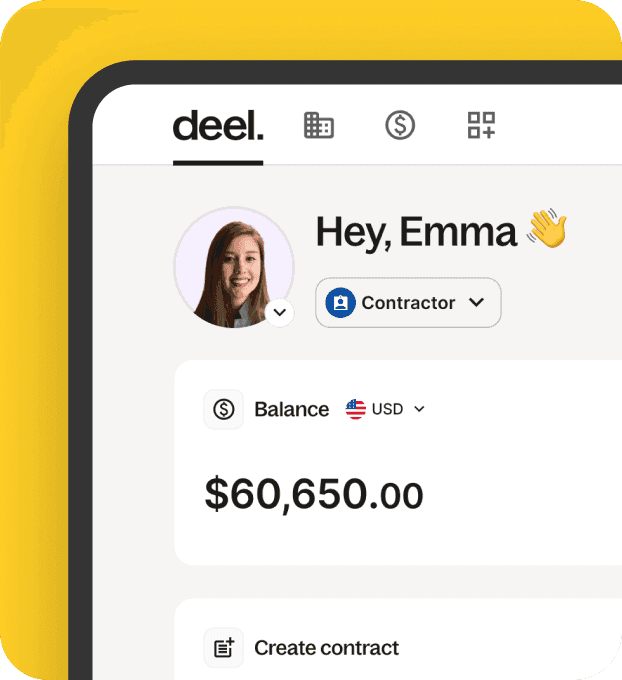
Deel HR connects HRIS, compensation, and engagement data in a single system of record, with reporting founders can pull before any board call or investor conversation.
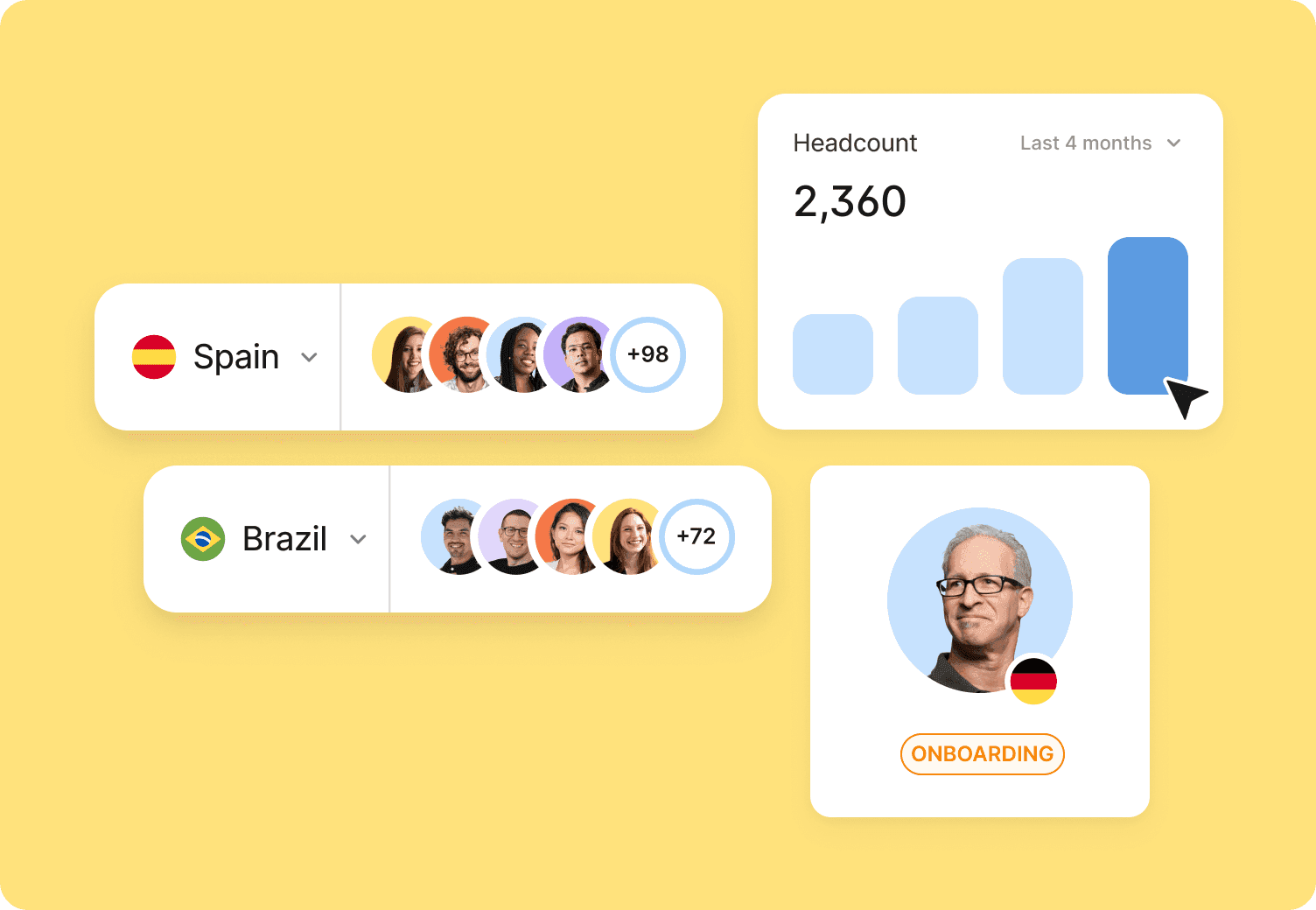
Headcount and org structure. Deel HR maintains real-time employee profiles, org chart visualization, and headcount reporting by country and function. When an investor asks for a headcount breakdown, the answer exists and is current.
Compensation. Deel Compensation includes salary bands benchmarked against market data from Aon Radford's third-party survey across thousands of companies. Founders can show not just what they are paying, but how it compares to market, and whether compensation is consistent across comparable roles.
Performance and engagement. Engage brings performance management, goal tracking, and engagement surveys into the same system. Top performers are identified through structured review processes rather than manager recollection. Retention risk surfaces through engagement data rather than departures.
Audit readiness. The platform maintains change history and downloadable audit reports. When an investor requests documentation of workforce decisions, the records exist in a format that does not require manual assembly.
The practical result is that founders using Deel HR can answer the seven investor questions from a single system rather than from a combination of tools, spreadsheets, and memory. The answers are consistent because they come from one source of truth, current because the system updates in real time, and verifiable because the underlying data is documented and auditable.
Beatgrid, a startup with a small team and one HR lead, used Deel to manage its entire global HR operation without adding headcount to the people function, demonstrating that full workforce data infrastructure does not require a dedicated HR team to maintain.
Guide
Don’t let outdated processes hold you back
Why the data problem compounds over time
One dynamic that founders frequently underestimate is how quickly data fragmentation compounds. At 10 employees, the gaps are manageable. At 30, the inconsistencies start producing different numbers depending on who runs the calculation. At 60, reconciling people data for a board presentation can take a week of effort that produces an output everyone still questions.
The reason is that each tool was optimized for its own purpose, not for the cross-functional questions that matter most in investor conversations. A performance management tool knows who received high ratings. A payroll system knows what people are paid. Neither knows both at the same time, in a format that connects performance to compensation in a way that is legible to an investor or a board.
Understanding the full benefits of an integrated HRIS means recognizing that the value compounds over time. The longer the system has been accumulating accurate, consistent data, the more defensible and useful that data becomes when it matters most.
Building investor-ready people infrastructure: a practical starting point
Founders who decide to address this before the next raise do not need to implement everything at once. The sequence that produces the most immediate return is:
-
Consolidate employee records into a single HRIS. Every employee profile, role, location, start date, and reporting line in one place.
-
Establish compensation bands for each function. Even rough ranges, grounded in market data, allow founders to answer questions about market positioning with something other than a shrug.
-
Define a performance review process and document the results. It does not need to be elaborate. It needs to produce a consistent output that can be retrieved.
-
Track retention with a defined methodology. Decide what counts as regrettable attrition. Calculate the rate quarterly. Know the number before an investor asks.
-
Build the org chart in the system, not in a slide deck. A visual representation of reporting lines that reflects the current state of the organization is a due diligence asset.
This sequence can be completed over a few weeks at a small company. The window for doing it thoughtfully is before the fundraising process begins, not during it, when every hour of founder time carries a higher opportunity cost.
Workforce data is not a compliance exercise or an HR department concern. For a pre-Series A founder, it is the foundation of the story you tell about your team: to investors, to prospective hires, and to yourself. When that data is fragmented, the story changes depending on who tells it and which tool they happen to open first. When it is consolidated, the story is consistent, verifiable, and credible.
Deel HR gives founders the infrastructure to maintain a single source of truth for their people data from day one, so that when the investor questions arrive, the answers already exist. Founders preparing for a raise can see how Deel HR works for startups.
Live Demo
Get a live walkthrough of the Deel platform
FAQs
What workforce data do Series A investors typically request?
Common requests include headcount by function and location, total compensation spend versus market benchmarks, 12-month retention rate, top performer identification, and org chart documentation. All of them test whether founders have a systematic understanding of their people operations.
Is an HRIS necessary for a company under 50 employees?
Not all startups need a full HRIS at 10 or 15 employees, but the cost of implementing one early is low compared to the cost of reconciling fragmented data before a funding round. Most founders who implement an HRIS under 50 people find the accumulated data significantly more valuable as headcount grows.
How does fragmented HR data affect fundraising?
Investors interpret inconsistent or unavailable workforce data as a governance gap. It creates friction, extends due diligence timelines, and can affect deal terms. Founders who answer people questions quickly and consistently are perceived as running more disciplined organizations.
What is people analytics, and why does it matter for startups?
People analytics refers to the use of data and reporting to understand workforce composition, performance, retention, and compensation. For startups, it matters because investors, boards, and senior candidates all evaluate people operations as a proxy for organizational health.
How long does it take to implement Deel HR?
Most startups can have core employee data consolidated and a basic org chart live within a few weeks. Compensation and performance modules can be configured alongside or after the initial setup.
Explore more Deel resources
Ellen Simmonds is a content marketing manager with a decade of experience in tech, leadership, startups, and the creative industries. A long-time remote worker, she's passionate about WFH productivity hacks and fostering company culture across globally distributed teams. She also writes and speaks on the ethical implementation of AI, advocating for transparency, fairness, and human oversight in emerging technologies to ensure innovation benefits both businesses and society.